6 Best Sorting Stations For Deep Focus To Organize Crafting
Boost your productivity with these 6 best sorting stations for deep focus. Organize your crafting supplies today to create a seamless, efficient workspace setup.
A chaotic craft room is the silent killer of knitting momentum. When needles are buried under piles of tangled wool and project notes are misplaced, the joy of the craft quickly evaporates. Organizing your space is not merely about aesthetics; it is about creating a frictionless environment where the transition from inspiration to casting on is seamless. Use these six sorting stations to reclaim your focus and ensure your fiber arts practice remains a source of relaxation rather than stress.
IKEA Alex Drawer Unit: Best for Bulk Storage


The Alex drawer unit is a staple in many fiber studios for good reason. Its shallow, wide drawers are perfectly suited for stashing folded hand-dyed skeins, spare knitting bags, and bulky sweater quantities of yarn that need to be kept away from direct sunlight.
Because the drawers slide fully out, it prevents the common frustration of yarn getting trapped in the dark, unreachable back corners of deep shelves. This accessibility ensures that you can see your entire inventory at a glance, making it easier to match a leftover ball of lace-weight mohair to a current project.
Be mindful that these units lack humidity control or moth-proofing. If storing delicate, untreated animal fibers like cashmere or high-end wool, consider placing individual items in breathable cotton bags before sliding them into the drawers.
The ScrapBox DreamBox: Ultimate All-In-One
The DreamBox is a massive investment that functions as a self-contained, closable studio. It is ideal for the knitter who requires a dedicated “zone” that can be tucked away entirely, preserving the clean lines of a living space when guests arrive.

This unit excels at housing everything from winding equipment and swift sets to vast library collections of knitting pattern books. Having your yarn winder, ball winder, and reference materials in one vertical footprint creates a high-efficiency workstation that minimizes travel time across the room.
However, the size is deceptive and can lead to over-accumulation. Only fill the bins with tools and fibers you currently rotate through, as the abundance of storage space often encourages hoarding rather than mindful consumption.
Really Useful Box Tower: Best for Small Notions
Knitting is defined by the minutiae: stitch markers, cable needles, tapestry needles, and progress keepers. A tower of small, transparent Really Useful Boxes allows for granular organization that keeps these vital accessories from disappearing into the abyss.
Clear containers are essential here because they allow for immediate visual identification. You can categorize by needle size, material—such as bamboo versus nickel-plated—or even by the specific project phase, keeping all notions for a complex Fair Isle sweater in one dedicated bin.
Avoid the temptation to dump all notions into one giant bin. Segmenting by size or function prevents the “needle hunt,” which is the quickest way to kill your creative flow during a late-night knitting session.
Honey-Can-Do Cart: Best Budget Rolling Option

A rolling utility cart is the most flexible tool for a knitter whose workspace is fluid. If you move from a comfortable armchair in the living room to a dining table for blocking large shawls, a cart allows you to move your current project and all necessary tools as a single unit.
These carts are perfect for housing the “working project.” Keep your current needles, a few spare skeins, a measuring tape, and a pair of scissors on the top shelf for immediate access.
While they lack the security of a closed cabinet, they are excellent for maintaining a “lean” workflow. Limit yourself to one project per cart level to prevent clutter from overwhelming your workspace.
ArtBin Super Satchel: Most Portable Solution

For the knitter who frequently travels to guild meetings, retreats, or the local yarn shop, the ArtBin Super Satchel is the gold standard for secure storage. These cases are rugged, stackable, and protect expensive needle sets from being crushed or bent.
The internal compartments can be adjusted to fit circular needle cases or DPN (double-pointed needle) tubes. They effectively shield your tools from dust, debris, and the occasional spilled cup of tea.
Be careful with plastic containers near temperature fluctuations. Plastic can become brittle in extreme cold or warp in high heat, so store these satchels in a climate-controlled room to protect the integrity of your needles.
IKEA Skådis Pegboard: Best for Vertical Space

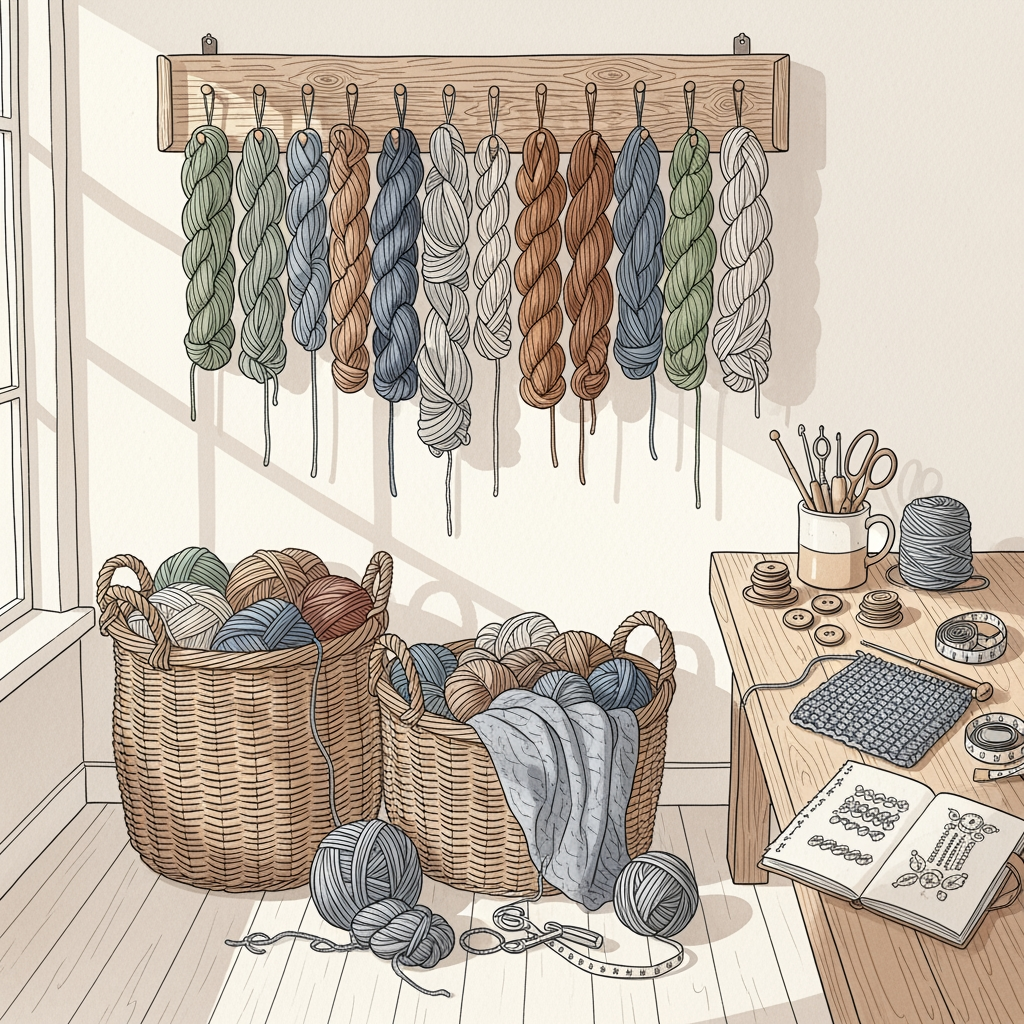
When horizontal surface area is limited, moving your tools to the walls is the smartest move a knitter can make. The Skådis system allows you to hang scissors, tape measures, and even spare needles at eye level.
This vertical organization removes the clutter from your knitting table, leaving more room for spreading out blocking mats or drafting schematics. It turns your tools into a functional display, making it easier to spot if a tool is missing before you start a delicate cast-on.
Never overload the pegboard with heavy, full skeins of yarn, as the hooks are designed for lightweight accessories. Use the board for the tools you use every single day, keeping your workspace clear for the actual fiber.
How to Pick a Station for Your Specific Craft
Selecting the right station depends entirely on the volume and type of your knitting. A lace knitter using fine 1.0mm needles needs different storage than someone working primarily with bulky-weight wool on size 10mm needles.
Assess your primary project type before purchasing. If you exclusively work with cotton, which is heavier and prone to stretching, ensure your storage allows for flat, supportive placement rather than hanging.
Consider the “reach test” as your primary metric. The best station is one where your most-used items—your primary needle set and favorite snips—are reachable without you having to stand up or leave your chair.
Organizing for Workflow vs. Just for Storage
Storage is about keeping items safe; workflow is about keeping them moving. A perfectly organized room is useless if the setup forces you to spend twenty minutes searching for a cable needle before you can resume your row.
Arrange your stations based on the order of operations in your knitting cycle. Keep your yarn-winding station near your yarn stash, and keep your notions and project patterns near your favorite knitting chair.
Stop treating your space like a yarn shop and start treating it like a factory. Only store items that are currently active in the rotation, and keep “backup” inventory in a separate, less accessible location to avoid visual noise.
Small Space Solutions to Maximize Your Area
Knitting in a small home requires vertical thinking and multi-functional furniture. Utilize the space under your ottoman for project bags or hang needle organizers on the back of doors to free up valuable floor space.
Focus on containers that can be stacked or nested when not in use. Transparent, stackable bins are essential for small areas, as they minimize the “visual weight” of the room while keeping your materials dust-free.
Always prioritize accessibility over sheer volume. It is better to have a small, highly efficient bin of active materials than a massive, disorganized closet full of yarn you haven’t touched in three years.
How to “Container-ize” Individual Project Kits
The most effective way to maintain focus is to treat every project as a self-contained kit. Use a project bag to hold the specific needles, notions, and yarn requirements for one item, and treat this bag as the only thing you need to “sort.”
Include a small pouch for the “essentials” within that kit: a darning needle, a pair of folding scissors, and a few locking stitch markers. This allows you to switch projects without leaving half your tools behind.
By containerizing, you eliminate the mental load of searching for components. You can switch from a stranded colorwork sweater to a simple stockinette sock in seconds, maintaining your focus by eliminating the setup time entirely.
Investing in the right storage is an investment in your productivity and the longevity of your craft. When your tools are organized, you spend more time knitting and less time managing clutter, ensuring that every session is as efficient as it is creative.