6 Best Desk Organizers For Beading Tools To Use
Tired of messy supplies? Discover the 6 best desk organizers for beading tools to keep your workspace tidy and efficient. Shop our top picks and organize today.
A cluttered workspace often leads to interrupted creativity and lost notions, much like losing a stitch marker in a complex cable pattern. While beading and knitting are distinct crafts, the organizational needs for delicate supplies, tiny tools, and project components overlap significantly. Establishing a streamlined system allows for a seamless transition between intricate pattern charts and detailed bead placement. Choosing the right storage solution transforms a chaotic surface into a sanctuary designed for focused, long-term fiber art mastery.
Akro-Mils Drawer Cabinet: Best for Bulk Storage


Large collections of seed beads, findings, and specialty clasps require a system that prevents intermingling and provides immediate visual clarity. These cabinets offer a modular approach, allowing for the segregation of items by size, color, or material composition.
For those maintaining a stash of various glass beads or specialized metal findings, the transparency of these drawers is vital. It eliminates the guesswork often associated with identifying a specific bead finish or jump ring gauge without needing to open every container.
- Pros: High volume capacity and stackable design.
- Cons: Can become unstable if overloaded with heavy metal components.
- Bottom line: Ideal for the dedicated maker who keeps an extensive inventory and values a permanent, high-capacity station.
The Beadsmith Rotating Tool Caddy: Top for Access
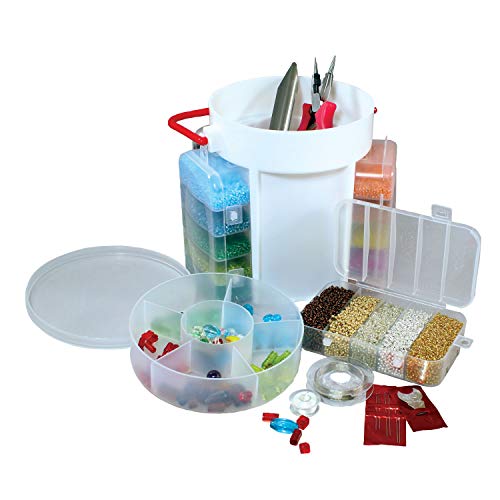
Accessing specialized pliers, chain-cutters, or bead reamers shouldn’t involve digging through a pile of tools. A rotating caddy keeps every implement within reach, mirroring the convenience of a well-organized needle roll for circular and double-pointed needles.
By centralizing the tools, the workspace remains clear of clutter, which is essential when working with delicate fibers and small beads. The vertical orientation utilizes minimal footprint while maximizing the accessibility of frequently used items.
- Pros: Keeps essential tools visible and upright at all times.
- Cons: Stationary footprint can be difficult to move around a desk.
- Bottom line: Perfect for those who prefer an open-work environment where every tool is visible and ready for the next step.
ArtBin Store-In-Tote Tray: Best for Portability

Knitting and beading often transition from the craft room to the living room or travel settings. Portability ensures that projects are not tethered to a single desk, providing the flexibility to work in different lighting conditions or comfortable environments.
These trays are robust and allow for the modular organization of current projects. Think of it as a dedicated kit for a specific beaded shawl; all necessary needles, beads, and patterns remain housed together, protected from loss or damage during transport.
- Pros: Secure latches and durable construction protect contents during travel.
- Cons: Limited space compared to stationary cabinets.
- Bottom line: Choose this if a primary goal is the ability to pack up a project and take the workspace on the go.
The Original Pink Box Wall Control Pegboard: Best for Space
Utilizing vertical wall space is a common strategy for fiber artists with limited table surface area. A wall-mounted system keeps delicate tools away from potential spills or heavy project materials that could crush fragile components.
Installation allows for a customized layout, where pliers, scissors, and layout mats can be arranged by frequency of use. It functions much like a wall-mounted yarn rack, freeing up the desk for the tactile work of assembly and construction.
- Pros: Completely clears the desktop while keeping items visible.
- Cons: Requires wall mounting which may not be feasible in all rooms.
- Bottom line: An excellent choice for small-space studios where maximizing every square inch of the room is necessary.
mDesign Desktop Caddy: Best Budget-Friendly Pick
Not every organizational need requires high-end, professional storage hardware. A simple, multi-compartment caddy can often do the trick for organizing essential daily tools like tweezers, tape measures, and needles.
This option is highly versatile and fits into tight corners. It serves as an entry-level solution for those building their collection, keeping miscellaneous notions from migrating into yarn balls or bead mats.
- Pros: Low cost and immediate utility without complex installation.
- Cons: Less specialized for tiny bead storage than dedicated drawer units.
- Bottom line: The best starting point for a beginner looking to tidy a workspace without a significant upfront investment.
Bead Buddy Design Save’n Go: Best All-in-One
Integrated work mats are a staple for anyone who combines beads with thread or wire. These all-in-one stations provide a secure surface that prevents beads from rolling away while keeping tools within the same frame.
The ability to fold or cover a work-in-progress is a major advantage. It ensures that if a project must be set aside, the configuration of the beads remains intact, much like leaving a complex chart mid-row.
- Pros: Combines storage with a dedicated, non-slip workspace.
- Cons: Bulkier than a standard tray, requiring a flat surface for use.
- Bottom line: Designed for the maker who needs an integrated workspace that protects work-in-progress from being disturbed.
How to Choose the Right Beading Organizer for You
Assessment of your current space and project frequency determines the most suitable system. Consider whether your tools remain stationary on a desk or if they need to move alongside you throughout the house.
Evaluate the quantity of small parts compared to larger tools. If the collection is heavy on tiny seed beads, prioritize drawer systems; if it focuses on wirework and pliers, lean toward wall-mounted or rotating storage.
- Assess your space: Measure the available desk area before committing to bulky units.
- Review your flow: Do you prefer reaching out to a side tray or looking up at a wall board?
- Plan for growth: Always choose an organizer with a bit of extra room for future project supplies.
Key Features to Look For in a Beading Organizer
Material quality is paramount when dealing with sharp tools and delicate components. Sturdy plastics or powder-coated metals are preferred, as they resist wear from metal tool edges and prevent snagging on fine wires or threads.
Look for adjustable dividers or modular components that allow for future customization. As skills evolve and project types change, a static storage box often loses its utility, whereas a modular one grows with the craft.
- Visibility: Clear materials save time by making inventory checks effortless.
- Accessibility: Ensure that the most frequently used tools are positioned at the front or top.
- Security: Latches or heavy-duty drawers prevent spills, which are disastrous when dealing with hundreds of loose beads.
Setting Up an Ergonomic Beading Workspace
Beading requires fine motor precision and intense focus, which puts strain on the eyes and neck. Position your primary tool organizer at eye level or within easy reach to minimize repetitive reaching motions.
Good lighting is just as important as storage. Ensure your chosen organization system does not cast shadows over your work area, and consider adding a dedicated task lamp that illuminates the specific working zone where your beads meet the needle or thread.
- Adjustable seating: Ensure the workspace height prevents hunched shoulders.
- Lighting: Use full-spectrum lighting to maintain accurate color perception for bead matching.
- Cleanup routine: End every session by clearing the mat and returning tools to their designated spots to prevent morning frustration.
FAQs About Storing Beading Tools and Supplies
How do I prevent beads from mixing? Use individual, sealable containers for each color and size. Avoid large bins that store multiple types together unless using airtight, divided inserts.
Can I use knitting notions cases for beads? Absolutely. Many notions cases designed for stitch markers and yarn needles work well for larger beads, though they often lack the fine dividers needed for tiny glass seed beads.
How often should I reorganize my tools? Conduct a maintenance review every few months. Re-evaluate which tools are actually being used; if a tool hasn’t been picked up in six months, consider storing it away from the primary desk to save space.
A well-organized workspace is a foundation for creativity, acting as a silent partner in the production of every intricate piece. By selecting the right storage solutions, you minimize distractions and maximize the time spent on the act of creating itself. A methodical approach to organization is the mark of a seasoned maker, ensuring that every bead and tool finds its place as reliably as a well-tensioned stitch.