6 Best Lightbox Tracers For Intricate Patterns To Try
Discover the 6 best lightbox tracers for intricate patterns in our expert guide. Elevate your creative precision and shop our top-rated picks for artists today.
Tracing intricate lace charts or complex embroidery designs onto fabric requires a steady hand and, more importantly, a reliable light source that illuminates every thread count. When working with fine silk or dense linen, the ability to see through the material saves hours of frustration and prevents costly misalignments. The right lightbox creates a workspace that reduces eye strain, allowing for longer sessions of detailed pattern transfer. Choosing the correct tool depends on the specific project scale, from small motif placement to full-quilt embroidery layouts.
Cricut BrightPad Go: The Best Cordless Option


Portability remains a primary concern for those who shift between a dedicated craft room and a favorite armchair. The Cricut BrightPad Go offers a rechargeable battery, freeing the workstation from the tangle of power cords that often snag on yarn cakes or delicate embroidery hoops.
This device features a remarkably even surface, which prevents the hotspots that can obscure details when tracing onto lighter fabrics like voile or lawn. Its adjustable brightness settings allow for fine-tuning the illumination to match the opacity of the specific fiber being used.
The primary trade-off is the smaller surface area, which may feel restrictive for large-scale quilt patterns. However, for charting lace motifs or tracing embroidery templates, the freedom to place the light anywhere on a table outweighs the size limitation.
Daylight Wafer 2: Thinnest and Brightest Pick

A sleek profile is more than just an aesthetic choice; it provides a seamless transition from the tabletop to the fabric surface. The Daylight Wafer 2 is exceptionally thin, ensuring that the wrist remains at a comfortable angle during long tracing sessions.
This model is prized for its high-quality LED color temperature, which mimics natural daylight. Accurate color representation is essential when distinguishing between similar shades of silk thread or marking fabric that must match a specific yarn dye lot.
While it lacks an internal battery, the consistent brightness provided by the direct power connection ensures that performance never dips during a project. If a permanent, high-visibility station is preferred over a mobile one, this unit offers the most professional light quality.
Artograph LightPad Pro: The Pro-Level Choice

For the maker who views tracing as a precision craft rather than a preliminary chore, the Artograph LightPad Pro offers unparalleled control. It features an adjustable color temperature, allowing users to toggle between cool light for high contrast and warm light for easier viewing on darker fabrics.
The surface is durable and built to withstand the pressure of heavy tracing tools, which is vital when marking dense fabrics like heavy-duty cotton or canvas. This longevity makes it a sound investment for those who produce patterns or embroidery designs on a frequent basis.
The cost is significantly higher than entry-level pads, but the performance jump is noticeable for those accustomed to specialized fiber work. If the goal is long-term reliability and extreme precision, the added expense is well-justified.
HUION A3 LED Light Pad: Best Large-Format Tracer
Large-format projects, such as full-size quilt tops or complex garment embroidery, demand a workspace that does not require constant repositioning. The HUION A3 provides the massive surface area necessary to trace full pattern sheets in a single go.
The illumination is consistent across the entire board, preventing the dreaded edge-fade that occurs with lesser-quality large pads. Its size makes it a centerpiece of the studio rather than a mobile accessory, fitting best on a dedicated craft desk.
Keep in mind that such a large surface requires extra storage space when not in use. It is the definitive choice for those who frequently work on large layouts and want to avoid the cumulative error of tracing in pieces.
US Art Supply Lightmaster: A Solid Mid-Range Buy
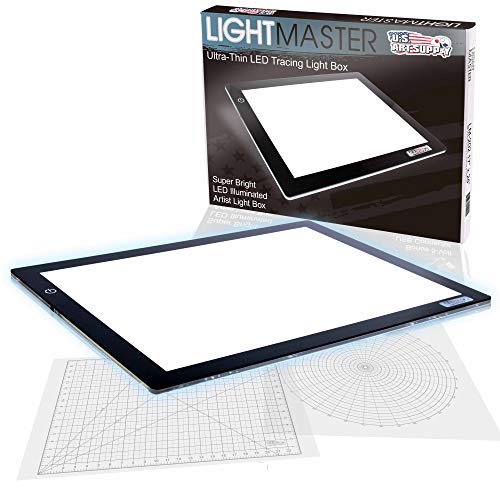
Finding the balance between professional features and an accessible price point is the hallmark of the US Art Supply Lightmaster. This unit provides a robust, dimmable surface that performs reliably for most fiber arts applications, including standard embroidery and needlepoint design.
It avoids the unnecessary complexity of pro-level models, focusing instead on a straightforward, flicker-free light source. For the average crafter, this simplicity is a virtue, offering exactly what is needed without extra settings that may never be utilized.
While the casing is slightly bulkier than the premium slimline models, it remains portable enough for craft nights or workshops. It stands as a reliable, no-nonsense tool that bridges the gap between bargain electronics and specialized studio equipment.
LITENERGY A4 Light Box: Best Budget-Friendly Pick

Not every project requires a top-tier investment, especially for those just starting to explore pattern transfer. The LITENERGY A4 is an incredibly popular entry-point that offers bright, functional light at a fraction of the cost of higher-end alternatives.
It is lightweight and powered via USB, making it easy to stash in a project bag alongside notions and needles. While the build quality is lighter and more plastic-focused than professional models, it delivers sufficient brightness for standard cotton and linen tracing.
The light output is not as infinitely adjustable as more expensive models, which may prove difficult on very thick or dark fabrics. However, for the majority of standard embroidery and knitting charting needs, it provides excellent value for the investment.
What to Look For in a Crafting Lightbox Tracer
When selecting a lightbox, the most critical factor is the uniformity of the light. Uneven illumination creates distracting shadows that make it difficult to follow fine lines, leading to mistakes in embroidery placement or pattern scaling.
Consider the surface size relative to the largest projects intended for production. A small pad is perfect for sock charts or individual embroidery motifs, but it will cause immense frustration when working on full-size garment schematics.
Finally, look for adjustable brightness levels. Different fabrics—from gossamer-thin silk to dense wool-blend felt—require varying levels of light penetration to make the under-drawing visible without causing significant glare.
How We Chose and Tested These Lightbox Tracers
Selection began by filtering out units with known flickering issues, as consistent, steady light is non-negotiable for intricate work. Each product was evaluated based on its light temperature, build quality, and ease of use in a typical craft environment.
We specifically looked for features that cater to the unique needs of fiber artists, such as weight, portability, and power source options. Products were prioritized if they offered high-quality LED arrays that maintain consistent output over long periods.
The final list represents a range of budgets and studio requirements, ensuring that every user finds a tool that matches their specific workflow. Whether for a hobbyist or a professional designer, these picks represent the best balance of reliability and performance currently available.
Lightbox Brightness: Understanding Lumens vs. Lux
It is common to confuse lumens, which measure the total light output, with lux, which measures the light intensity on a specific surface. For tracing, lux is the more relevant metric because it determines how well the light penetrates the fabric.
Higher lux ratings allow for better tracing of opaque or tightly woven materials. When working with delicate natural fibers like mohair or cashmere, choose a lower setting to prevent heat buildup on the fabric surface.
Always check for flicker-free certification. A lightbox that oscillates, even slightly, will induce eye strain within minutes, destroying the focus required for complex needlework.
Using Your Lightbox for Embroidery and Quilting
When transferring designs to fabric, always use a water-soluble or heat-erasable marking tool to ensure your work remains pristine. Tape the pattern securely to the lightbox surface to prevent shifting, which is a frequent cause of distorted embroidery lines.
For sheer fabrics, place the pattern on the lightbox and lay the fabric flat on top, using small clips or pins to hold it in place. If the fabric is darker or thicker, crank the lightbox brightness to its highest setting and ensure the room is dimly lit to maximize contrast.
Consistency is the secret to professional-looking results. Take the time to align your grainline perfectly with the light source before you begin marking, as even a slight skew can compromise the structural integrity of a finished quilt or garment.
Selecting the right lightbox is an investment in the long-term health of your eyesight and the professional quality of your finished fiber projects. By matching the tool’s features to your specific crafting needs, you ensure a more enjoyable and accurate creative process.