7 Best Measuring Rulers For Gauge Checks You Can Trust
Precision matters in crafting. Discover 7 reliable rulers for accurate gauge checks, ensuring your projects meet exact standards with professional results.
Nothing ruins a project faster than realizing your sweater is two sizes too big because your gauge was slightly off. Achieving the perfect stitch density is the difference between a garment you wear every day and one that sits forgotten in your closet. While many tools promise precision, only a few are reliable enough to become permanent fixtures in your knitting bag. Here are seven trusted gauge rulers that will help you master your tension and ensure a professional fit every time.


Cocoknits Maker’s Keep Gauge Ruler: Best Overall

The Cocoknits Maker’s Keep is a masterclass in functional design for the modern knitter. It isn’t just a ruler; it is a magnetic wearable accessory that keeps your metal tools within reach while you work.
The gauge ruler itself is made of sturdy, matte-finished plastic that doesn’t glare under bright task lighting. Its clear markings make it easy to isolate a single inch of stockinette, which is vital when you are counting stitches in a dark, fuzzy mohair blend.
Because it is part of a larger system, it feels substantial in the hand. If you are prone to losing your small tools between the sofa cushions, this is the most reliable way to keep your gauge check tool exactly where you need it.
ChiaoGoo 6-Inch Needle Gauge and Ruler

ChiaoGoo is beloved for their needles, and their gauge tool carries that same reputation for precision. This is a no-nonsense, lightweight tool that fits into almost any notions pouch without adding bulk.
The standout feature here is the inclusion of both metric and US sizing, which is essential if you use a mix of imported and domestic needles. The holes are cleanly punched, ensuring that your needle tip doesn’t snag or get stuck as you test it.
Be aware that because it is a thin, flat tool, it can sometimes be hard to locate in a disorganized project bag. However, for the knitter who values portability and accuracy above all else, this is an essential piece of kit.
Katrinkles Wooden Knitting Gauge and Ruler
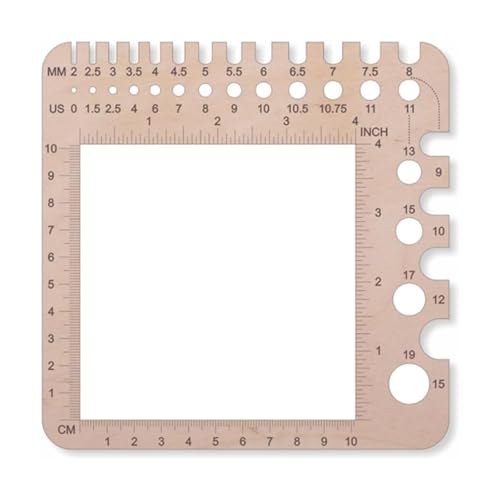
If you prefer the tactile warmth of natural materials, Katrinkles offers a beautiful alternative to plastic or metal tools. These wooden gauges are laser-cut with extreme precision, providing a lovely, non-slip feel in your hands.
Wooden tools are particularly helpful if you are working with slippery materials like silk or bamboo yarn. The friction of the wood helps keep the tool steady against your swatch, preventing it from sliding around while you count your stitches.
One trade-off is that wood can be more fragile than metal; avoid tossing it into the bottom of a heavy gear bag. If you treat it with care, it will age gracefully and become a cherished part of your knitting kit.
Susan Bates Knit-Chek Gauge Tool and Ruler
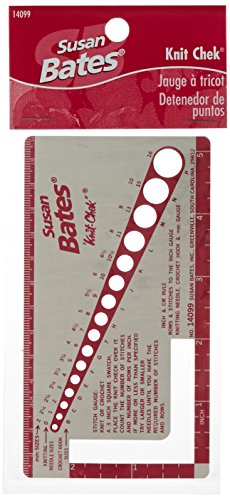
The Susan Bates Knit-Chek is a classic for a reason, having been a staple in knitting bags for generations. It is a simple, utilitarian tool that provides a reliable way to check both needle size and stitch count.
This tool is specifically designed to be durable and affordable. It lacks the bells and whistles of newer, boutique tools, but it gets the job done without any fuss.
If you are a beginner who is just building your tool kit, start here. It removes the guesswork from matching your needles to your pattern requirements without requiring a significant investment.
Clover Knitting Needle Gauge with Ruler

Clover’s gauge tool is a reliable workhorse that features a very clear, high-contrast scale. The markings are printed in a way that resists rubbing off, even after years of frequent use in the bottom of a project bag.
The design is slightly more ergonomic than standard flat rulers, making it easier to hold steady against a swatch. This is particularly helpful when you are measuring a swatch that has been blocked and might be slightly uneven.
This tool is a great middle-ground choice for knitters who want something more substantial than a basic plastic ruler but don’t want to pay a premium for designer materials. It is consistent, readable, and highly durable.
Knitter’s Pride Mindful Collection Gauge
The Mindful Collection by Knitter’s Pride focuses on calming, aesthetic design, but the gauge tool is surprisingly practical. It features a clean, minimalist layout that makes reading your stitch count very easy.
The teal color scheme is distinct, which makes it much easier to spot in a cluttered knitting bag compared to clear or white tools. It is also quite sturdy, resisting bending even when packed tightly with yarn and needles.
This is a great choice for knitters who appreciate a cohesive "look" for their tools. It performs its primary function with complete accuracy while adding a touch of intentionality to your crafting space.
Addi Needle Gauge and Stitch Counter Tool
Addi is known for engineering-grade tools, and their gauge and stitch counter is no exception. This tool is built to last a lifetime and is often favored by knitters who work with a high volume of projects.
The integrated stitch counter is a clever addition, allowing you to track your row count alongside your gauge check. It is a dual-purpose tool that saves you from needing to carry a separate clicker or manual counter.
The metal construction is smooth and snag-free, which is a major advantage when working with delicate fibers like lace-weight alpaca. It is an investment, but one that pays off in durability and multi-functionality.
Why Accurate Gauge Swatching Matters for Fit
Gauge is the mathematical foundation of your garment. If your gauge is off by even half a stitch per inch, that discrepancy multiplies across the entire width of a sweater, potentially resulting in a fit that is inches too large or small.
Always remember that your gauge can change based on your mood, the time of day, or even the type of needle you are using. A metal needle might make you knit tighter, while a wooden needle might encourage a looser, more relaxed tension.
Never skip the swatch, even if you have used the same yarn and needle size before. Different dye lots of the same yarn can have slight variations in diameter, which directly impacts your final stitch density.
How to Properly Use a Gauge Ruler for Accuracy
To get an accurate reading, your swatch must be blocked and fully dry before you even pick up your ruler. Fabric behaves very differently once the fibers have relaxed and bloomed in water.
Place your ruler on a flat surface and count your stitches over four inches, then divide by four to get your stitches per inch. Measuring over a larger area is always more accurate than trying to measure a single inch, as it accounts for small variations in tension across the row.
Avoid stretching the swatch while you measure, as this will give you a false, looser gauge. Let the fabric lie in its natural state, and use the markings on your ruler to confirm that your count matches the pattern’s requirements.
Understanding Metric vs US Needle Sizing Tools
Needle sizing can be confusing because the US system uses arbitrary numbers that don’t always correspond to the actual diameter of the needle. The metric system, which measures the diameter in millimeters, is the global standard for a reason.
When using a gauge tool, always prioritize the millimeter measurement listed on your yarn label or pattern. This ensures that you are using the actual physical size required, regardless of whether the pattern was written using US or UK sizing conventions.
If you find that your needle doesn’t fit perfectly into a hole on your gauge tool, always choose the size that is the closest match. Remember that a needle that is slightly too large will create a looser gauge, while one that is too small will tighten your fabric significantly.
Investing in a high-quality gauge ruler is one of the most cost-effective ways to improve the quality of your finished knitting. By taking the time to measure your stitches accurately, you transform your hobby from a guessing game into a precise craft. Choose a tool that feels comfortable in your hands, keep it in your notions bag, and never start a project without checking your tension first. Happy knitting, and may your gauge always be spot on!