6 Best Scale Measures For Accurate Wax Ratios Included
Achieve perfect candle consistency with these 6 best scale measures for accurate wax ratios. Read our expert review and select the right tool for your craft today.
Precision in fiber arts extends far beyond gauge swatches and needle sizes, especially when treating wool with protective waxes. Achieving the correct ratio of wax to fiber is the difference between a water-repellent, breathable garment and a sticky, stiff mess. Investing in a reliable digital scale ensures that every ounce of wax and gram of fiber is accounted for, eliminating the guesswork that leads to wasted materials. These six tools provide the accuracy necessary to keep your hand-dyed yarns and finished accessories in prime condition.
Greater Goods Digital Scale: Best Overall Value


Reliability is the hallmark of this scale, making it a staple for anyone who frequently processes medium-sized batches of fiber. Its clean design minimizes the risk of snagging delicate mohair or loose rovings during the weighing process.
The platform is wide enough to accommodate a standard mixing bowl without obscuring the readout screen. This visibility prevents accidental errors when pouring wax, a common frustration when working with bulky equipment.
For those balancing hobbyist projects with the occasional gift for others, this scale hits the “goldilocks” zone. It provides high-accuracy readings without the steep price tag associated with professional laboratory equipment.
My Weigh KD-8000 Scale: Best for Big Batches

When moving from a single hat to a full sweater’s worth of fiber, capacity becomes the primary constraint. The My Weigh KD-8000 handles larger loads with ease, ensuring that the weight of a heavy stainless steel bowl doesn’t exceed the scale’s maximum limit.
This unit features a protective cover over the display, shielding sensitive electronics from wax drips or errant fiber bits. Such durability is vital for long-term use in a busy studio environment where accidents are bound to happen.
While its footprint is larger than a standard kitchen scale, the added surface area provides much-needed stability. It is the tool of choice for makers who batch-process entire fleeces or multiple skeins at once.
AMW-SC-2KG Pocket Scale: Precision on a Budget
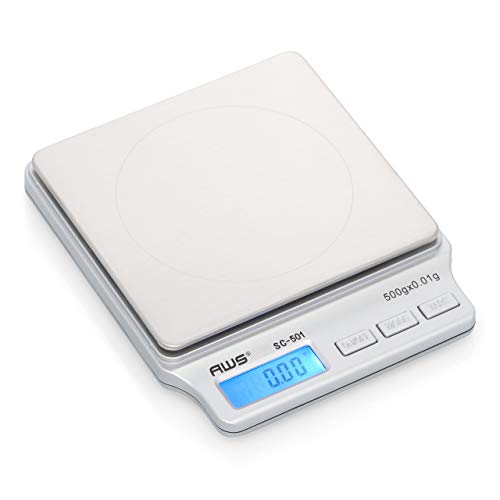
Small-scale projects, like treating a pair of socks or a small swatch, require extreme sensitivity to minor weight changes. Pocket scales often provide the highest level of precision for those fractional gram measurements that larger scales might miss.
Because this scale is compact, it tucks away easily in a project bag alongside circular needles and stitch markers. It is an ideal companion for workshops or guild meetings where portable accuracy is essential.
Keep in mind that the small platform requires a lightweight container, such as a paper cup or a small plastic tray. It is less suitable for large mixing bowls but unbeatable for delicate, high-precision wax mixing.
Etekcity Digital Kitchen Scale: Most User-Friendly

Simplicity often prevents human error, particularly when rushing to get a project finished before a deadline. The Etekcity scale features an intuitive interface that requires almost no learning curve for the beginner fiber artist.
The backlit display remains legible even under dim studio lighting, preventing squinting during late-night knitting sessions. Its responsive buttons react quickly, allowing for rapid adjustments when fine-tuning wax ratios.
This model is a workhorse, designed to handle daily use without faltering or losing calibration. It is a perfect entry-level choice for makers who want consistent results without managing complex settings.
Ozeri Pronto Digital Scale: Sleek and Simple
The Ozeri Pronto excels by removing the clutter that often plagues digital scales. Its slim profile makes it easy to slide into a drawer, preserving valuable workspace in smaller knitting corners.
Despite its minimalist appearance, the scale is surprisingly robust. The stainless steel finish resists stains and wipes down effortlessly after handling tacky waxes or resins.
For the minimalist knitter who appreciates functional beauty, this tool offers a satisfying experience. It is straightforward, efficient, and avoids the “over-engineered” feel of more expensive digital devices.
Weigh Gram Digital Pocket Scale: For Test Batches

Experimenting with different wax concentrations requires tiny test batches to ensure the desired texture and finish. The Weigh Gram scale provides the surgical precision needed to track these micro-variations.
Its high sensitivity allows for testing grams and even tenths of a gram, ensuring that new formulas can be replicated exactly once the perfect blend is found. Precision at this stage prevents ruining an entire batch of premium wool.
Although this scale is not designed for heavy lifting, it is a critical instrument for the scientific side of fiber care. Treat it as a precision laboratory tool rather than a standard kitchen gadget.
How to Pick the Right Scale for Your Wax Projects
Selecting the right tool depends heavily on the volume of your work and the frequency of your projects. Ask whether the scale will be used for large, infrequent batches or small, daily adjustments.
- Capacity: Ensure the scale can hold the weight of your heaviest containers plus the wax and fiber.
- Precision: Look for 0.1g or 1g increments depending on the scale of your mixing.
- Platform Size: Verify that the surface is large enough to remain stable under your specific equipment.
Remember that a scale is only as good as the space it occupies. If your studio space is cramped, prioritize compact models; if you have a dedicated workshop, invest in a larger, more stable platform.
Key Scale Features: Tare, Units, and Auto-Off
The “tare” function is the most critical feature, allowing the user to reset the weight to zero after placing a container on the platform. Without this, calculating the actual weight of the wax becomes a tedious math exercise.
Switchable units are also vital, as some recipes provide measurements in ounces while others use grams. A scale that struggles to toggle between these units is a common source of calculation errors.
Be cautious of the auto-off feature; while it saves battery life, a scale that powers down too quickly can interrupt a sensitive measurement. Select a model with an auto-off delay long enough to allow for deliberate, careful pouring.
Why Measuring by Weight Beats Volume for Wax Ratios
Measuring by volume—using tablespoons or milliliters—is notoriously inaccurate for substances like wax, which vary in density. A tablespoon of solid wax pellets will never equal a tablespoon of melted wax, leading to inconsistent saturation.
Weight provides a universal, objective measure that is immune to the “packing density” of the wax flakes. This ensures that every time you treat your fiber, the ratio of protective coating remains identical to the last successful batch.
Consistency in weight creates a predictable outcome, protecting the integrity of the fiber. When you work with expensive luxury yarns, you cannot afford the variability that comes with volume-based measurement.
How to Calibrate and Care for Your Digital Scale
Even the most expensive scale can lose its accuracy over time, especially when moved between different surfaces. Regularly check the calibration using a known weight, such as a standardized calibration mass or a simple coin with a known weight.
Keep the scale away from heat sources and high-moisture areas, as these can interfere with the internal sensors. A cool, dry shelf is the ideal storage location for maintaining long-term electronic health.
Finally, always store the scale on a flat, level surface when not in use. Constant tension on one side of the platform can cause the sensors to drift, leading to inaccurate readings during your next project.
Mastering the use of a digital scale transforms wax treatment from a risky experiment into a predictable part of your fiber care routine. By prioritizing precision and choosing a tool that fits your specific workflow, you safeguard your handmade items for years to come.