6 Best Digital Scales For Yarn Estimation For Accuracy
Find the 6 best digital scales for precise yarn estimation. Learn how these tools ensure accuracy for your fiber projects with our expert-tested selections.
Every knitter knows the sinking feeling of watching their yarn supply dwindle as they approach the final rows of a sweater. Having a reliable digital scale allows you to transform your leftover "yarn chicken" anxiety into a precise mathematical calculation. By measuring your remaining fiber in grams, you can accurately predict if you have enough yardage to finish that bind-off. This guide explores the best tools to ensure you never run out of yarn mid-project again.
My Weigh iBalance 201: Best Professional Option


When you are working with rare, hand-dyed luxury fibers, you need a scale that doesn’t fluctuate. The iBalance 201 is a laboratory-grade tool that offers the kind of stability required for high-stakes knitting.
It features a high-precision sensor that detects even the slightest weight shift. This is essential when you are trying to calculate the exact yardage of a precious 50-gram skein of cashmere or silk blend.
The trade-off here is the footprint and the price point. It is a larger piece of equipment that occupies significant space on your knitting desk, but for the serious stash-manager, the reliability is worth every penny.
Etekcity Digital Kitchen Scale: The Top Value Pick

If you just need a straightforward way to weigh your yarn cakes before starting a project, this is the industry standard for a reason. It is incredibly affordable, reliable, and handles the weight of a standard 100-gram skein with ease.
The interface is simple, featuring a clear "tare" function that lets you subtract the weight of your bowl or swift. This is vital when you are weighing loose yarn that might otherwise roll off the platform.
While it lacks the hyper-sensitivity of lab-grade scales, it is more than accurate enough for 99% of knitting needs. It is the perfect entry-level tool for anyone just beginning to track their yarn usage.
Ozeri Pronto Digital Scale: Best Compact Choice

For knitters who travel to workshops or knit in small spaces, the Ozeri Pronto is a fantastic, low-profile option. It is slim enough to slide into a project bag, yet robust enough to handle full-sized skeins.
Its design is sleek and easy to clean, which matters if you are prone to snacking while you knit. The buttons are responsive, and the display is bright, which helps when you are working in lower light conditions.
Keep in mind that its compact size means the platform is smaller. If you are weighing a massive, bulky-weight sweater quantity, you may need to use a container to keep the yarn from obscuring the screen.
GreaterGoods Digital Scale: Best User Interface

Sometimes, the best tool is the one that is the least frustrating to use. The GreaterGoods scale features a clean, intuitive design that prioritizes readability and ease of use.
The display is exceptionally large and backlit, which is a lifesaver when you are trying to read measurements while holding a tangled mess of mohair. It is also quite durable, standing up well to the occasional drop or spill.
This scale is an excellent choice for knitters who want a "set it and forget it" tool. It doesn’t have unnecessary bells and whistles, just a clean interface that does exactly what it promises.
Escali Primo Digital Scale: Best for Durability
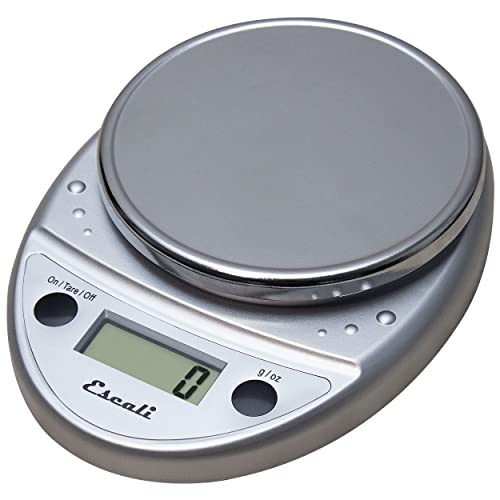
The Escali Primo is legendary in the kitchen, and that durability translates perfectly to the fiber arts studio. It is built to withstand years of heavy use, which is ideal if you are constantly weighing your stash for inventory.
The design is intentionally simple, with a sealed control panel that protects the internal electronics from stray fiber bits. If you work with shedding fibers like alpaca or unspun wool, this feature is a significant advantage.
It is a workhorse that rarely needs calibration. If you want a scale that will still be accurate a decade from now, this is the one to choose.
AWS Blade Series Scale: Best for Tiny Samples

Sometimes, you only have a tiny scrap of yarn left and need to know its weight to determine if it’s worth keeping. The AWS Blade Series is a pocket-sized, high-precision scale that excels at measuring very small amounts.
Because it is designed for extreme precision, it is sensitive to air currents. You will need to ensure you are working on a stable, draft-free surface for the most accurate reading.
This is not the scale for weighing a full sweater quantity, but it is indispensable for sampling. If you are a designer or a spinner who needs to weigh small swatches, this is your best friend.
Why Precision Matters for Yarn Yardage Estimates
Knitting is a game of finite resources, and yarn is often the most expensive variable. Even a difference of five grams can be the deciding factor between finishing a sleeve and having to hunt down a matching dye lot.
Using a scale helps you understand your "yarn economy." By weighing your yarn at the start and end of a project, you can calculate exactly how much you use per square inch, which helps you better estimate future projects.
Precision also helps with blocking. Knowing the dry weight of your garment allows you to track how much water it retains, which is helpful for consistent shaping and drying times.
How to Calculate Remaining Yardage by Weight
To estimate remaining yardage, you must first know the total weight and total yardage of your original skein. Use the formula: (Total Yardage / Total Weight) * Remaining Weight = Remaining Yardage.
For example, if a 100-gram skein has 400 yards, you have 4 yards per gram. If you have 15 grams left, you have approximately 60 yards remaining.
Always remember that this is an estimate, as yarn density can vary slightly throughout a skein. It is always wise to leave a "safety margin" of a few yards for your bind-off.
Essential Tips for Accurate Fiber Weighing
Always tare your container before adding the yarn to ensure you are measuring only the fiber. If you are weighing a yarn cake, ensure it is fully wound and not dragging on the table, as this will skew your results.
- Avoid drafts: Air conditioning or fans can cause the scale to fluctuate.
- Use consistent units: Stick to grams, as they are the standard for most yarn labels.
- Check your platform: Keep the weighing surface clean of dust and fiber bits.
- Calibration: If your scale has a calibration function, use it occasionally to maintain accuracy.
Frequently Asked Questions About Yarn Scales
Do I need a scale that measures to the 0.01g? For most knitting, 1g precision is sufficient. Only use 0.01g scales for very small, high-value samples.
Does humidity affect the weight of my yarn? Yes, natural fibers like wool are hygroscopic and can absorb moisture from the air. For the most accurate results, weigh your yarn in a stable, climate-controlled environment.
Can I use my kitchen scale? Absolutely, as long as it is accurate and has a tare function. There is no need to buy a "knitting-specific" scale if your kitchen tools are precise.
Investing in a digital scale is one of the most practical upgrades you can make to your knitting toolkit. It removes the guesswork from your projects, allowing you to knit with confidence rather than fear of running out. By mastering the weight-to-yardage calculation, you gain a deeper understanding of your materials and become a more empowered maker. Choose the scale that fits your specific needs, and enjoy the peace of mind that comes with true precision.