7 Best Row Tracking Journals For Project Notes
Stay organized with our top 7 row tracking journals. These picks offer structured layouts to boost project productivity and keep your essential notes on track.
Every knitter knows the sinking feeling of finding a beautiful, half-finished sweater in a project bag with no memory of which needle size was used. A dedicated journal transforms your crafting from a series of scattered attempts into a cohesive, professional-grade portfolio of your work. These seven journals offer the structure needed to track gauge, fiber behavior, and modifications with precision. Choosing the right one is the first step toward mastering your craft and ensuring your future projects are even better than your last.
The Knitter’s Pride Mindful Collection Journal


This journal is designed for the knitter who values a cohesive, meditative approach to their craft. It leans into the aesthetic of the Mindful needle line, offering a clean, serene layout that doesn’t overwhelm the page.
The real beauty here is the focus on project progression rather than just raw data. If you are someone who gets distracted by complex charts, the simplicity of this layout keeps your focus on the stitches at hand.
It lacks some of the deep technical tracking fields found in more specialized books. However, for the knitter who wants a beautiful record of their creative journey, it is an elegant choice.
Cocoknits Maker’s Journal for Project Tracking
Cocoknits is the gold standard for knitters who treat their craft like an engineering project. This journal is built around the "Knitter’s Method," emphasizing logical, modular tracking that makes complex garments manageable.
The pages are specifically designed to help you track your modifications, which is vital if you are adjusting patterns for fit or changing yarn weights. If you find yourself constantly recalculating stitch counts, this system handles the heavy lifting for you.
It is a more utilitarian, "no-nonsense" tool compared to others on this list. While it might look less like a scrapbook, it is arguably the most effective way to ensure your finished sweater actually fits your body.
Fringe Supply Co. Field Notes for Every Knitter
These pocket-sized notebooks are perfect for the knitter who lives in the "on-the-go" world. They are small enough to tuck into a notions pouch, ensuring you never lose that brilliant idea you had on the train.
Because they are compact, they prioritize brevity over detail. They are ideal for quick notes on row counts, yarn dye lots, or stitch patterns, but they aren’t meant for long-form narrative journaling.
These are excellent for keeping a "project history" across multiple bags. If you are a multi-project knitter, keeping one of these in every bag is the best way to prevent the dreaded "what needle size was I using?" panic.
The Knit Note by Making Magazine for Projects

Making Magazine has a distinct, artistic voice, and this journal reflects that sensibility perfectly. It is designed for the maker who views knitting as a holistic part of their creative life.
The layout encourages you to document not just the yarn and needles, but the why behind your project. It includes space for swatches, yarn labels, and sketches, making it a tactile archive of your growth.
The tradeoff is that it requires a bit more time to fill out than a standard logbook. If you enjoy the process of "documenting" as much as the knitting itself, this will quickly become your most prized possession.
Della Q Maker’s Journal for Detailed Records
Della Q understands that makers have a lot of gear, and this journal is built for the organized enthusiast. It features specialized sections for tracking needles, hooks, and notions alongside your active projects.
The depth of the record-keeping is its strongest asset. You can track everything from the specific fiber content—like the drape of an alpaca blend versus the memory of a wool-nylon sock yarn—to your personal modifications.

It is a substantial book that isn’t meant to be carried in a small purse. Think of this as your "master record" that stays at your knitting station, keeping your technical data safe and accessible.
Moleskine Passion Journal for Knitting Notes

The Moleskine brand is synonymous with quality paper, and this specific edition for knitters is a reliable classic. It offers a structured yet flexible format that appeals to those who like to customize their own tracking systems.
The paper quality is excellent, which matters if you are using fountain pens or markers to color-code your charts. It holds up well to the wear and tear of being tossed into a project bag for months on end.

It lacks the specific "knitting-centric" prompts found in newer, niche journals. You will need to be disciplined about creating your own shorthand if you want to track things like gauge or row repeat variations consistently.
Tallgrass Knitting Journal for Record Keeping
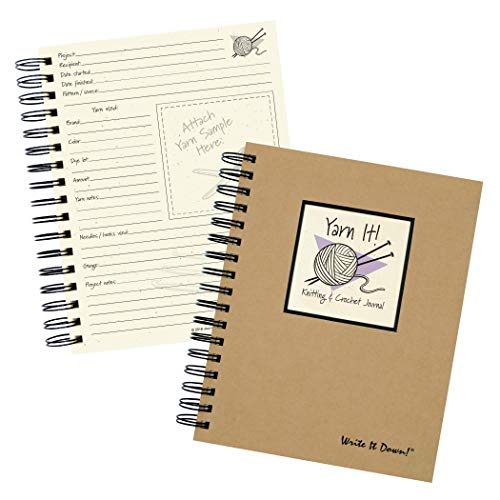
Tallgrass focuses on the essential data that every knitter needs to repeat a successful project. It is straightforward, durable, and avoids the fluff that often distracts from the actual work.
The layout is particularly good for tracking yarn consumption, which is a common pain point. If you are worried about running out of yarn on a large project, this journal provides the structure to calculate your usage as you go.
It is a workhorse journal. It is not designed to be a coffee table book, but it is designed to be a reliable partner that helps you finish your projects with confidence.
Why You Should Keep a Physical Knitting Journal
Digital apps are convenient, but they lack the tactile feedback of a physical page. Writing down your row counts reinforces the memory of the pattern, helping you internalize the construction of the garment.
Physical journals also serve as a permanent archive that doesn’t rely on software updates or cloud storage. Ten years from now, you will be able to flip through your notes and remember exactly why you chose a specific bind-off for a shawl.
Furthermore, it allows you to tape in physical swatches. Seeing how a specific yarn blooms after a soak and block is information that no screen can accurately replicate.
Essential Details to Log for Every New Project
To get the most out of your journal, consistency is key. Always ensure you record these fundamental details:
- Yarn details: Brand, colorway, dye lot, and fiber content.
- Needle information: Material (bamboo vs. metal), size, and cable length.
- Gauge: Stitches and rows per 4 inches, both before and after blocking.
- Modifications: Any changes to the pattern, such as lengthening sleeves or adjusting the neckline.
- Start/Finish Dates: Helpful for tracking your personal knitting speed and project management.
How to Choose the Best Journal for Your Needs
Start by asking yourself how you knit. If you are a process knitter who loves the meditative aspect, choose a journal with space for reflection and sketches.
If you are an outcome-oriented knitter who focuses on complex garments, prioritize a journal with technical charts and modification logs. Don’t be afraid to try a simple notebook first to see what data you actually reach for.
Ultimately, the "best" journal is the one you will actually use. If a book is too complex, you’ll stop filling it out; if it’s too simple, you’ll feel like you’re missing vital information.
Keeping a knitting journal is the single most effective way to elevate your craft from hobbyist to expert. By tracking your materials, modifications, and gauge, you create a personalized library of success that grows with every cast-on. Find the format that suits your style, commit to the habit, and watch your knitting confidence flourish. Your future self will thank you every time you pick up a project and know exactly where you left off.