6 Best Stitch Spacing Wheels For Uniform Holes
Achieve professional leatherwork with our top 6 stitch spacing wheels. Discover tools that ensure perfectly uniform holes for consistent, high-quality seams.
Achieving perfectly spaced stitches in leatherwork is much like maintaining consistent tension across a complex lace shawl; it requires the right tools and a steady hand. Just as you wouldn’t use a blunt needle for delicate silk yarn, you shouldn’t settle for imprecise marking tools when preparing your leather for stitching. These six spacing wheels offer the mechanical reliability needed to ensure your holes are perfectly aligned every time. Choosing the right one is the difference between a professional-looking heirloom piece and a project that looks handmade in the wrong way.
Tandy Leather Stitching Spacer: Best Overall Pick


The Tandy Leather Stitching Spacer is the reliable workhorse of the leathercraft world, much like a classic set of nickel-plated knitting needles that never lets you down. It provides a consistent, no-nonsense approach to marking your stitch lines, making it an excellent starting point for any maker.
This tool excels because of its simplicity and ease of adjustment. If you’ve ever spent hours swatching to find the perfect gauge for a sweater, you’ll appreciate how quickly this wheel allows you to toggle between different stitch lengths. It holds its setting firmly, preventing the "drift" that can ruin a long seam.
The trade-off here is the weight and feel. It isn’t as ergonomic as high-end boutique tools, but it gets the job done with clinical efficiency. For most projects, from simple wallets to tote bags, this is the consistent performer you want in your kit.
Seiwa Adjustable Stitching Groover: Top Precision

When you are working on fine leather goods, precision is non-negotiable, much like working with lace-weight yarn where a single dropped stitch ruins the entire motif. The Seiwa tool is designed for the perfectionist who demands absolute accuracy in every mark.
This tool functions as both a groover and a spacer, giving you a clean channel for your stitches to sit in. By recessing your thread, you protect it from abrasion, which is similar to choosing a high-twist yarn to prevent pilling in high-friction areas like underarms.
The adjustment mechanism is incredibly fine-tuned. While it requires a bit more practice to master than a standard wheel, the resulting uniformity is unmatched. It is the tool of choice for those who want their hand-stitching to mimic the flawless look of a high-end machine.
Craftool Pro Spacer Set: Best For Heavy Leather
If you’re tackling thick, vegetable-tanned leather, you need a tool with substantial weight and structural integrity. Think of this as choosing sturdy wooden needles for a bulky wool project; you need something that won’t flex under the pressure of the material.
The Craftool Pro set comes with multiple interchangeable wheels, allowing you to match your stitch length to the thickness of your thread. Just as you wouldn’t use a worsted-weight needle for chunky roving, you shouldn’t use a tiny spacing wheel on heavy-duty saddle leather.
Because these tools are built to be robust, they can feel a bit heavy in the hand during long sessions. However, that heft is a benefit when you are pressing into dense leather, as it provides the necessary leverage to leave a clear, deep mark without requiring excessive physical exertion.
Weaver Leather Spacing Tool: Best Value Choice

Finding a balance between quality and cost is a challenge every crafter faces, whether you are buying luxury hand-dyed wool or essential hardware. The Weaver Leather spacing tool offers a fantastic entry point without sacrificing the basic functionality required for professional results.
It is straightforward, durable, and lacks the unnecessary bells and whistles that often drive up the price of high-end tools. If you are just starting your journey into leathercraft, this tool will help you develop the muscle memory needed for consistent spacing without breaking your budget.
The main consideration here is that it may lack the fine-tuning micro-adjustments of more expensive models. If you find yourself needing to switch between very specific, non-standard stitch lengths, you might eventually outgrow it. For standard 3mm to 5mm spacing, however, it is perfectly adequate.
Wuta Professional Stitching Wheel: Best Durability
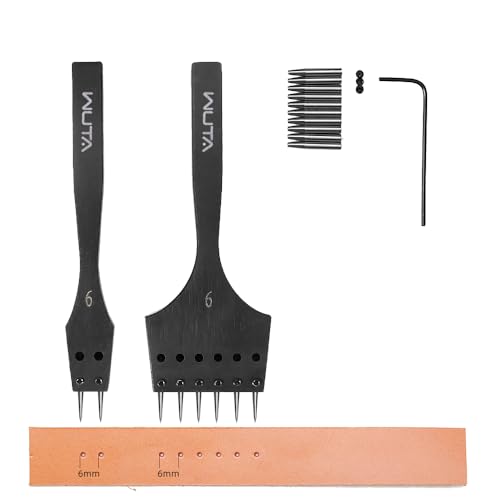
Durability is the hallmark of a great tool, especially for those who spend hours at their workbench. The Wuta wheel is constructed from hardened steel, ensuring the teeth remain sharp and defined even after hundreds of projects.
Using this wheel feels like using a high-quality stainless steel needle; it is smooth, rigid, and reliable. The teeth are designed to grip the leather surface firmly, ensuring that the wheel doesn’t skip or slide off the line, even when working on slick or finished leathers.
While it is a bit more expensive than basic models, the longevity makes it a smart investment. You won’t have to worry about the teeth dulling or bending, which is a common frustration with cheaper, softer metal tools. It is a "buy it once" kind of tool.
Kyoshin Elle Spacing Tool: Best For Fine Details
For makers who specialize in intricate, small-scale items like watch straps or fine jewelry, the Kyoshin Elle tool is a revelation. Its design is delicate and precise, allowing for very tight spacing that larger tools simply cannot achieve.
In knitting terms, this is your 2.0mm circular needle for fine sock work. It handles tight tolerances with ease, ensuring that your stitches look elegant and refined rather than bulky or uneven. The balance of the tool is excellent, reducing hand fatigue during delicate marking work.
Because it is designed for fine work, it is not suitable for heavy-duty projects. Using it on thick, dense leather could damage the delicate teeth. Keep this tool reserved for your finer leathers and precision-oriented projects to maintain its integrity.
How to Choose the Right Spacing Wheel for Projects
Selecting the right wheel is entirely dependent on the thread size and leather thickness you’ve chosen. Much like selecting a needle size based on your yarn’s WPI (wraps per inch), you must match your tool to the scale of your project.
- Consider Thread Thickness: Thicker thread requires wider spacing to prevent the leather from tearing between holes.
- Evaluate Leather Density: Softer leathers require a lighter touch, while dense leathers demand a tool that provides firm, consistent pressure.
- Project Scale: Use smaller wheels for fine, ornamental items and larger wheels for structural, heavy-duty goods.
Always test your spacing on a scrap piece of the same leather you intend to use. Just as a gauge swatch prevents a sweater that doesn’t fit, a test mark ensures your stitch spacing complements the overall aesthetic of your finished piece.
Understanding Stitch Lengths for Uniform Results
Uniformity is the secret to professional-looking leatherwork. If your stitch lengths vary, the eye immediately detects the inconsistency, just as it catches an uneven tension in a stockinette stitch panel.
Aim for a ratio where your stitch length is roughly 1.5 to 2 times the thickness of your thread. This provides enough leather between the holes to maintain structural strength while keeping the stitches looking tight and intentional.
Don’t be afraid to adjust your technique based on the leather’s "stretch." Some leathers will elongate under tension, which can make your spacing look wider than you intended. Keep your pressure consistent throughout the entire line to maintain that perfect rhythm.
Tips for Achieving Even Holes in Thick Materials
When working with heavy materials, the primary challenge is keeping the wheel from slipping as you apply pressure. I find it helpful to use a straight edge or a stitching guide to keep the wheel perfectly vertical.
If you are struggling to get a deep enough mark, avoid going over the line multiple times. This often leads to "double-tracking," which looks messy. Instead, use a slightly heavier tool or apply more controlled, singular pressure.
If you are using a mallet to punch holes after marking, ensure your chisel is aligned perfectly with the mark. Even the best spacing wheel cannot compensate for a chisel that enters the leather at an angle. Keep your wrist locked and your movement fluid.
Maintenance Guide for Your Metal Stitching Tools
Metal tools require basic care to stay in peak condition, much like keeping your needles clean and rust-free. After every use, wipe your spacing wheels with a soft cloth to remove any leather dust or oils that may have accumulated.
If you live in a humid environment, a light coating of machine oil can prevent oxidation, especially on carbon steel tools. Store them in a dry place, preferably in a dedicated organizer, to prevent the teeth from clashing against other tools and dulling.
If you notice the teeth becoming dull, they can be carefully honed with a fine abrasive stone. However, be cautious; if you aren’t comfortable with metalwork, it is often better to replace the wheel to ensure you don’t ruin the spacing geometry.
Whether you are crafting a rugged belt or a delicate accessory, the quality of your stitch spacing defines the final result. By selecting a tool that matches your specific project needs and maintaining it with care, you ensure that every hole is as precise as a perfectly knit stitch. Take your time, test your materials, and let these tools provide the foundation for your best work yet. Happy making!