6 Best Notebook Organizers For Pattern Storage
Keep your creative projects tidy with these 6 top-rated notebook organizers. Learn how to store patterns efficiently while maintaining a clutter-free workspace.
Every knitter eventually reaches a point where their coffee table is buried under a mountain of loose printouts, scribbled sticky notes, and half-finished charts. Keeping your patterns and project notes organized is just as vital as choosing the right yarn for your gauge. Whether you prefer the infinite scroll of a digital database or the tactile satisfaction of pen on paper, having a system prevents "project amnesia." Here are the best tools to help you keep your knitting life as tidy as your tension.
Ravelry Digital Pattern Library: Best For Organization
Ravelry is the industry standard for a reason, acting as a massive, searchable database for every pattern you’ve ever loved. It allows you to tag projects, store PDFs, and link your yarn stash directly to your queue.
For the modern knitter, the primary advantage is accessibility; you can pull up a complex lace chart on your tablet while sitting in a dimly lit living room. Because it tracks your projects over years, it becomes a historical record of your growth as a maker.
However, the sheer depth of the site can feel overwhelming to beginners. If you aren’t disciplined about uploading your photos or logging your yardage, the library can quickly become a digital junk drawer rather than a useful tool.
Cocoknits Maker’s Portfolio: Best Premium Choice
The Cocoknits Maker’s Portfolio is designed for the knitter who treats their craft like a high-end studio practice. It features a sophisticated, modular design that allows you to store patterns, needles, and notions in one sleek, professional-looking binder.
This choice is ideal for those who work on multiple complex projects simultaneously. If you have a stranded colorwork sweater on the needles while also working on a pair of socks, the portfolio keeps your charts and specific tool requirements physically separated and protected.
The tradeoff here is the price point and the footprint. It is a significant investment that requires a dedicated spot in your knitting bag, which might be overkill if you only ever work on one simple scarf at a time.
Erin Condren Knitting Planner: Best Custom Layout


If you thrive on structure, the Erin Condren Knitting Planner offers a highly structured environment for tracking every detail of a project. It includes dedicated sections for gauge swatches, yarn tracking, and project timelines.
Using a planner like this forces you to slow down and document your process, which is invaluable when you are working with luxury fibers that require specific care instructions. It turns your knitting into a documented journey rather than just a hobby.
Be aware that this system requires a high level of maintenance to be effective. If you find yourself forgetting to write down your needle size or the specific dye lot of your wool, the planner will quickly become a collection of empty pages.
KnitPicks Project Journal: Best For Beginners

The KnitPicks Project Journal is a straightforward, no-nonsense tool that focuses on the essentials. It provides clear, pre-printed fields for yarn information, needle sizes, and project notes, making it perfect for those just starting their knitting journey.
It removes the intimidation factor of complex organizational systems, allowing you to focus on the act of knitting itself. It’s small enough to tuck into a project bag, ensuring your notes are always where your yarn is.
While it lacks the advanced features of a modular system, its simplicity is its greatest strength. It is a reliable, affordable companion that won’t distract you from the task of mastering your purls and knits.
Moleskine Classic Notebook: Best For Portability

A classic Moleskine notebook is the ultimate tool for the knitter who likes to sketch, brainstorm, and scribble notes on the go. It doesn’t have pre-printed fields, which gives you the total freedom to map out custom shawl shapes or modify existing charts.
For those who knit during commutes or in public spaces, the compact size and durable cover are essential. It handles ink and pencil well, ensuring your notes remain legible even after months of being tossed into a tote bag.
The downside is the lack of structure; you are responsible for keeping your own index and project records. If you aren’t organized by nature, your notes can become a chaotic scramble of half-finished thoughts and stray yarn scraps.
Filofax Personal Organizer: Best Modular System

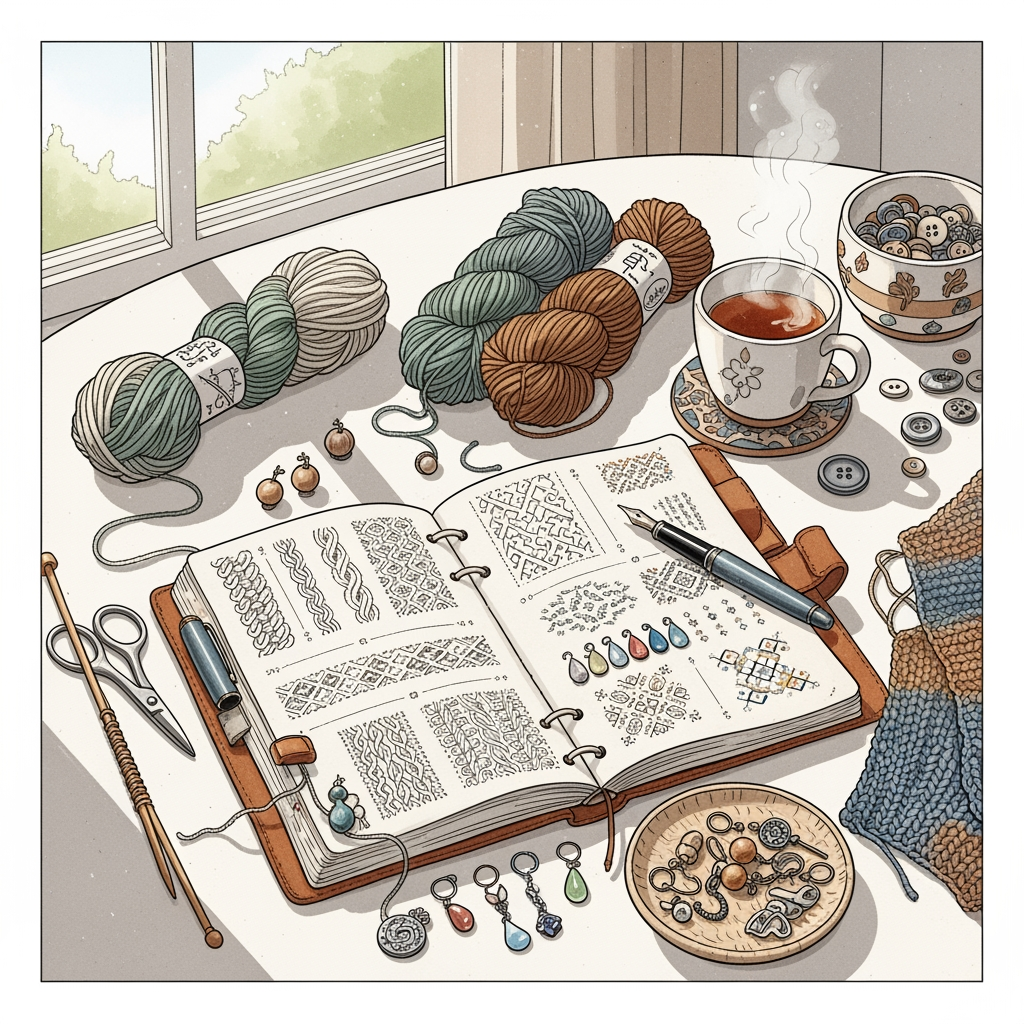
The Filofax system is the gold standard for knitters who want to build their own custom organization tool from the ground up. By adding different inserts, you can combine a calendar, a pattern repository, and a needle inventory in one place.
This modularity allows the organizer to grow alongside your skills. You can start with basic project pages and eventually add complex charts or reference sheets for different cast-on methods as your repertoire expands.
Because it uses a ring-binder mechanism, you can easily remove pages to take them to a knitting circle or a local yarn shop. Just be careful with the rings; if they get snagged on delicate mohair or fine silk, they can cause unwanted pulls in your work.
Why You Need a Dedicated Knitting Pattern Organizer
Without a dedicated system, you will inevitably lose track of vital information like dye lots, needle sizes, or modifications made to a pattern. When you are halfway through a sweater and realize you’ve lost the chart for the sleeve decreases, the frustration can derail your entire project.

An organizer acts as a "second brain" for your knitting. It allows you to store the technical details that don’t fit on a pattern printout, such as how a specific superwash wool behaved after blocking or which needle material gave you the best tension for a particular project.
Ultimately, organization creates a bridge between your creative impulses and the finished garment. It ensures that when you return to a project after a long break, you can pick up exactly where you left off without any guesswork.
Key Features to Look for in a Pattern Notebook
When shopping for an organizer, consider the physical environment of your knitting space. You need something that can lay flat or be propped up, allowing you to read your charts while your hands are busy with your needles.
- Size: Does it fit in your project bag?
- Paper quality: Does it prevent ink bleed-through?
- Storage pockets: Can it hold loose yarn samples or swatches?
- Accessibility: Is it easy to add or remove pages?
Avoid notebooks with spiral bindings if you tend to knit with sticky fibers, as the metal coils can snag and ruin your yarn. Look for sturdy covers that can withstand the wear and tear of being transported to fiber festivals or knit nights.
Digital vs. Physical Pattern Storage Comparison
Digital storage offers the benefit of instant searchability and cloud backups, ensuring you never truly "lose" a pattern. It is perfect for the knitter with a massive library who needs to find a specific cable pattern in seconds.
Physical storage, conversely, offers a tactile connection to your work that screens simply cannot replicate. Writing down your notes by hand has been shown to improve memory retention, which helps you internalize the techniques you are using in your knitting.
The best approach is often a hybrid one. Use digital tools to store and organize your master library, but keep a physical notebook for your immediate, active project notes and modifications.
Tips for Maintaining Your Knitting Project Records
Consistency is the secret to a successful record-keeping system. Make it a habit to fill out your project card the moment you cast on, noting the yarn brand, colorway, and needle size used for your gauge swatch.
Don’t be afraid to tape a small snippet of your yarn into your notebook. This acts as a visual reference for future projects and helps you identify fibers when you are digging through your stash years later.
If you make a mistake, don’t erase it; cross it out. Seeing your corrections can be a great way to learn from your past errors, ensuring you don’t repeat the same tension issues or counting mistakes in your next project.
Finding the right organizational tool is a personal process that should evolve as your knitting practice grows. Whether you choose a high-tech digital database or a simple, well-worn notebook, the goal is to reduce the friction between you and your needles. Pick a system that makes you feel excited to start your next project, and don’t be afraid to experiment until you find what truly clicks. Happy knitting, and may your rows always be even and your stitch counts always correct.