7 Best LED Task Lights For Detailed Finishing Tested
We tested the top 7 LED task lights for precision finishing. Discover which models offer the best clarity, color accuracy, and adjustability for your projects.
Achieving the perfect stitch requires more than just high-quality yarn and the right needles; it demands impeccable visibility. When you are working with dark mohair or complex lace, poor lighting is the fastest way to lose your place or miss a dropped stitch. These seven lighting solutions have been vetted for their ability to illuminate the fine details of your fiber art projects. Choosing the right lamp can transform your knitting experience from a straining chore into a relaxing, precise craft.
Brightech LightView Pro: Best Overall Magnifier
When you are working with dark, fingering-weight yarns, even the best eyes can struggle to see individual stitches. This lamp combines a crisp LED light source with a high-quality magnifying lens, making it an essential tool for identifying splits in your yarn or correcting errors in intricate cable patterns.
The magnification is particularly helpful when you need to inspect your work for consistent tension or check if you’ve accidentally picked up a strand of a neighboring ply. It removes the guesswork from complex lace charts where a single misplaced yarn-over can ruin the entire repeat.
However, the magnifying glass can sometimes create a narrow field of vision. It is best used for spot-checking or detailed fixes rather than long-term, continuous knitting.
OttLite 2-in-1 LED Floor and Table Lamp Choice
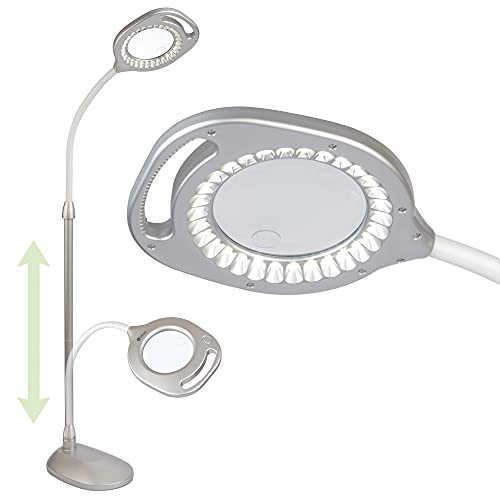

Versatility is the hallmark of a great knitting station, and this lamp excels by transitioning seamlessly between floor and table configurations. If you alternate between a cozy armchair for evening knitting and a dining table for blocking your finished garments, this flexibility is a game-changer.
The light quality mimics natural daylight, which is crucial for color accuracy. There is nothing worse than finishing a project only to realize in the morning sun that your "matching" yarn colors are actually two different dye lots.
While the base is sturdy, it can be a bit bulky in small spaces. Ensure you have enough floor clearance if you plan to move it frequently between rooms.
Neatfi XL 2,200 Lumens Task Lamp for Precision
If you are a professional-level knitter or someone who spends hours on complex stranded colorwork, you need raw power. This lamp offers an incredibly wide coverage area, ensuring your entire lap is illuminated without harsh shadows.
The 2,200 lumens provide a level of clarity that makes even the darkest navy or black wool look like bright white cotton. You will find that you can knit for longer periods without your eyes feeling heavy or strained.
Because of its size, this lamp is a permanent fixture. It is not designed for travel, so reserve this for your primary "knitting nook" where you do the bulk of your work.
Vekkia LED Neck Reading Light for Travel Use

Traveling with your knitting is a joy, but hotel lighting is notoriously dim and unreliable. This neck light sits comfortably around your shoulders, casting light directly onto your needles without bothering your travel companions.
It is lightweight enough that you will forget you are wearing it after a few rows. It is the perfect solution for knitting on airplanes, in trains, or in dimly lit coffee shops.
Keep in mind that the battery life is limited compared to plug-in models. Always carry a portable power bank if you are planning a long project session away from an outlet.

Daylight Company Slimline 3 Table Lamp Review

This lamp is the gold standard for crafters who prioritize aesthetics and functionality in equal measure. Its slim profile means it won’t clutter your workspace, yet it packs enough punch to illuminate an entire project bag’s worth of yarn.
The touch-sensitive dimming feature is excellent for adjusting to the shifting light of the day. As the sun sets, you can gradually increase the brightness to maintain a consistent visual field.
The arm is highly adjustable, allowing you to position the light exactly where your needles meet the yarn. It is a premium investment, but one that pays off in reduced eye fatigue over years of use.
Phive Architect LED Desk Lamp for Dark Spaces
Architect-style lamps are beloved by knitters for their reach and stability. This model features a wide, flat head that distributes light evenly, preventing the "hot spots" that can cause glare on reflective needles, like polished nickel or aluminum.
The heavy-duty clamp base is ideal if you have limited desk space. It keeps your surface clear for your pattern, stitch markers, and spare needles.
Be aware that the industrial look may not fit every decor style. However, for sheer mechanical performance and durability, it is hard to beat.
Globe Electric 56963 Swing Arm Lamp for Knits

Sometimes, simplicity is the best approach. This classic swing-arm lamp is a reliable workhorse that provides focused, directional light exactly where you need it.
It is particularly effective for knitters who use a "flicking" or "picking" style and need to see the needle tips clearly as they enter the stitch. It is easy to adjust, stays in place, and is very affordable.
While it lacks the fancy dimming features of modern LED lamps, it is compatible with most smart bulbs. You can easily upgrade it to a full-spectrum bulb to get the color-rendering benefits of more expensive units.
Essential Features for Fiber Arts Task Lighting
When shopping for a lamp, don’t just look at the price tag. Look for a lamp that offers adjustable color temperature, as you want to simulate daylight (around 5000K-6000K) to see your true yarn colors.
- Flicker-free technology: Essential to prevent the subtle strobe effect that causes headaches.
- Arm reach: Ensure the lamp can extend over your lap while you are reclined.
- Glare control: Look for diffusers that soften the light so it doesn’t bounce off your needles.
Avoid lamps that only offer a "warm" yellow light. While cozy, it masks the subtle shifts in tone that are vital for colorwork and makes it difficult to distinguish between similar shades.
Why Color Rendering Index Matters for Stitches
The Color Rendering Index (CRI) measures how accurately a light source reveals colors compared to sunlight. For knitters, a CRI of 90 or higher is non-negotiable.
If you are working with variegated yarns or subtle gradients, a low CRI light will make your colors look muddy and muted. You might struggle to see where one color ends and another begins, leading to mistakes in your pattern.
Always check the packaging for the CRI rating. If it isn’t listed, it is likely too low for high-end fiber arts.
How Proper Lighting Prevents Knitting Eye Strain
Eye strain in knitting often manifests as a dull ache behind the eyes or a feeling of "fuzziness" when you look away from your work. This happens when your eyes are constantly trying to adjust to low-contrast environments.
By using a dedicated task light, you create a high-contrast environment where the yarn stands out against the needles. This allows your eyes to relax and focus on the mechanics of the stitch rather than searching for the yarn.
Remember to take "eye breaks" every 20 minutes by looking at something across the room. Good lighting is the foundation, but your eyes still need the occasional rest.
Investing in quality lighting is just as important as investing in high-quality wool or ergonomic needles. By providing your eyes with the clarity they need, you ensure that your projects remain a source of joy rather than physical discomfort. Take the time to evaluate your specific knitting environment and choose a lamp that supports your unique needs. Happy knitting, and may your stitches always be even and your light always bright.