6 Best Tabletop Magnifying Lamps For Detail Work
Need precision for crafts? We review the 6 best tabletop magnifying lamps, evaluating clarity, lighting, and stability to help you work with perfect detail.
When you are working with dark mohair or intricate lace charts, the difference between a dropped stitch and a perfectly executed row is often just a matter of light. A good magnifying lamp acts as a second set of eyes, saving you from the frustration of squinting at tiny, dark stitches. Choosing the right tool isn’t just about magnification; it’s about clarity, reach, and how the light interacts with your yarn. Here are six top-tier options to help you keep your stitches precise and your eyes relaxed during those long marathon knitting sessions.
Brightech LightView Pro: Best Overall Magnifier
The Brightech LightView Pro has earned its reputation as the gold standard for crafters who need versatility. Its 3-diopter lens offers a gentle magnification that doesn’t distort your depth perception, which is crucial when you are working on complex cable patterns.
The swing arm is the real star here, allowing you to position the lens exactly where your needles meet the yarn. Whether you are sitting in a deep armchair or at a dedicated craft desk, the reach is consistent and stable.
If you struggle with eye fatigue after an hour of knitting, the flicker-free LED light on this model makes a world of difference. It provides a clean, white light that helps you distinguish between similar shades of wool without the harsh glare that can make stitch definition disappear.
Neatfi XL 2,200 Lumens LED Magnifying Lamp
If you work with fine-gauge lace or dark, navy-colored wool, the Neatfi XL is a powerhouse. The sheer brightness of 2,200 lumens ensures that every single fiber is illuminated, making it much easier to see the structure of your stitches.
The large lens size is the primary advantage for knitters, as it covers a wider field of view than standard lamps. You can see several inches of your work at once, which is vital when you are checking for mistakes in a complicated lace repeat.
However, keep in mind that this lamp is heavy and requires a sturdy surface for mounting. It is best suited for a permanent knitting station rather than a portable setup you move from room to room.
OttLite Dual-Shade LED Magnifier for Detail


OttLite has long been the go-to for color accuracy, and this dual-shade model is no exception. When you are doing stranded colorwork or intarsia, seeing the true, natural color of your yarn is non-negotiable.
The dual-shade design allows you to direct light from two different angles, which helps eliminate those pesky shadows that hide your stitches. This is particularly helpful when working with fuzzy fibers like alpaca or angora, where the halo can obscure the stitch definition.
It is a more compact option, making it an excellent choice for knitters who have limited desk space. While the magnification is modest, the clarity of the light is unmatched for discerning subtle color shifts.
Tomons Swing Arm LED Desk Lamp with Magnifier

The Tomons lamp leans into a more traditional aesthetic, but don’t let the classic look fool you. It offers a functional, no-nonsense approach to magnification that is perfect for the minimalist knitter.
The wooden accents and industrial design make it a beautiful addition to a living room, blending in with your home decor when you aren’t actively knitting. The adjustable arm is smooth and holds its position well, even when you lean in close to count stitches.
It is a great mid-range option for those who want a reliable, steady light source without the industrial look of a professional-grade workshop lamp. It provides just enough magnification to help with reading charts or picking up a dropped stitch in a dark yarn.
Carson DeskBrite 200 Magnifying Desk Lamp
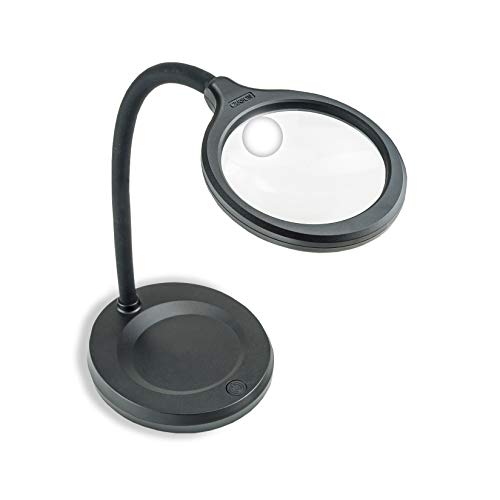
The Carson DeskBrite 200 is a fantastic entry-level choice for knitters who need a portable solution. It is compact, lightweight, and can be powered by batteries, which is a lifesaver if you don’t have an outlet near your favorite knitting spot.
Because it is smaller, it won’t provide the massive coverage of a larger swing-arm lamp. However, it is perfect for those "spot checks"—when you need to zoom in on a tricky decrease or verify a stitch count in a specific section of your project.
It’s an honest, simple tool that doesn’t pretend to be a full-studio lighting rig. For the knitter who values simplicity and portability, this is a very practical addition to your knitting bag or side table.
VLT 5-Diopter LED Magnifying Glass Lamp

When you are working with extremely fine yarn, such as lace-weight silk or thin cotton, a 5-diopter lens is a significant advantage. This level of magnification brings the tiny details of your work into sharp focus, making it easier to spot twisted stitches.
The higher diopter count means you will have to hold your needles slightly closer to the lens to get the perfect focus. Once you find that "sweet spot," however, the level of detail is incredible for troubleshooting complex stitch patterns.
This lamp is best for experienced knitters who are comfortable with higher magnification and need that extra help for precision work. It turns the most challenging, microscopic stitches into a manageable, clear landscape.
Key Features to Consider for Knitting Lighting
When shopping for a lamp, don’t get distracted by fancy bells and whistles. Flicker-free LEDs are the most important feature, as flickering light causes subtle, subconscious eye strain that leads to headaches during long knitting sessions.
Consider the reach of the arm carefully. You need a lamp that can extend over your project without forcing you to hunch over, which leads to neck and shoulder pain.
- Color Rendering Index (CRI): Look for a high CRI (90+) to ensure colors look natural.
- Mounting Style: Decide between a heavy base (for portability) or a clamp (for desk stability).
- Brightness Control: A dimmable feature is essential for switching between high-contrast day knitting and late-night projects.
Understanding Diopters and Magnification Levels
Diopters measure the power of a magnifying lens, and there is a common misconception that "more is always better." In reality, higher magnification reduces your field of view and requires you to work much closer to the lens.
For general knitting, a 3-diopter lens is usually the sweet spot, providing a comfortable balance between zoom and working distance. If you are doing extreme detail work or repairing vintage lace, a 5-diopter lens is appropriate.
Always remember that as magnification increases, the distance between your work and the lens decreases. If you find yourself bumping your needles against the glass, your magnification is likely too high for your specific project.
LED vs Fluorescent Bulbs for Fiber Projects
LED technology has largely rendered fluorescent bulbs obsolete in the knitting room, and for good reason. LEDs are instant-on, meaning you don’t have to wait for the light to "warm up" to its full brightness.
Fluorescent bulbs often have a slight, imperceptible flicker that can make your eyes work harder to focus on the yarn structure. LEDs also run much cooler, which is vital when you are working with delicate natural fibers that can be sensitive to heat.
Furthermore, LEDs provide a more consistent color temperature. You want a "daylight" spectrum (around 5000K-6000K) to ensure that the yarn you see in the lamp is the same color it will be when you walk out the door.
How Proper Lighting Prevents Eye Strain Errors
Eye strain is the silent killer of knitting progress, often leading to subtle errors like miscounting rows or missing a yarn-over. When your eyes are tired, your brain stops "seeing" the gaps and textures that define your stitch patterns.
Proper lighting doesn’t just help you see; it helps you maintain rhythm. When you can clearly see the next stitch, you don’t have to pause and squint, which allows your hands to move with greater fluidity and consistency.
Invest in a quality lamp as you would a quality set of needles. It is a tool that protects your most valuable asset—your vision—and ensures that you can continue enjoying this craft for decades to come.
Finding the right magnifying lamp is an investment in your comfort and the longevity of your knitting hobby. Whether you choose the wide reach of the Neatfi or the color accuracy of the OttLite, the goal is to reduce strain and increase your enjoyment. Take your time to consider your specific project needs and your workspace limitations before making a choice. With the right light, those dark, intricate projects will become far less daunting and much more rewarding.