
6 Best Yarn Needles For Grafting Toes For Knitters
Grafting toes requires precision. We review the six best yarn needles, focusing on eye size, tip bluntness, and durability to ensure your seams are seamless.
Grafting the toes of a sock is the final, high-stakes hurdle that turns a pair of tubes into a professional-looking garment. Using the wrong needle can turn a meditative Kitchener stitch session into a frustrating exercise in snagging and splitting delicate yarn plies. The right tool acts as an extension of your fingers, gliding through live stitches with ease and precision. This guide explores the best needles to ensure your hard work ends with a seamless, invisible finish.
Clover Bent Tip Tapestry Needles: Best Overall


When you are deep into the rhythm of Kitchener stitch, the last thing you want is a straight needle poking into the fabric you’ve already grafted. The Clover Bent Tip design is a game-changer because the angled point allows you to scoop stitches without dragging the needle through the surrounding yarn.
This ergonomic shape mimics the natural movement of your wrist, reducing fatigue during long grafting sessions. For those working with fingering weight sock yarn, the slightly blunt tip is sharp enough to find the stitch path but rounded enough to avoid piercing the fiber itself.
It is rare to find a tool that balances price and performance so effectively. If you are looking for a reliable, go-to needle that handles 95% of sock projects, this is the one to keep in your notions pouch.
Bohin France Size 18/22 Chenille Needles Choice

Bohin France is legendary for a reason: their needles are exceptionally smooth and possess a high-quality finish that resists oxidation over time. Unlike standard tapestry needles, Chenille needles have a sharper point, which can be a double-edged sword for the novice knitter.
If you are working with a high-twist, multi-ply wool, that sharp point can sometimes snag a single strand if you aren’t careful. However, for those using rustic, non-superwash wools or yarns with a bit of halo, that extra sharpness helps you navigate through dense, felted-adjacent stitches.
The size 18/22 variety pack gives you the versatility to switch between heavy-duty boot socks and delicate lace-weight hosiery. These are the "workhorse" needles for the knitter who values traditional craftsmanship and a polished, professional feel.
Dritz Yarn Darners With Flexible Nylon Loops

We have all been there: squinting at a tiny needle eye, trying to thread a fuzzy mohair or a thick wool yarn without success. Dritz Yarn Darners solve this by using a flexible nylon loop instead of a traditional metal eye, making threading nearly instantaneous.
These are particularly helpful for knitters with limited dexterity or those who struggle with eye strain. Because the loop is collapsible, it can accommodate a wide range of yarn weights, from lace to worsted, without needing to change your tool.
The tradeoff here is that the needle body itself is often thicker than a standard tapestry needle. If you are grafting a very tight gauge sock, the bulk of the needle might feel a bit cumbersome as it passes through the loops.
Cocoknits Stainless Steel Stitching Needles
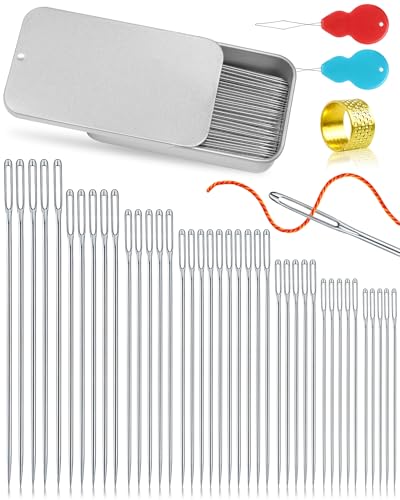
Cocoknits has mastered the art of the "minimalist tool," and their stainless steel needles are no exception. These needles are incredibly smooth, allowing them to slide through even the stickiest of fibers—like high-traction cotton or sticky alpaca—without any resistance.
The set typically comes with three different sizes, covering everything from delicate sock work to weaving in bulky ends. Because they are made of steel, they are virtually indestructible and won’t bend or warp after years of use.
One hidden benefit is the magnetic nature of these needles; they pair perfectly with a magnetic needle minder. If you are prone to losing your tools between the sofa cushions, these are a sturdy, reliable investment that will last a lifetime.
ChiaoGoo Tapestry Needles With Storage Case

ChiaoGoo is a household name for a reason, and their tapestry needles maintain that reputation for quality and thoughtful design. The inclusion of a sturdy, transparent storage case is the real selling point here, as it keeps your needles organized and prevents them from wandering off.
The needles themselves are finished with a high-grade nickel-plated surface, providing a slick, frictionless experience. They are stiff enough to hold their shape under tension but thin enough to maneuver through tight, small-gauge sock stitches.
If you are a knitter who likes to keep a "travel kit" in your project bag, this set is ideal. You get a range of sizes that ensures you are never caught unprepared, regardless of the yarn weight you’ve chosen for your latest pair of socks.
Tulip Etimo Tapestry Needles With Large Eyes

Tulip is a Japanese brand known for their meticulous manufacturing standards, and these needles feel like jewelry in your hands. The large, polished eyes make threading a breeze, while the slightly tapered, rounded tip is designed specifically to glide through fibers without splitting them.
These needles are exceptionally well-balanced, which makes the repetitive motion of the Kitchener stitch feel fluid rather than mechanical. The finish is smooth but not overly slick, giving you just enough "grip" to maintain control over your tension.
While they come at a premium price point, the quality is evident the moment you pick them up. If you suffer from hand cramping or simply appreciate the feel of a precision-engineered tool, these are worth the splurge.
Why Needle Tip Shape Matters for Kitchener Stitch
The shape of the tip determines whether your needle "finds" the center of the stitch or pierces the yarn ply. A sharp tip is excellent for piercing, but in Kitchener stitch, you want to travel through the existing loops, not through the fiber itself.
- Blunt/Rounded Tips: Best for preventing accidental splitting of plied yarns.
- Bent Tips: Ideal for ergonomic movement and preventing the needle from catching on adjacent fabric.
- Sharp Tips: Best for dense, felted, or very tightly twisted yarns where you need to force a path.
If your needle is constantly splitting your yarn, you are likely using a tip that is too sharp for your specific fiber. Switch to a more rounded, tapestry-style tip, and you will notice an immediate improvement in the smoothness of your grafting.
How to Choose the Right Size Needle for Your Yarn
The general rule is that the needle eye should be only slightly larger than the yarn itself to prevent the yarn from being "dragged" or stretched out of shape. If the eye is too large, it creates a bulky knot that can distort the final stitch of your toe.
- Lace/Fingering Weight: Use a size 22 or 24 tapestry needle.
- Sport/DK Weight: Use a size 20 or 22 tapestry needle.
- Worsted/Bulky Weight: Use a size 18 or even a bent-tip darner.
Always remember that the thickness of the needle body is just as important as the eye. A thick needle in a fine-gauge sock will leave visible holes in your grafting, regardless of how well you tension your stitches.
Essential Tips for Seamless Toe Grafting Success
The secret to a perfect graft isn’t just the needle; it’s the tension you apply to the yarn as you pull it through. Keep your tension consistent with the rest of the sock; if you pull too tight, the toe will look puckered, but if you leave it too loose, you’ll have unsightly gaps.
- Block first: If you are struggling to see your stitches, block the sock before grafting to relax the fibers.
- Use a contrasting color: If you are a beginner, practice your Kitchener stitch on two pieces of scrap yarn in contrasting colors.
- Work in good light: Grafting is a detail-oriented task that requires clear visibility to ensure you aren’t skipping loops.
Don’t be afraid to redo a few stitches if they look uneven. Grafting is a slow process by design, and taking an extra minute to ensure each stitch is seated correctly is what separates a homemade sock from a professional-looking one.
Frequently Asked Questions About Grafting Tools
Q: Does it matter if my needle is plastic or metal? A: Metal needles are generally thinner and smoother, which is better for fine-gauge sock yarn. Plastic needles are often too thick for socks but are excellent for bulky, hand-spun yarns.
Q: How do I know if I’ve split a ply? A: If the yarn feels "stuck" or requires extra force to pull through, you have likely caught a ply. Stop, back up, and re-insert the needle to ensure it passes cleanly through the center of the loop.
Q: Can I use a sewing needle for grafting? A: Avoid standard sewing needles as they are far too sharp and can easily cut your yarn. Always use a tapestry or darning needle with a rounded tip designed for fiber arts.
Selecting the right needle is a small detail that yields significant results in the longevity and appearance of your hand-knitted socks. By matching your needle tip and size to your specific yarn, you eliminate the friction that leads to split plies and uneven tension. Keep a variety of these tools in your kit, and you will find that the final step of your project becomes the most satisfying part of the process. Happy knitting, and may your toes be perfectly grafted every time.

