7 Best Needle Cables For Magic Loop Techniques
Discover the 7 best needle cables for Magic Loop. Learn how flexibility and join quality impact your knitting efficiency and comfort for seamless projects.
Mastering the magic loop technique requires a delicate balance between needle tip precision and cable flexibility. When you are pulling a long cord through a tight circumference, the last thing you want is a stubborn, coiling wire fighting your rhythm. Choosing the right needle system can transform a frustrating, snag-prone project into a meditative, seamless experience. Here are the top contenders to help you achieve knitting flow.
ChiaoGoo Red Lace: The Gold Standard for Flexibility
If you ask a room full of sock knitters what they use for magic loop, the majority will point to the ChiaoGoo Red Lace. The secret lies in the multi-strand steel cable coated in nylon, which offers unparalleled flexibility without sacrificing durability.
Unlike plastic cords that develop a "memory" and refuse to lie flat, these cables are virtually memory-free. This allows them to bend easily for small-diameter projects like glove fingers or narrow sock cuffs.
The trade-off is that these cables are quite thin, which some knitters find slightly difficult to manipulate if they have dexterity issues. However, for sheer performance in magic loop, they remain the industry benchmark for a reason.
HiyaHiya Steel: Best for Smooth, Snag-Free Transitions
HiyaHiya steel needles are legendary for their seamless join architecture. When you are working on a magic loop project, the transition from the cable to the needle tip is the most common point for yarn to catch.
These needles feature a swivel-like join that allows the cable to rotate independently of the tip. This prevents the cord from twisting and coiling as you move your stitches around the loop, which is a game-changer for long, repetitive projects.
While the tips are exceptionally sharp—perfect for intricate lace—they can be quite aggressive for those who push the needle with their fingertip. If you are a "pusher," consider using a leather thimble to protect your skin during long sessions.
Addi Rocket: Superior Join Quality for Magic Loop
The Addi Rocket series is built for speed, featuring a nickel-plated finish that lets yarn glide effortlessly. The join is famously smooth, often described as a "click" connection that sits flush against the cable.
Because these cables are slightly stiffer than the ChiaoGoo variety, they provide a bit more structure. This is a massive advantage if you are working with heavy, worsted-weight wool that tends to drag on the needles.
Be aware that Addi cables are thicker and have a distinct "bounce." If you prefer a cable that stays exactly where you put it, the Rocket might feel a bit too energetic for your taste.
Knitter’s Pride Mindful Collection: Tangle-Free Cords
The Mindful Collection focuses on the user experience, featuring stainless steel cords that are exceptionally soft to the touch. These cables are designed to resist tangling, making them ideal for knitters who tend to ball up their projects in a bag.
The connection points are reinforced and smooth, ensuring that your stitches don’t snag as you transition from the needle to the cord. This is particularly helpful when working with delicate, single-ply yarns that are prone to splitting.
While the needles themselves are lovely, the real star is the cable technology. If you struggle with cord memory, this collection offers a refreshing, frustration-free alternative to standard plastic tubing.
Lykke Driftwood: Best Natural Feel for Magic Loop
If you find metal needles too cold or slippery, the Lykke Driftwood needles provide a warm, tactile experience. These needles are made from smooth, treated birch, which offers just enough "grab" to keep your stitches from sliding off unexpectedly.
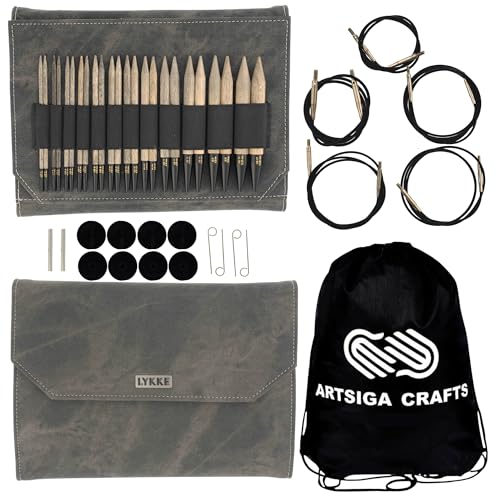

The cables included with these sets are surprisingly flexible for a wood-based system. They allow for a gentle magic loop, though they won’t be as supple as the thin steel cables found in dedicated lace sets.
These are best suited for knitters who prefer a slower, more controlled pace. Because wood needles have more friction than metal, they are excellent for slippery fibers like silk or bamboo blends.
Clover Takumi Bamboo: Lightweight and Grip-Friendly
Clover Takumi needles are a staple in many beginner kits for a reason: they are incredibly lightweight and forgiving. The bamboo surface provides a natural grip that helps maintain even tension, especially when working with slick, superwash wools.
The cables on these needles are functional and sturdy, though they do have more "memory" than steel options. You may find yourself needing to straighten them with a quick dip in warm water before starting your project.
These are an affordable entry point for those wanting to try magic loop without investing in a premium set. They are not as fast as steel, but they offer a level of stability that can make learning the technique much less intimidating.
Kollage Square Needles: Ergonomic Cable Solutions

Kollage square needles are designed with ergonomics in mind, featuring a flat-sided profile that is easier on the hands. The square shape can help improve stitch consistency, as it forces a slightly different tension than a traditional round needle.
The cables used for these needles are specifically engineered to be soft and flexible, complementing the ergonomic nature of the tips. They are excellent for knitters suffering from arthritis or hand fatigue.
Because the needles have a unique shape, they do require a slight adjustment period. Once you find your rhythm, however, the combination of the square tip and the supple cable makes magic loop feel remarkably effortless.
Key Factors for Selecting Magic Loop Cable Lengths
For magic loop, the length of your cable is just as important as the needle material. You generally need a minimum of 32 to 40 inches to comfortably accommodate the loop and the working stitches.
- 32 inches: Good for small circumferences like socks or mittens.
- 40 inches: The "Goldilocks" length for most magic loop projects, including hats and sleeves.
- 47+ inches: Ideal for sweaters or large cowls where you need extra room to maneuver.
If your cable is too short, you will find yourself fighting the tension of the cord, which leads to "laddering"—those unsightly vertical gaps between stitches. Always err on the side of a longer cable; you can always manage excess, but you cannot create length where there is none.
Why Cable Memory Matters for Small Circumferences
Cable memory refers to the tendency of a cord to retain the shape it held while packaged. When a cable is "coily," it exerts outward pressure on your stitches, making it difficult to keep your tension consistent.
This pressure is the primary cause of uneven stitches in magic loop. If your cable is constantly trying to spring back into a circle, you will spend more energy controlling the cord than you will actually knitting.
To test a cable, hold it by the needle tips and let it hang; if it stays coiled, it will likely fight you during magic loop. Look for cables labeled "memory-free" or those made from soft, multi-strand steel to ensure a smooth knitting experience.
Essential Maintenance Tips for Needle Cable Care
To keep your cables in top shape, avoid storing them in extreme temperatures. Heat can make some plastic cables tacky or brittle, while extreme cold can cause them to become stiff and prone to cracking.
Periodically clean your cables with a damp cloth to remove oils and dust. A buildup of grime can make the join feel "sticky," causing stitches to snag even if the needle-to-cable transition is perfect.
If your cable has a stubborn kink, soak it in a bowl of warm (not boiling) water for a few minutes. Gently straighten it while it cools, and it should return to a flexible, manageable state for your next project.
Finding the perfect magic loop setup is a journey of trial and error, but focusing on cable flexibility is the most reliable shortcut to success. Whether you prefer the surgical precision of steel or the comfort of wood, prioritize tools that minimize resistance. Once you have a cable that moves with you rather than against you, you will find that even the smallest circumferences become a joy to knit. Happy stitching!