6 Best Storage Boxes For Button Collections To Organize
Keep your button collection neat with our top six storage picks. We evaluate durability and layout to help you organize your sewing supplies with ease.
Every knitter eventually reaches the point where their button jar overflows, turning a source of creative inspiration into a disorganized mess. Finding that perfect, vintage mother-of-pearl toggle for a finished cardigan shouldn’t require digging through a mountain of mismatched plastic shanks. These storage solutions help you categorize your findings so you can focus on your stitches instead of hunting for hardware. Properly sorted buttons are the secret to finishing your garments with the professional polish they deserve.
Iris USA Plastic Craft Organizer: Best Overall


This organizer is the gold standard for those of us who view buttons as a foundational part of our stash. Its modular design allows you to see exactly what you have at a glance, which is vital when you’re trying to match a button to the specific sheen of a hand-dyed merino yarn.
The clear plastic construction is a major advantage for color-matching. If you are working on a stranded colorwork yoke, you need to see the tonal variations in your buttons immediately to ensure they don’t clash with your main color.
The trade-off here is the depth of the compartments. While perfect for standard shirt buttons or small wooden toggles, they might struggle with chunky, oversized statement buttons often used on thick, bulky-weight cowls.
ArtBin Super Satchel Box: Best For Large Stashes
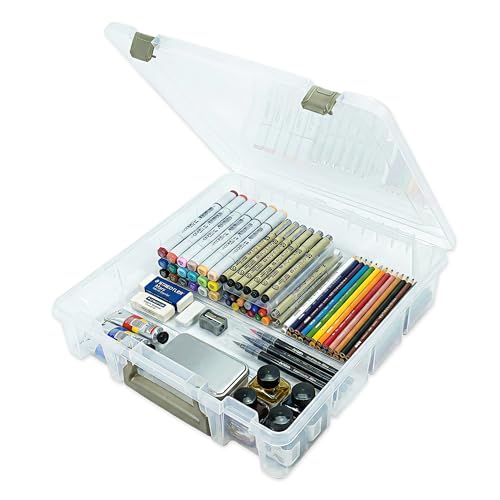
If your button collection has grown into a small library, the ArtBin Super Satchel is the only way to maintain sanity. It offers a massive amount of surface area, which is essential if you organize your buttons by color or size rather than by style.
I often recommend this for knitters who harvest buttons from thrifted garments. You need a dedicated, deep space to toss "unknowns" before you take the time to sort and clean them later.
The sheer size can be a drawback if you lack dedicated shelf space. It isn’t a portable project bag companion, so keep this for your home studio rather than your knitting circle meetups.
Darice Bead Storage Containers: Best For Sorting

These small, individual screw-top jars are a lifesaver for the meticulous knitter. If you have a collection of delicate, vintage glass or antique metal buttons, keeping them separated prevents scratching and chipping.
The individual containers mean you can pull out just the "blue" or "wood" set without dragging your entire collection across the table. It’s perfect for when you’re auditioning buttons against a swatch to see how they interact with the fabric’s texture.
Be mindful that these jars are small. They are not suitable for large, heavy horn buttons, which can get stuck or simply not fit through the narrow openings.
Plano 3700 StowAway Utility: Best Durable Option

Originally designed for fishing tackle, this box is incredibly rugged and built to withstand years of use. For the knitter who travels frequently or carries their "finishing kit" to workshops, the locking mechanism is far more secure than standard craft boxes.
The adjustable dividers allow you to customize the size of your compartments. This is ideal if you have a mix of tiny glass beads and massive, chunky wooden toggles that need different footprint requirements.
The plastic is quite thick, which makes it heavy. If you’re already hauling a heavy project bag filled with yarn cakes and multiple sets of interchangeable needles, consider if you have the weight capacity for this extra gear.

Muji Polypropylene Case: Best Minimalist Choice
For the knitter who prefers a clean, uncluttered workspace, Muji cases offer a sleek and uniform aesthetic. They stack perfectly, turning a chaotic pile of buttons into a neat, professional-looking filing system.
The semi-transparent finish keeps your buttons visible but mutes the visual noise. This is a great choice if your craft room doubles as a living space and you want your supplies to look like decor rather than clutter.
The downside is the lack of locking latches on some models. If you tip your bag over, you might find yourself with a floor full of buttons, which is a disaster if you have pets or small children.
Creative Options Pro-Latch: Best Secure Storage
The Pro-Latch system is designed to stay shut no matter how much you jostle it. If you are the type of knitter who keeps a "finishing kit" in their car or project bag, this is the safest way to store your buttons.
I appreciate the reliability of the latches. There is nothing more frustrating than arriving at a knitting retreat only to find your carefully curated button collection scattered across the bottom of your tote bag.
The internal compartments are fixed, which limits your flexibility. You cannot change the layout to accommodate larger items, so this is best for uniform collections rather than a "junk drawer" style stash.
How to Categorize Your Buttons for Easy Access
The best way to categorize your buttons depends entirely on how you shop for them. I suggest starting by sorting by material—wood, metal, plastic, and natural shell—as these often dictate the care required for the finished garment.
Once you have your categories, consider sub-sorting by size. When you are blocking a finished sweater, you need to know exactly which buttons fit through your buttonholes without stretching the fabric.
- Size: Sort by diameter (e.g., 10mm, 15mm, 20mm).
- Material: Keep natural fibers like wood and horn separate from synthetics.
- Color: Essential for quick aesthetic matches.
Protecting Vintage Buttons From Moisture and Dust
Vintage buttons, especially those made from early plastics like Bakelite or natural materials like bone, are susceptible to environmental damage. Moisture can cause metal shanks to rust, which will eventually stain your hand-knit wool.
Keep a small silica gel packet inside your storage box to absorb ambient humidity. This is especially important if you live in a humid climate or store your buttons in a basement craft room.
Avoid storing your collection in direct sunlight. UV rays can cause vintage plastics to become brittle or change color, ruining the patina that makes those buttons so special in the first place.
Why Material Matters When Storing Antique Buttons
Antique buttons are often made of materials that react poorly to one another. For example, some vintage plastics can "off-gas" over time, which may damage or corrode nearby metal buttons.
Natural materials like mother-of-pearl or bone are porous. If they are stored against a piece of cheap, oily plastic, they can absorb those chemicals and lose their natural luster over time.
When in doubt, store your most precious, antique, or natural-material buttons in individual acid-free bags before placing them in your organizer. It’s an extra step, but it protects the integrity of your hard-won collection.
Essential Tips for Organizing a Growing Collection
Don’t try to organize your entire collection in one sitting. It’s a project best done in small, quiet moments—perhaps while you are working on a mindless stockinette project that doesn’t require constant counting.
Label your containers clearly. Even if you think you’ll remember where the "wooden toggles" are, six months from now, you’ll be glad you took the time to stick a label on the box.
Finally, be ruthless about weeding out buttons you truly don’t love. If a button is damaged or doesn’t fit your aesthetic, pass it along to a younger knitter or a local school art program to keep your own stash focused and usable.
Organizing your button collection is an act of care for your future knitting projects. By investing in the right storage, you ensure that your hard-earned buttons remain in pristine condition for years to come. Take your time to sort them, keep them protected, and enjoy the ease of having the perfect finishing touch at your fingertips. Your finished sweaters will thank you for the extra attention to detail.