7 Best Blocking Boards For Drying Finished Projects
Discover the 7 best blocking boards to perfect your crochet and knitting. Learn how these essential tools ensure professional, symmetrical results every time.
You’ve spent weeks selecting the perfect yarn, managing your tension, and weaving in those final ends, only to find your project looks a bit uneven off the needles. Blocking is the transformative step that turns a "handmade" garment into a professional-quality piece of knitwear. Choosing the right surface for this process is just as critical as choosing your needles. Here are the top seven blocking mats to help your stitches bloom and your edges lie perfectly flat.
Knitter’s Pride Lace Blocking Mats: Best Overall


These mats hit the sweet spot between density and flexibility, making them a staple in many experienced knitters’ toolkits. They offer enough resistance to hold T-pins firmly, yet they aren’t so hard that your hands ache after a long session of pinning out a complex shawl.
The surface texture is specifically designed to grip delicate fibers like lace-weight alpaca or mohair without snagging. Because they are moisture-resistant, you won’t have to worry about them warping or retaining odors after a wet-blocking session.
While they are excellent for most projects, they aren’t the thickest mats on the market. If you are pinning down a heavy, water-logged wool sweater, you might find the pins occasionally pierce through the back.
Grassland Foam Blocking Tiles: Best for Large Knits
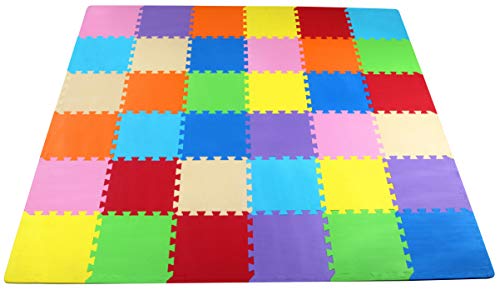
When you are working on a full-sized blanket or a heavy cabled sweater, you need a vast, modular surface that won’t shift under the weight of the fabric. These tiles interlock securely, creating a seamless landscape that can be expanded to fit even the largest afghans.
The thickness of these tiles is a major advantage for heavy-duty blocking. You can push your pins in at an angle to create extra tension, which is essential for opening up tight, dense cables that might otherwise look bunched up.
The tradeoff here is storage space. Because they are quite thick and bulky, they are less ideal for a knitter living in a small apartment who needs to tuck their tools away in a closet.
Cocoknits Blocking Board: Best for Precision Work

If you are a knitter who obsesses over symmetry and exact measurements, this board is a game-changer. It features a unique, printed grid system that allows you to align your pieces with mathematical accuracy, ensuring both sleeves of a sweater are identical in length.
The material is firm and dense, which provides a satisfying "pop" when you insert a pin. It is particularly useful for blocking small, intricate pieces like lace motifs or individual sweater panels before seaming.
It is a premium investment, and the surface area is smaller than a full-floor mat system. It won’t be your go-to for a king-sized blanket, but for garment construction, it is unmatched.
Boye Interlocking Foam Mats: Best Budget Choice

You don’t need to spend a fortune to get a functional blocking surface. These foam mats are widely available and do exactly what they claim: provide a soft, pinnable area for your finished projects to dry.
They are lightweight and easy to rearrange, making them perfect for beginners who are just starting to experiment with blocking. They work well for scarves and cowls, where you don’t need a massive amount of surface area.
The main drawback is durability; over time, the foam can start to crumble or lose its "grip" on pins after repeated use. Think of these as a reliable entry-level tool that will serve you well until you decide to upgrade.
ArtBin Foam Blocking Tiles: Best Durable Option
ArtBin tiles are known for their high-density foam construction, which resists the wear and tear of constant pinning and unpinning. If you block projects every single week, you will appreciate how well these hold their shape over time.
They are resistant to moisture, which is vital when you are blocking superwash wools that hold a significant amount of water. You won’t have to worry about the foam degrading or becoming "spongy" after a few months of heavy use.
They are slightly firmer than other options, which means you’ll need a bit more force to insert your pins. However, this firmness is exactly what keeps your edges crisp and straight during the drying process.
KnitIQ Blocking Mats: Best for Grid Alignment
KnitIQ mats come with a printed grid that is incredibly helpful for visual learners and those who struggle with "eyeballing" their blocking. When you are trying to stretch a shawl into a perfect crescent, having those lines as a guide is invaluable.
The mats are thick enough to hold long T-pins securely without the points poking out the bottom. This adds a layer of safety and convenience, especially if you are blocking on a dining room table and want to avoid scratching the surface.
The grid is printed clearly, but be mindful of color transfer. While rare, it is always a good idea to lay a thin white towel over the grid if you are working with very pale, delicate fibers.
Susan Bates Knit-Check Mat: Best Compact Surface
Sometimes you only need to block a small swatch or a single glove, and dragging out a massive mat system is overkill. The Susan Bates Knit-Check is a compact, portable surface that is perfect for those quick, small-scale blocking tasks.
It is incredibly easy to store in a project bag, making it a favorite for knitters who travel to retreats or workshops. It’s the ultimate "on-the-go" tool for ensuring your gauge swatches are accurate before you dive into a large garment.

Because of its size, it is obviously not suitable for full-sized sweaters or large shawls. It is a niche tool, but one that fills a specific gap in a knitter’s collection perfectly.
Why Blocking Is Essential for Finished Projects
Blocking is the final act of knitting, and it is where the "magic" happens. When you block, you are essentially relaxing the fibers, allowing them to settle into their final shape and evening out any slight irregularities in your tension.
For lace, blocking is non-negotiable; it opens up the yarn-overs and reveals the hidden architecture of the pattern. Without it, a lace shawl will look like a crumpled, dense mess rather than the airy, delicate fabric it was meant to be.
Even for stockinette garments, blocking helps the fabric drape correctly and ensures that your seaming will be much easier. It turns individual stitches into a cohesive, professional-looking textile.
How to Choose the Right Blocking Mat Material
When shopping for mats, always look for high-density, closed-cell foam. This material is moisture-resistant, meaning it won’t soak up the water from your wet project and harbor mold or mildew.
Consider the thickness of the mat in relation to your pins. If you use heavy-gauge T-pins, you need a mat that is at least half an inch thick to provide enough "bite" for the pin to stay anchored.
Avoid soft, low-density foam that feels like a yoga mat, as it often lacks the structural integrity to hold tension over several days. You want a surface that feels firm to the touch, ensuring your project stays exactly where you pinned it.
Pro Tips for Achieving Professional Blocked Edges
- Use T-pins, not sewing pins: T-pins have a larger head and a thicker shaft, providing the necessary leverage to hold heavy, wet wool in place.
- Don’t overstretch: Only stretch your project as much as the fiber naturally wants to go; overstretching can permanently distort the stitch definition and cause the fabric to sag.
- Use a blocking wire for straight edges: If you are blocking a scarf or a sweater panel, threading a stainless steel blocking wire through the edge stitches will give you a perfectly straight line that pins alone cannot achieve.
- Let it dry completely: Never remove your pins until the project is 100% dry; removing them early can cause the fibers to "snap back" and ruin the shape you’ve worked so hard to set.
Investing in a quality blocking surface is one of the smartest decisions you can make to elevate your knitting. Whether you choose a grid-heavy board for precision or large tiles for massive blankets, the right tool will make the process feel like a rewarding ritual rather than a chore. Take your time, pin with care, and enjoy watching your beautiful handiwork reach its full potential.