
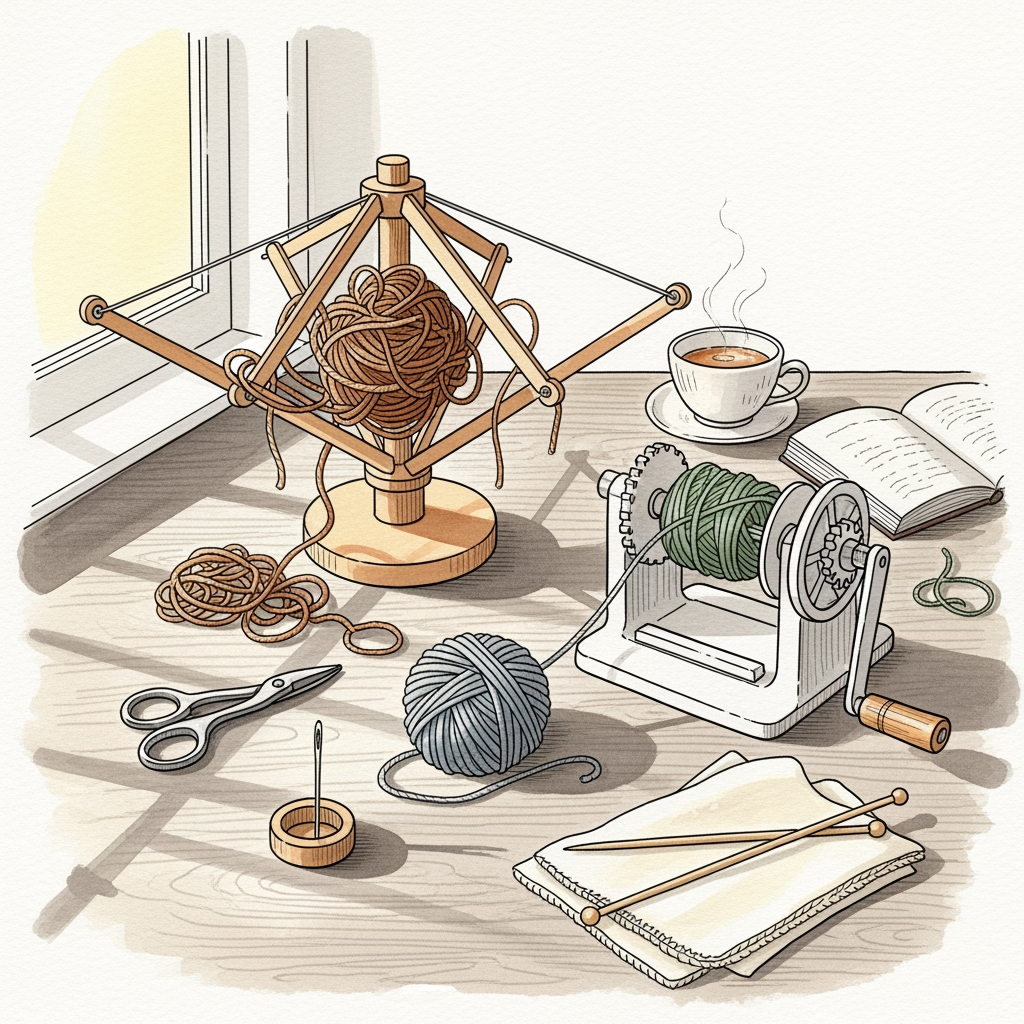
7 Best Swift Stands For Winding Hanks To Try
Discover the top 7 swift stands for winding yarn hanks. We compare durability, ease of use, and stability to help you find the perfect tool for your stash.
Transitioning from store-bought yarn cakes to luxurious hand-dyed hanks is a rite of passage for every knitter. However, managing those long, tangled loops of fiber without a proper swift can quickly turn a relaxing evening into a frustrating battle with knots. A quality swift acts as your extra set of hands, holding the yarn under consistent tension so you can wind it into neat, usable balls. Choosing the right tool depends on your space, your budget, and how often you find yourself falling in love with beautiful, untwisted skeins.


Stanwood Needlecraft Tabletop Swift: Best Overall
The Stanwood tabletop swift is the gold standard for many serious knitters because of its rock-solid construction and smooth rotation. It features a metal clamp that secures firmly to almost any table edge, preventing the wobbly "walking" sensation that plagues cheaper plastic alternatives.

When you are winding a delicate lace-weight mohair or a heavy, multi-ply wool, consistent speed is vital to prevent snagging. The Stanwood’s ball-bearing mechanism ensures the swift spins freely with the slightest pull of the yarn. This reduces the risk of the yarn catching on a rough edge, which can cause uneven tension or, in the worst cases, snapped fibers.
While it is an investment, the durability of the metal and wood components means it will likely be the last swift you ever need to buy. If you frequently work with expensive, hand-dyed yarns, the peace of mind provided by this smooth, reliable tool is well worth the upfront cost.

Amish Style Wooden Swift: Best Eco-Friendly Pick
If you prefer a natural aesthetic or lack a suitable table edge for clamping, the Amish style swift is a brilliant, low-tech solution. These swifts sit directly on your tabletop or floor, relying on a wide, stable base rather than mechanical tension.
Because they are usually crafted from unfinished or lightly oiled wood, they have a tactile, heirloom quality that feels right at home in a cozy knitting nook. They are also incredibly easy to disassemble and store flat in a drawer, making them perfect for knitters with limited space.
The primary tradeoff is that they require a bit more manual oversight during the winding process. Because they don’t have the high-speed ball bearings of a metal umbrella swift, you’ll need to keep a closer eye on the tension to ensure the yarn doesn’t slip off the arms.
Lacis Wooden Umbrella Swift: Best Classic Design
The Lacis umbrella swift is a nod to traditional craftsmanship, often favored by knitters who appreciate the mechanical beauty of a classic design. It functions exactly like an umbrella, expanding and contracting to accommodate hanks of various circumferences.
Its wooden construction is gentle on delicate fibers like silk or alpaca, which can sometimes be damaged by the sharp edges of cheaper plastic tools. The action is smooth and rhythmic, allowing you to establish a meditative pace while you wind your stash.
However, these swifts require a bit of maintenance to keep the wooden joints moving freely. A quick wipe-down with a wood-safe wax or oil every few months will prevent the arms from sticking, ensuring your winding sessions remain smooth and snag-free for years.
KnitPicks Yarn Swift: Best Value for Beginners
For the knitter who is just starting to venture into the world of hanks, the KnitPicks swift offers a functional, no-frills experience at an accessible price point. It is lightweight and easy to set up, making it a great entry-level tool for those who aren’t ready to commit to a high-end wooden model.
It uses a standard umbrella mechanism that effectively holds hanks of most sizes. While it is made of lighter materials than professional-grade swifts, it is perfectly capable of handling standard worsted or DK weight yarns without issue.
If you are a casual knitter who only winds a few hanks a month, this is a practical choice that gets the job done. Just be mindful not to force the tension; keep your winding speed moderate to protect the plastic components from unnecessary stress.
Strauch Jumbo Ball Winder and Swift: Best Heavy Duty
If you are a prolific knitter who buys yarn in massive quantities or frequently works with heavy, bulky-weight fibers, the Strauch system is a powerhouse. This is a tool designed for the serious maker who treats yarn preparation as a professional-grade task.
The jumbo capacity allows you to wind massive skeins into generous cakes without having to stop and restart mid-process. The heavy-duty construction is built to withstand the torque and pressure of winding large amounts of yarn, ensuring that the swift doesn’t buckle or tip over.
The downside is the footprint; this is not a tool you can hide away in a small craft box. It is a dedicated piece of equipment that demands a permanent spot in your studio, but for the knitter who values efficiency above all else, it is unmatched.
Nancy’s Knit Knacks Swift: Best Precision Tool
Nancy’s Knit Knacks is renowned for engineering, and their swift is no exception; it is designed for the knitter who demands absolute precision. These swifts are often built with high-quality materials and tight tolerances that prevent the annoying "wobble" found in mass-produced models.
What sets this tool apart is the attention to detail in how the yarn feeds off the swift. The arms are designed to minimize friction, which is essential when you are working with high-twist yarns that have a tendency to kink or snarl if the tension isn’t perfect.
If you are a perfectionist who tracks your gauge meticulously and avoids even the slightest inconsistency in your yarn, this tool is designed for you. It turns the chore of winding into a precise, satisfying mechanical process.
ChiaoGoo Yarn Swift: Best Portable Design Choice
ChiaoGoo is a brand known for understanding the realities of modern knitting, and their swift is designed with portability in mind. If you attend knitting retreats or frequently travel to fiber festivals, this is the tool you want in your bag.
It is compact, lightweight, and engineered to collapse into a very small profile without sacrificing stability. Despite its small size, it holds a surprisingly wide range of hank sizes, making it versatile enough for everything from a tiny lace remnant to a large sweater quantity of wool.
It is a fantastic option for the "knitting nomad" who needs a reliable tool that can be packed away in a suitcase or project tote. While it might not be as heavy-duty as a permanent studio installation, its convenience and design efficiency are second to none.
How to Properly Setup Your Swift for Winding Hanks
Proper setup begins with ensuring your swift is securely anchored to a stable surface. Before you place your yarn, expand the swift arms just enough so that the hank hangs loosely; you should be able to insert your hand between the yarn and the swift arm with ease.
If you stretch the hank too tightly, you risk over-stretching the fibers, which can ruin the "bounce" of wool or distort the drape of silk. Once the hank is on, remove the ties—usually two or three pieces of scrap yarn—that keep the hank in its loop shape.
Always start by finding the two ends of the yarn and securing one to your ball winder. Rotate the swift slowly by hand for the first few turns to ensure the yarn is feeding smoothly and not catching on any stray loops or tangles.
Umbrella vs Amish Style Swifts: Which Suits You?
The choice between an umbrella and an Amish style swift usually comes down to your available space and the type of yarn you use. Umbrella swifts are mechanical, fast, and great for high-volume winding, but they require a sturdy table edge to clamp onto.

Amish style swifts are stationary and sit on a flat surface, making them ideal if you don’t have a table with an overhang or if you prefer a tool that doesn’t involve complex hinges. They are generally quieter and more stable, but they don’t offer the same "spin-on-a-dime" speed as a ball-bearing umbrella swift.
Think about your environment: if you have a dedicated craft desk, an umbrella swift is likely the more efficient choice. If you knit on the coffee table or the kitchen island, an Amish style swift will be much less intrusive and easier to set up on the fly.
Essential Tips for Maintaining Your Yarn Swift Tools
Maintenance is the difference between a tool that lasts a lifetime and one that breaks after a season. For wooden swifts, keep them away from extreme humidity or direct heat sources, as wood can warp and cause the arms to bind.
If your swift uses metal ball bearings, a tiny drop of sewing machine oil once a year will keep the rotation silky smooth. Always inspect the arms for any small splinters or rough patches; even a tiny snag can cause a delicate fiber like cashmere or silk to fray.
Finally, never leave your swift under tension when you aren’t using it. Once you finish your winding session, collapse the arms and remove the tension, as leaving it open can strain the joints and weaken the structure over time.
Finding the right swift is about matching your tool to your specific knitting habits and the types of fiber you love most. Whether you prioritize the speed of a professional-grade umbrella swift or the simplicity of a hand-crafted Amish model, the goal is to make your prep work as effortless as possible. Don’t be afraid to invest in a quality piece, as it will save you countless hours of untangling and allow you to focus on what really matters: the stitches. Happy winding, and may your yarn always flow freely from your swift to your needles.
