6 Best Loom Row Counters for Complex Patterns
Master complex patterns with ease. We review the 6 best loom row counters, highlighting features that ensure accuracy and efficiency for every weaver’s project.
When you are deep into a complex lace chart or a multi-repeat cable pattern, losing your place is the fastest way to derail your progress. A reliable row counter acts as a silent partner, ensuring you don’t have to keep a running tally in your head while managing yarn overs and decreases. Choosing the right tool depends on your personal knitting style and how much you prefer to interact with your gear. These six counters are the gold standard for keeping your project on track, regardless of complexity.
Knitters Pride Knitter’s Kacha Kacha Counter


The Kacha Kacha is a favorite among knitters who prefer a tactile, audible confirmation that their row has been recorded. It features a simple push-button mechanism that produces a satisfying "kacha" sound, confirming the count without you needing to look down.
This counter is particularly useful when you are working on projects with dark or fuzzy yarns like mohair, where seeing your stitches clearly is difficult. Because it is a standalone clicker, it doesn’t add weight to your needles, which is a major plus if you are knitting a heavy sweater on thin needles.
However, the button can occasionally be depressed accidentally if it’s rattling around loose in your project bag. I recommend keeping it in a dedicated notions pouch or tethering it to your project bag to ensure your count stays accurate.
Clover Kacha-Kacha Knitting Row Counter
Clover’s version of the clicker is remarkably similar to the Knitters Pride model, offering a consistent and reliable experience for the user. It is built with a sturdy plastic casing that withstands the inevitable drops and tumbles that occur in a busy knitting life.
The primary advantage here is the locking mechanism, which prevents the counter from accidentally advancing. If you are the type of knitter who keeps their project in a crowded tote bag, this feature is essentially non-negotiable.
It is a straightforward, no-nonsense tool that does exactly what it promises. It won’t win any fashion awards, but it will survive years of heavy use without failing you mid-project.
CocoKnits Maker’s Keep Magnetic Counter
The Maker’s Keep is less of a simple counter and more of a comprehensive project management system. It functions as a slap-bracelet that stores your needles and notions, with a magnetic row counter that sits right on your wrist.
Having the counter on your wrist is a game-changer for knitters who suffer from "hand-off" fatigue. You don’t have to reach for a tool on the table; you simply tap the counter with your thumb while holding your needles.
The magnetic nature of the tool means you can also use it to hold your darning needles or stitch markers. Just be mindful if you work with delicate electronics, as the strong magnet should be kept away from tablets or phones.
Susan Bates Handheld Mechanical Counter
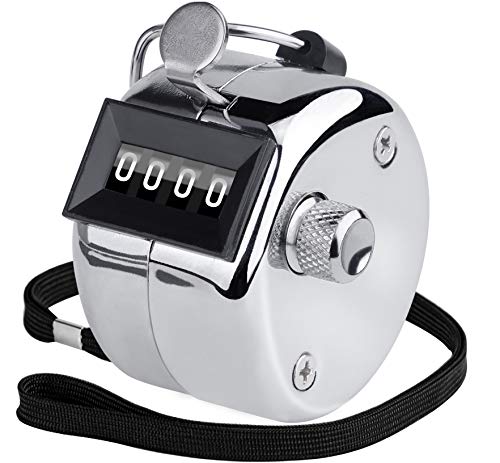
For those who prefer a traditional, old-school approach, the Susan Bates mechanical counter is a classic for a reason. It features a rotating dial that tracks up to 99, making it ideal for long, repetitive projects like blankets or shawls.
The beauty of this tool lies in its mechanical simplicity. There are no batteries to die and no screens to go dark, meaning it will function perfectly for decades if you treat it well.
It is a bit bulkier than modern digital options, which can be a drawback if you like to travel light. However, if you are working on a large-scale project at home, its durability and ease of use are unmatched.
Row Counter Ring by ChiaoGoo Accessories

The ChiaoGoo ring counter is a brilliant piece of engineering for the minimalist knitter. It sits directly on your finger like a piece of jewelry, allowing you to advance the count with a quick flick of your thumb.
Because it is always on your hand, you are far less likely to forget to count your row. It is perfect for those who knit in short bursts—perhaps while waiting for the bus or during a quick lunch break—where you might otherwise lose track of your progress.
The downside is that it can be tight on some fingers, and the small buttons can be tricky if you have limited dexterity. If you find it fits well, however, it is arguably the most seamless way to integrate counting into your natural knitting rhythm.
Digital Finger Row Counter by Knit Picks

Digital finger counters are the modern standard for many, offering a clear LCD display that is easy to read even in low light. These devices are incredibly lightweight and strap onto your finger with an adjustable band.

The reset button is usually the most important feature to look for, as you don’t want to accidentally clear your progress halfway through a complex repeat. Always test the sensitivity of the button before you start a project; some are very prone to accidental clicks.
These are excellent for knitters who struggle with the tactile clickers or who need a large, backlit display. Just remember to carry a spare battery, as the screen will eventually fade when you least expect it.
Why Mechanical Counters Beat Digital Apps
While smartphone apps are convenient, they often force you to break your flow by putting down your needles to tap a screen. Mechanical counters allow you to keep your eyes on your work and your hands on your needles.
Apps are also prone to crashing or locking your phone screen, which is a major frustration when you are in the middle of a tricky lace chart. A physical counter is a dedicated tool that is always ready, never requires a password, and won’t distract you with notifications.

There is also something to be said for the tactile ritual of clicking a counter. It marks the completion of a row, providing a sense of accomplishment that a digital screen simply cannot replicate.
How to Track Rows in Complex Lace Patterns
When working on complex lace, I highly recommend using a counter in tandem with a written tally on your chart. The counter tracks your total row count, but the tally helps you keep track of where you are within a specific 12-row repeat.
If you are working with a chart that includes both right-side and wrong-side rows, make sure your counter is set to track every row, not just the patterned ones. It is easy to assume you only count the "active" rows, but this is the most common way to get lost in a pattern.
Always double-check your count at the end of every repeat. If your stitch count doesn’t match the pattern requirements, you know immediately that you missed a click on your counter.
Integrating Counters Into Your Daily Workflow
The secret to successful row counting is consistency. You must make the act of clicking the counter a part of the "finishing" motion of your row, just like moving your yarn to the front or back.
If you find yourself forgetting to click, try placing your counter in a specific spot—like right next to your project bag or attached to your needle case. You need a visual cue that reminds you to engage the tool the moment you finish your last stitch.
Don’t be afraid to use multiple counters if your project is particularly complex. Use one for the total row count and another for the specific number of repeats you have completed.
Troubleshooting Common Row Counter Errors
The most common error is the "phantom click," where you accidentally advance the counter while moving your project. If this happens, don’t panic; simply look at your work to see if your progress matches the counter.
If you realize you have been off by a row or two, use your stitch markers to count the rows you have actually completed. It is often easier to recount the physical stitches than to try and guess where you went wrong based on the counter alone.
Finally, if a mechanical counter starts to stick or skip, a tiny puff of air or a gentle clean can often fix the issue. Never force a button that feels stuck, as this can break the internal gears and render the tool useless.
Finding the right row counter is a personal journey that depends as much on your hand size as it does on your knitting style. Whether you choose the reliable click of a Kacha Kacha or the modern convenience of a finger ring, the best tool is the one you actually remember to use. Trust your intuition, keep your tools handy, and don’t let a lost row ruin your rhythm. Happy knitting, and may your stitch counts always be accurate.