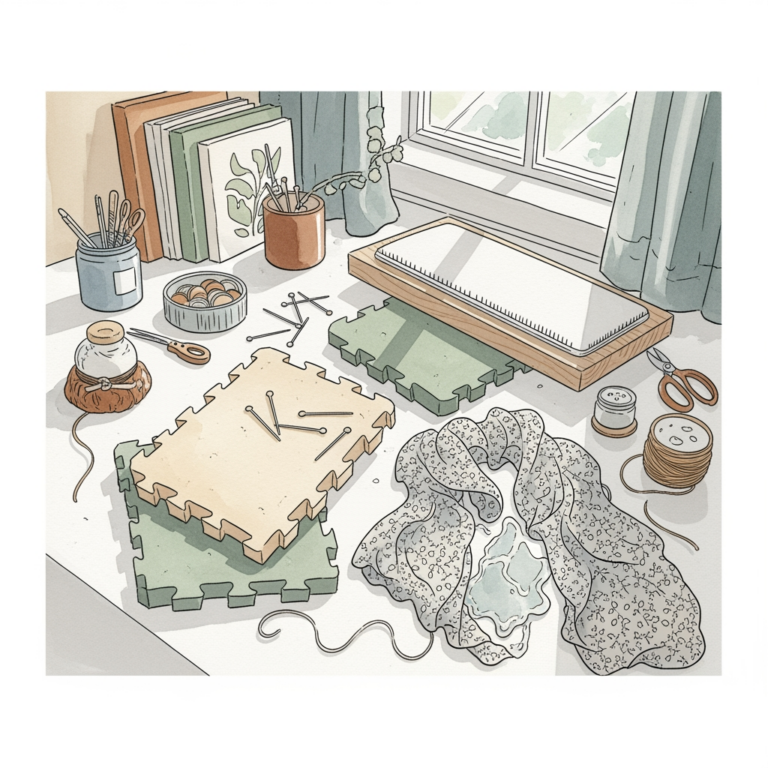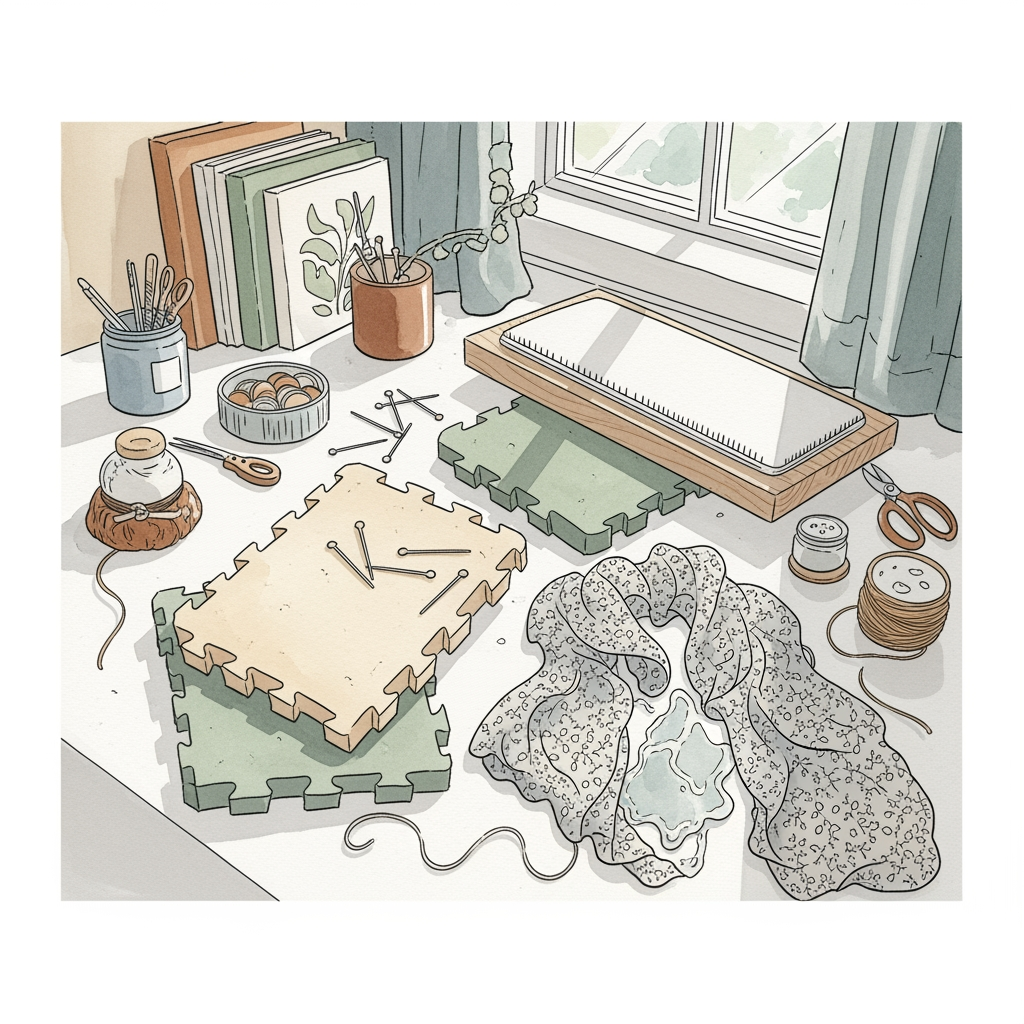
6 Best Blocking Mats With Grid Lines For Precision
Achieve perfect symmetry in your knitting projects with our top 6 grid-lined blocking mats. Discover durable, precise tools for professional-grade results.
Blocking is the final, transformative step that turns a puckered, uneven piece of knitting into a professional-grade garment. Without a reliable surface, your hard-earned stitches can end up lopsided or improperly sized after a wash. Choosing the right blocking mat with clear grid lines is the difference between guessing your dimensions and achieving perfect symmetry. This guide explores the best tools to help you master the art of the perfect block.
Knitter’s Pride Knit Blockers and Mats Set


The Knitter’s Pride set is a favorite because it treats blocking as a structural engineering task rather than just pinning fabric to foam. By combining high-density mats with their signature "knit blockers"—plastic combs with multiple pins—you save significant time compared to individual T-pins.
If you are blocking a large lace shawl, the ability to anchor long edges in one motion is a game changer. You won’t have to worry about the fabric shifting between individual pin points, which is a common frustration when working with delicate mohair or fine lace-weight yarns.
The mats themselves are sturdy, though they do require a bit of space for storage. If you work primarily on small accessories, the footprint might feel large, but for the serious garment knitter, this is a top-tier investment.
Clover Blocking Mats: Precision and Durability

Clover has built a reputation on consistency, and their blocking mats are no exception. These tiles are designed to lock together seamlessly, creating a flat, reliable plane that doesn’t buckle under the weight of damp, heavy wool projects.
The grid lines on these mats are printed with high-contrast ink that holds up well against repeated moisture exposure. When you are blocking a sweater to specific schematic measurements, having a grid that doesn’t fade after ten uses is vital for maintaining your sanity.
While they are slightly firmer than some cheaper alternatives, this density is a benefit. Pins stay exactly where you place them without wiggling, ensuring your edges remain sharp and your seams align perfectly for assembly.
Exerz Extra Thick Foam Blocking Board Tiles

Sometimes, you need a blocking surface that can handle the aggressive tension required for stubborn fibers like cotton or linen. The Exerz tiles offer an impressive thickness that allows for deep pin penetration without the risk of hitting a hard floor underneath.
This extra depth is particularly useful if you are working with bulky, heavy-gauge sweaters that require a lot of force to stretch into shape. Thinner mats often compress too much, causing pins to lean and distort the edge of your knitting.
The grid lines are clear and easy to read, acting as a built-in ruler for your project. If you struggle with consistent sizing, using these grids to measure your piece while it dries is the best way to ensure both sleeves match perfectly.
Magma Blocking Mats with Printed Grid Lines
Magma mats are designed with the modern knitter in mind, focusing on a balance between portability and surface area. They feature a distinct grid pattern that makes it easy to track increases and decreases on complex cables or lace motifs.
Because these tiles are lightweight, they are excellent for knitters who don’t have a dedicated craft room and need to pack their project away. You can easily clear them off the dining table once the blocking session is done.
The trade-off here is that they are slightly softer than industrial-grade options. While they are perfect for standard wools and blends, be mindful of the pin angle when working with very heavy, water-logged garments to avoid the pins pulling out of the foam.
Darice Interlocking Foam Blocking Boards

Darice boards are a staple in many knitting kits because they offer a no-nonsense, functional solution at an accessible price point. They interlock like puzzle pieces, allowing you to build a surface that fits your specific project dimensions, whether it’s a tiny sock or a massive afghan.
The grid lines are simple and straightforward, which is perfect for beginners who might be intimidated by more complex measurement systems. They provide enough structure to keep your knitting square and help you visualize the final shape of your project.
Keep in mind that these mats are best suited for standard blocking. If you are doing extreme stretching on a regular basis, the foam may eventually show wear at the interlocking edges, so handle the connections with care.
Boye Precision Grid Blocking Mat System

The Boye system is designed for knitters who demand high precision and repeat results. The grid layout is exceptionally clear, making it a great choice for those who are blocking items with geometric patterns or intarsia blocks that need to be perfectly square.
The surface material is quite grippy, which helps prevent your knitting from sliding around while you are trying to insert your pins. This is especially helpful if you are working with slippery fibers like silk or bamboo, which tend to shift if you breathe on them the wrong way.
This system is an excellent middle-ground option for those who want professional results without the premium price tag of high-end specialty sets. It is a reliable, durable workhorse that will serve you well for years of projects.
Why Grid Lines Matter for Professional Blocking
Grid lines are not just aesthetic; they are the primary tool for ensuring your finished garment matches the schematic in your pattern. When you knit a sweater, the fabric is inherently stretchy and prone to distortion; blocking to a grid "trains" the fibers to hold their intended shape.
Without a grid, it is nearly impossible to tell if your piece is slightly skewed or if your shoulders are balanced. Even a half-inch difference between two sleeves can make a garment look homemade rather than handmade.
Using the grid allows you to apply tension evenly across the entire surface. By pinning to the same line on both sides of a garment, you guarantee that your final product will have the professional drape and symmetry that define high-quality knitwear.
Essential Tools for Precision Wet Blocking
Beyond the mats, your choice of pinning hardware is just as critical to the final outcome. T-pins are the industry standard for a reason: they are rust-proof and provide a wide surface to hold your knitting firmly in place.
For delicate lace, you might also consider blocking wires, which you thread through the edges of your work to create smooth, sweeping curves. Wires eliminate the "scalloping" effect that can sometimes happen when you use too many individual pins on a long edge.
Always ensure your pins are stainless steel to avoid rust marks on your wet fibers. There is nothing more heartbreaking than finishing a beautiful white lace shawl only to find tiny orange spots where your pins were placed.
Caring for Your Foam Blocking Mat Surfaces
Foam mats are durable, but they are not indestructible, and proper care will extend their lifespan significantly. After every blocking session, wipe the mats down with a damp cloth to remove any residual dye or wool fibers that might have transferred from the yarn.
Avoid storing your mats in direct sunlight or near heat sources, as this can cause the foam to warp or become brittle over time. A cool, dry place is best to keep the interlocking edges tight and the surface flat.
If you find that your mats are starting to pick up odors from wet wool, a light misting of a mild vinegar solution can help neutralize them. Just be sure to let them air dry completely before stacking them back into storage.
How to Properly Pin Your Knits for Shape
The secret to effective blocking is to pin from the center outward, working your way toward the edges. This prevents the fabric from bunching up or becoming distorted as you stretch it to the grid lines.
Start by pinning the corners and the center points of each side to establish your baseline dimensions. Once the piece is anchored, you can fill in the gaps with additional pins to smooth out the edges and highlight your stitch patterns.
Remember that blocking is about relaxing the fibers, not strangling them. You want the fabric to be taut enough to show its shape, but not so stretched that the stitches look thin or the yarn loses its natural elasticity.
Investing in a quality blocking mat with a reliable grid is one of the most impactful upgrades you can make for your knitting practice. By providing a stable, measured foundation, these tools ensure that your hard work results in a beautiful, wearable garment every time. Take the time to choose the mat that fits your specific project needs, and you will see an immediate improvement in the finish of your knits. Happy blocking, and may your edges always be crisp and symmetrical.