6 Best Finishing Needles For Embroidery To Try
Elevate your embroidery with these 6 top finishing needles. Discover the best tools to secure threads and perfect your projects with professional precision.
Finishing your knitting projects is the final, crucial step that transforms a pile of yarn into a polished, professional garment. Whether you are weaving in ends on a complex colorwork sweater or securing a simple garter stitch scarf, the right needle makes all the difference. Choosing an improper tool often leads to split yarn, frustration, or visible tails that ruin your hard work. This guide explores the best finishing needles to ensure your hard-earned stitches remain secure and invisible.
Clover Chibi Bent Tip Tapestry Needles


These needles are iconic for a reason, primarily because of that signature bent tip. When you are working on a dense seam or trying to navigate the back of a tight stitch, that slight curve acts like a hook to guide the needle through without piercing the yarn ply.
The Chibi case is an added bonus, keeping your needles from disappearing into the depths of your project bag. Because they are made of a smooth, nickel-plated steel, they glide through most fibers with minimal friction.
However, be aware that the tips are slightly blunt. While this is perfect for weaving into finished fabric, it can be a struggle if you need to pierce a strand of yarn to anchor a tail securely.
Bohin France Size 18/22 Tapestry Needles

Bohin needles are the gold standard for many professionals because of their superior finish and durability. They feel substantial in the hand and possess a high-quality polish that prevents snagging on delicate fibers like mohair or silk.
The size 18/22 variety pack is incredibly versatile for a stash-building knitter. The larger size 18 handles chunky weight yarns with ease, while the size 22 is fine enough for fingering weight projects without stretching out your finished stitches.
If you find yourself constantly breaking cheaper needles or dealing with rust, the investment in Bohin is well worth it. They are remarkably resistant to bending, even when forced through thick, felted seams.
Dritz Assorted Yarn Darners with Case

Dritz needles are the reliable workhorse you will find in almost any local craft store. They are straightforward, no-nonsense tools that get the job done without any unnecessary flair or high price tags.
The assorted pack is particularly helpful for beginners who aren’t yet sure what yarn weights they will prefer long-term. Having a range of eye sizes allows you to experiment with how different needles interact with your specific tension and yarn choice.
The downside is that they lack the refined, ultra-smooth finish of premium brands. If you are working with sticky, high-twist wool, you might feel a bit of drag compared to a polished steel or nickel needle.
Tulip Hiroshima Tapestry Needle Set
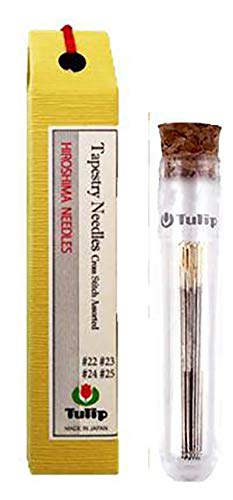
Tulip needles are a luxury experience for the knitter who appreciates fine craftsmanship. These Japanese-made needles have a remarkably smooth surface and a polished eye that protects your yarn from abrasion during the weaving process.
The set comes in a beautiful, convenient tube that keeps the needles organized and protected. Because the steel is high-quality, these needles are stiff and resistant to distortion, which is vital when you are finishing a heavy, cabled cardigan.
While the price point is higher, the longevity and the sheer pleasure of using a perfectly smooth tool make them a favorite for heirloom projects. If you are finishing a project that took you months to knit, don’t skimp on the finishing tool.
Susan Bates Finishing Needles with Eye

Susan Bates needles are often recognized by their unique, elongated eye design. This shape is specifically engineered to hold onto thicker yarns, making them easier to thread than standard needles with small, circular eyes.
They are generally made of a durable, flexible plastic or coated metal. This flexibility can be a major advantage when you need to maneuver around tight corners or awkward angles in a garment’s construction.
Be mindful that the plastic versions can sometimes feel a bit "grabby" against certain synthetic fibers. If you are working with a very slick acrylic, the plastic might feel fine, but for wool, I always prefer their metal options.
CocoKnits Steel Tapestry Needle Set

CocoKnits has mastered the art of the "knitter-friendly" tool, and their steel needles are no exception. These needles are magnetized, which is a brilliant feature for anyone who has ever dropped a needle into a deep-pile carpet and spent an hour searching for it.
The set includes three different sizes, all with a nice, rounded point that is designed to glide between stitches rather than through them. This is essential for preventing the "splitting" of your yarn, which can cause unsightly bumps in your finished work.
The aesthetic is clean and modern, and the storage case is slim enough to fit into any project bag. They are a thoughtful, well-designed choice for the knitter who values both form and function in their toolkit.
Understanding Needle Eye Types for Yarn
The eye of the needle is just as important as the tip when it comes to finishing. A needle with an eye that is too small for your yarn will cause the yarn to fray and thin out as you pull it through the fabric.
Conversely, an eye that is too large can stretch your stitches, leaving visible holes where you have woven in your ends. Always choose an eye that allows the yarn to pass through with just a tiny bit of resistance.
If you struggle with threading, look for needles with elongated eyes or "self-threading" notches. These features can save you significant time and frustration, especially when working with darker yarns or in low-light conditions.
Choosing the Right Size for Your Project
The rule of thumb is to match your needle size to the weight of your yarn. For bulky or super-bulky yarns, you need a large, heavy-duty needle to ensure the yarn tail stays put and doesn’t pull out over time.
For fine yarns like lace or fingering weight, use a smaller, thinner needle to avoid distorting the fabric. If your needle feels too thick for the stitch you are weaving through, you are likely going to create a visible lump in your finished piece.
Always test your needle on a swatch before tackling your final garment. If the needle feels like it is fighting the yarn, step down a size; if it keeps slipping out, step up.
How to Properly Hide Ends in Knitting
Hiding ends is not just about tucking them away; it is about anchoring them so they cannot migrate back to the surface. The best way to do this is to follow the path of the existing stitches in a duplicate stitch pattern.
By mirroring the path of the yarn in your knitting, you effectively "lock" the tail into the fabric structure. This is much more secure than simply weaving the tail back and forth in a straight line, which is prone to loosening with wear.
Never cut your yarn tail too short after weaving it in. Leave at least an inch or two of tail to account for the natural movement and "settling" of the yarn fibers after the first wash and block.
Essential Tips for Securing Your Seams
When sewing seams, the tension of your yarn is just as important as the needle you choose. If you pull your sewing yarn too tight, you will create a stiff, puckered seam that ruins the drape of your garment.
Instead, aim for a tension that matches the gauge of your knitting. You want the seam to be invisible, yet strong enough to hold the weight of the garment without sagging or gaping.
Finally, always weave your ends in on the wrong side of the work. If you are working with a reversible fabric, try to weave your ends into the base of the stitches where they will be naturally hidden by the surrounding yarn plies.
Investing in a quality set of finishing needles is one of the most impactful upgrades you can make for your knitting practice. By matching your tool to your fiber and using the right weaving techniques, you ensure that your projects look as beautiful inside as they do on the outside. Take the time to test these options and find the ones that feel best in your hands. Happy finishing, and may all your ends stay perfectly tucked away.