6 Best Gauge Swatching Rulers For Accuracy
Achieve perfect tension with our top 6 gauge swatching rulers. Discover precision tools designed to ensure your knitting projects fit exactly as intended.
Achieving the perfect fit in a hand-knit garment begins long before you cast on your first stitch. A precise gauge swatch is the bridge between a beautiful yarn and a wearable piece of clothing that actually fits your body. Investing in a quality gauge ruler removes the guesswork that often leads to heartbreaking frogging sessions later on. These six tools provide the accuracy needed to ensure your tension matches the designer’s intent.
Cocoknits Maker’s Keep Gauge Ruler: Best Overall
The Cocoknits Maker’s Keep is a favorite because it integrates seamlessly into the workflow of a busy knitter. It features a magnetic base that keeps your stitch markers secure, but the real star is the sturdy, easy-to-read ruler attached to it.
The ruler itself is made of a durable, matte-finished material that doesn’t glare under harsh lighting. This is a massive advantage when you are counting tiny stitches in dark-colored wool or mohair blends.
Because it is designed to be part of a larger ecosystem of tools, it feels substantial in the hand. If you are the type of knitter who loses small tools in the sofa cushions, this is the reliable anchor you need.
ChiaoGoo Stainless Steel Needle Gauge and Ruler


Stainless steel is the gold standard for durability in knitting tools, and ChiaoGoo delivers a tool that will likely last a lifetime. This gauge is laser-etched, meaning the measurements won’t rub off after years of friction against your yarn.
The needle sizing holes are precise, which is critical if you have a collection of vintage needles with worn-off markings. It also includes a convenient cutout for measuring your gauge in both inches and centimeters.
One minor trade-off is the slickness of the metal. If you are working with very fine lace weight yarn, the metal can occasionally snag if you aren’t careful, though this is rare.
Katrinkles Wooden Stitch Gauge and Ruler Tool
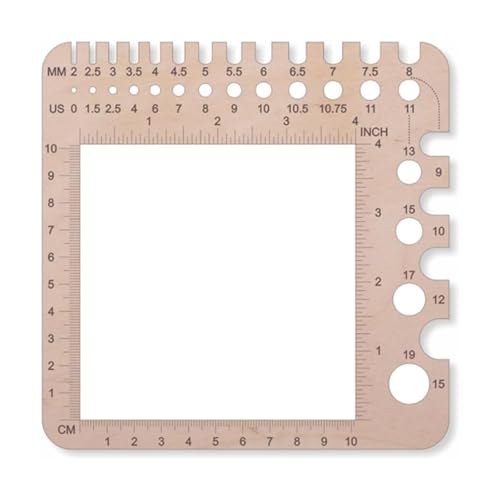
Katrinkles tools are crafted from wood, offering a tactile, organic experience that many knitters prefer over cold metal or plastic. They are lightweight and often feature whimsical designs that make the tedious task of measuring gauge feel like a treat.

Wood has a natural "grip" that helps keep your swatch from sliding around while you count. This is especially helpful if you are working with slippery fibers like silk or bamboo blends that tend to skitter across plastic rulers.
However, keep in mind that wood can warp if left in a humid environment or near a heat source. Treat these tools with the same care you would your favorite wooden knitting needles.
Susan Bates Knit-Check Ruler for Precision
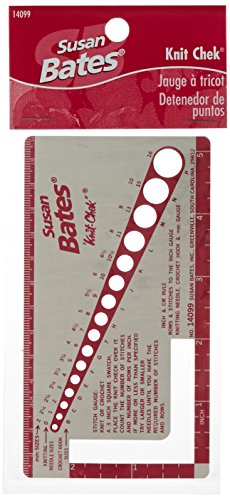
The Susan Bates Knit-Check is a classic for a reason: it is a no-nonsense, highly functional tool that has been in knitting bags for generations. It combines a needle sizer and a gauge window in one compact, lightweight plastic frame.
The "window" cutout is the standout feature here, as it forces you to count stitches through a fixed space. This eliminates the common error of measuring a partial stitch or being inconsistent with your starting point.
While it lacks the aesthetic appeal of boutique wooden tools, its utility is unmatched for the price. It is the perfect "workhorse" tool to keep in your project bag for quick checks on the go.
Fringe Supply Co. Brass Gauge Ruler Tool
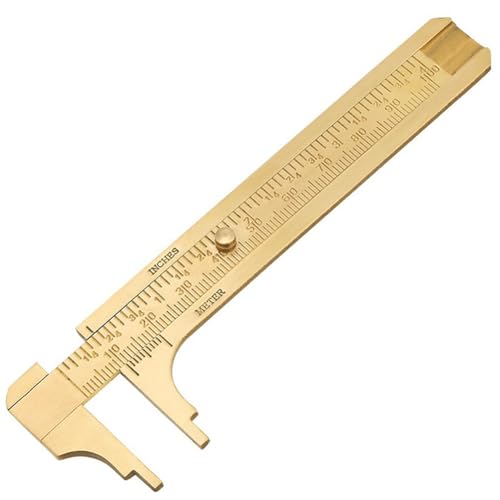
Brass is a beautiful, heavy material that develops a unique patina over time, making this tool feel like an heirloom. The weight of the brass helps hold your swatch flat against the table, which is vital for getting an accurate count.
Because brass is a dense metal, the markings are deeply etched and easy to read. This tool is a joy to use if you appreciate the weight of quality craftsmanship in your hands.
The only downside is that brass can tarnish if exposed to moisture, so it’s best to keep it dry. If you love tools that age with your knitting practice, this is an excellent investment.
Clover Knitting Needle Gauge and Ruler Set

Clover is known for consistency, and their gauge set is no exception. It includes a variety of sizing holes that cover almost every standard needle size, from sock-weight 2.0mm to bulky 10.0mm needles.
The plastic is flexible, which is a benefit if you tend to carry your gauge tool in a crowded project bag. It won’t snap under pressure, and the markings remain legible even after heavy use.
If you are a beginner, this set is the most accessible entry point. It provides everything you need to verify your needle size and your stitch count without requiring a significant financial commitment.
Why Gauge Swatching Is Critical for Fit
Gauge is the foundation of every successful garment; ignore it, and you risk a sweater that is either a tent or a tourniquet. A swatch is a small sample that tells you how your specific tension interacts with the chosen yarn.
Even if you use the exact yarn and needle size recommended by a pattern, your personal knitting style—how you wrap the yarn or hold your needles—will change the outcome. Factors like fiber elasticity also play a huge role.
- Wool: Bounces back and maintains shape.
- Cotton/Linen: Can stretch or "grow" significantly after washing.
- Alpaca: Often drapes more and can lose structure if not knitted at a firm gauge.
How to Use a Gauge Ruler for Accurate Counts
To get an accurate count, you must measure your swatch while it is lying flat on a hard, level surface. Never measure while holding the swatch in your hands, as the weight of the fabric will distort the stitch count.
Place your ruler across the center of your swatch, avoiding the edges where stitches tend to be uneven. Count the number of stitches within the specific inch or centimeter window provided by your tool.
Be sure to count to the nearest half-stitch if possible. If your pattern calls for 20 stitches over 4 inches, and you count 19.5, you may need to adjust your needle size to achieve the correct density.
Common Mistakes When Measuring Your Swatch
The most common mistake is measuring a swatch that hasn’t been blocked. Knitting changes drastically after a soak and a dry, as the fibers bloom and settle into their final configuration.
Another error is counting too few stitches. Always measure over at least four inches, as measuring a single inch can lead to significant cumulative errors across a full garment.
Finally, avoid "stretching" the swatch to meet the pattern’s gauge. If you have to pull the fabric to make the count work, your finished garment will be stiff, uncomfortable, and prone to distorting while worn.
Essential Tips for Blocking Your Test Swatch
Blocking is the process of washing and shaping your swatch to simulate the final garment’s behavior. Use the same water temperature and detergent you intend to use for the finished piece to ensure the fibers react exactly as they will later.
After washing, pin your swatch to a blocking mat, ensuring it is square and not over-stretched. Allow it to dry completely—this can take 24 hours or more depending on the fiber content.
Once dry, measure your gauge again. You will often find that the stitch count changes significantly from the "off-the-needles" state to the "blocked" state. This final measurement is the only one that truly matters for your pattern.
Mastering the art of the gauge swatch is the single most effective way to elevate your knitting from a hobby to a craft. By choosing a ruler that suits your personal style and committing to the blocking process, you ensure that every hour spent knitting results in a garment you are proud to wear. Remember that your tension is unique, and your tools are simply there to help you translate that skill into professional-grade results. Happy knitting, and may your gauge always be spot on.