6 Best Fiber Weighing Scales For Drafting Ratios
Precision is vital in fiber drafting. We review the top 6 scales to help you measure ratios accurately, ensuring consistent quality for your textile projects.
Achieving consistent yarn thickness relies heavily on the precision of your drafting ratios during the spinning process. Whether you are blending luxury fibers or spinning a standard wool top, knowing exactly how much mass you are drawing out is the secret to a perfectly balanced yarn. This guide breaks down the best weighing tools to help you master your spinning consistency. Investing in the right scale transforms your fiber prep from an intuitive guess into a repeatable, professional-grade craft.
My Weigh iBalance 201: Best Overall for Accuracy


When you are spinning delicate luxury fibers like silk or cashmere, even a fraction of a gram can throw off your drafting ratio. The iBalance 201 is widely considered the gold standard for spinners because it offers high sensitivity without the drift found in cheaper models.
Its primary strength lies in its 0.01g readability, which allows you to measure tiny adjustments in your fiber prep. If you are attempting a consistent long-draw technique, having this level of granular data ensures that your fiber supply remains uniform throughout the entire bobbin.
The tradeoff is the size; it is a dedicated piece of equipment that takes up permanent space on your workstation. If you need a scale that stays put and provides unwavering, laboratory-level precision, this is the one to keep on your spinning desk.
American Weigh Scales Blade: Best Portable Scale
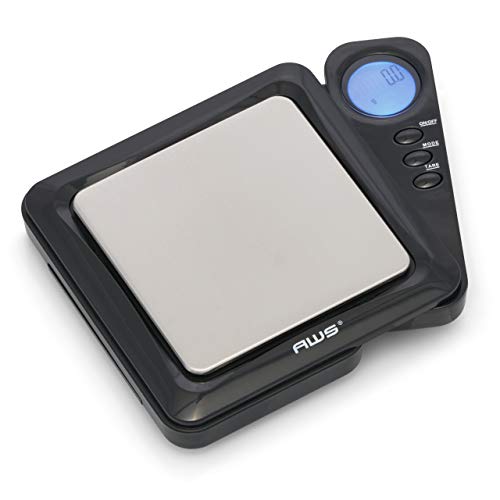
If you belong to a spinning guild or attend fiber retreats, you know the struggle of trying to weigh fiber in a drafty room. The Blade series is designed with a protective cover that doubles as an expansion tray, making it perfect for field use.
It is small enough to tuck into a project bag alongside your spindle or drop-spindle kit. Despite its compact footprint, it handles the weight of a standard wool batt or a few ounces of roving with ease.
Be aware that portability often means a smaller weighing surface. While it is excellent for weighing out individual portions for spinning, it might feel a bit cramped if you are trying to weigh a massive, unrolled batt.
Ohaus Scout Pro: Best Professional Grade Option

The Ohaus Scout Pro is the tool of choice for those who treat spinning as a rigorous science. It is built to withstand heavy, daily use, featuring a high-capacity platform that handles large fiber batches without needing to be recalibrated constantly.
For the production spinner who creates custom-spun yarn for clients, this scale provides the repeatability required for professional labeling. You can trust that the weight you record for a 100-gram skein is accurate down to the milligram, every single time.
It is a significant investment compared to standard kitchen scales. However, if you are scaling up your operation or simply demand the highest tier of engineering, the durability of the Scout Pro is unmatched in the fiber arts world.
Jennings CJ-4000: Best for Larger Fiber Batches
Spinners who work with large-scale projects, such as spinning enough wool for a full-sized sweater, often find standard pocket scales too limiting. The Jennings CJ-4000 offers a generous capacity and a large platform that comfortably holds bulky fiber.
Its standout feature is the fast stabilization time, which means you aren’t waiting for the numbers to stop jumping while you are trying to divide a large batt into equal drafting sections. It is a workhorse that handles the heavy lifting of raw fiber preparation.
The downside is that it is less sensitive to the extremely small, sub-gram increments compared to the iBalance. It is best used for calculating total yardage or dividing large quantities rather than precise micro-blending.
Smart Weigh Digital Pro: Best Value for Spinners

Finding a balance between cost and performance is the biggest challenge for the hobbyist spinner. The Smart Weigh Digital Pro hits that sweet spot by offering reliable accuracy for a price that leaves more room in your budget for high-quality fleece.
It features a backlit display that is easy to read even in the dim lighting of a cozy spinning corner. It is intuitive to use, meaning you won’t spend your spinning time wrestling with complex menus or confusing calibration settings.
While it lacks the heavy-duty casing of the professional models, it is more than sufficient for the average home spinner. If you are looking for a solid, reliable tool that won’t break the bank, this is your best starting point.
GDEALER Digital Pocket Scale: Best Budget Pick

Sometimes you just need a simple, no-frills scale to ensure your hand-spun singles are consistent enough to ply together. The GDEALER pocket scale is incredibly affordable, making it accessible for those just starting their spinning journey.
It is surprisingly accurate for its price point and fits easily into a pencil case or notions bag. This is the perfect "starter" scale for someone who is still learning the mechanics of drafting and doesn’t want to over-commit financially.
Keep in mind that it is a budget tool, which means it may require more frequent calibration checks. Treat it gently, keep it away from moisture, and it will serve you well during your initial experiments with drafting ratios.
Why Precision Matters for Drafting Fiber Ratios
Drafting is the act of pulling fiber from your supply to create a consistent thickness before it is twisted into yarn. If your drafting ratio fluctuates, your yarn will have "thick and thin" spots, which can be an intentional design choice—or a frustrating lack of control.
By weighing your fiber into equal portions before you start, you create a physical anchor for your spinning. If you know you are spinning 5 grams of fiber for every 10 yards of yarn, you can maintain that ratio throughout the entire project.
Consistency is the difference between a "homemade" look and a "handmade" heirloom. Precision tools take the guesswork out of the process, allowing you to focus on the feel of the fiber rather than worrying about the resulting yarn weight.
Understanding Grams vs Grains in Fiber Spinning
In the spinning world, you will often see measurements in both grams and grains. Grams are the standard for most modern spinners, but many traditional patterns or antique spinning wheels reference grains.
- Grams: The metric standard, easy to calculate and widely used on modern scales.
- Grains: A much smaller unit of measurement (1 gram is approximately 15.43 grains), often used for very precise, delicate fiber calculations.
Most digital scales allow you to toggle between these units at the touch of a button. If you are following a pattern that uses an older system, don’t be intimidated; simply set your scale to the correct mode and let the technology do the conversion for you.
How to Calibrate Your Scale for Consistent Drafts
A scale is only as good as its calibration, and even the most expensive models can drift over time. Small changes in temperature, humidity, or even accidental bumps can throw off your readings.
Always keep your calibration weights in a safe place. Most scales come with a specific weight (e.g., 100g or 200g) that you should use to reset the baseline periodically.
If you notice your readings are inconsistent—for example, if a known weight shows up as different values on different parts of the platform—it is time to recalibrate. A quick check before a long spinning session ensures your drafting ratios stay rock-solid.
Essential Tips for Weighing Raw Wool and Batts
When weighing raw wool, remember that fiber is hygroscopic, meaning it absorbs moisture from the air. A batt weighed on a rainy day will weigh more than the same batt weighed on a dry day.
For the most accurate results, try to weigh your fiber in a consistent environment. If you are blending fibers, weigh each component separately before combining them to ensure your blend ratio is exactly what you intended.
Finally, always use a small container or a piece of parchment paper on the scale platform to keep it clean. This protects the sensitive sensors from lanolin, debris, and stray fiber bits that can accumulate over time.
Choosing the right scale is an investment in the quality and consistency of your hand-spun yarn. Whether you opt for a high-end professional model or a budget-friendly pocket scale, the key is to use it consistently to track your drafting ratios. By removing the guesswork from your fiber prep, you allow yourself the freedom to focus on the rhythm and joy of spinning. Happy spinning, and may your bobbins always be perfectly balanced.