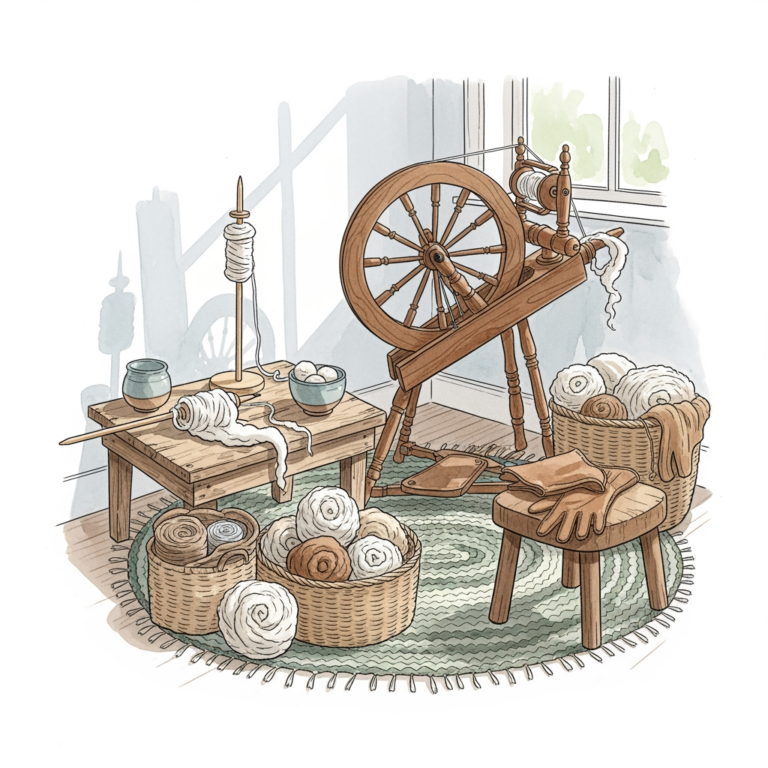
6 Best Lazy Kates For Tensioned Plying To Use Now
Boost your spinning efficiency with these 6 tensioned lazy kates. Discover our top picks for smooth, tangle-free plying and improved yarn consistency today.
Plying your handspun yarn is the moment where all your hard work at the wheel finally comes together into a balanced, usable strand. If you’ve ever struggled with uneven tension or bobbins that spin out of control, you know how frustrating the process can become. A tensioned lazy kate is the secret weapon that transforms plying from a chore into a precise, meditative craft. These tools provide the necessary drag to keep your singles smooth and consistent, ensuring your finished fabric has the drape and structure you envisioned.
Hansen Crafts Tensioned Lazy Kate: Top Choice
The Hansen Crafts model is widely considered the gold standard for serious spinners who demand precision. Its design is incredibly robust, featuring a sophisticated braking system that offers exceptionally fine-tuned control.
When you are plying delicate fibers like silk or high-twist merino, you need a kate that doesn’t jerk the yarn. The Hansen system provides a smooth, consistent drag that prevents the singles from over-twisting or snapping during the plying process.
Because it is engineered with such high tolerances, it handles both small and large bobbins with equal grace. If you prioritize consistency above all else, this is the investment piece that will last a lifetime of spinning.
Ashford Jumbo Tensioned Lazy Kate Review


Ashford has long been a staple in the fiber community, and their Jumbo Tensioned Lazy Kate is a workhorse for those who spin large quantities of yarn. It is specifically designed to accommodate the larger bobbins found on their Jumbo flyers.
The tension mechanism is simple yet highly effective, using a straightforward friction brake that is easy to adjust on the fly. If you are plying bulky art yarns or heavy wools, this kate provides the stability needed to manage the extra weight without tipping over.
While it lacks the ultra-fine adjustments of boutique models, its reliability is unmatched for production spinning. It is a fantastic choice if you want a tool that "just works" without requiring a steep learning curve.
Schacht Tensioned Lazy Kate for Production
Schacht is known for their exquisite craftsmanship, and their tensioned kate is no exception. It features a beautiful wooden construction that feels substantial and stable on your floor or table.
The tensioning system is remarkably intuitive, allowing you to dial in the perfect amount of resistance for a wide variety of fiber types. If you are a production spinner moving quickly between different yarn weights, the ease of adjustment is a massive time-saver.
It is particularly well-suited for those who use Schacht wheels, as the bobbins sit securely and spin with minimal vibration. The bottom line: it is a high-performance tool that balances aesthetic beauty with serious mechanical utility.
Majacraft Tensioned Lazy Kate Performance
Majacraft’s approach to the lazy kate is all about modularity and precision. Their tensioned units are designed to integrate seamlessly with their unique wheel systems, offering a level of control that feels almost surgical.
The tension adjustment is incredibly responsive, making it ideal for spinners who work with slippery fibers like alpaca or mohair. These fibers often want to slide off the bobbin too quickly, but the Majacraft system holds them firmly in check.
If you are a fan of the Majacraft ecosystem, adding their tensioned kate is a logical upgrade that will immediately improve your plying results. It is a refined tool for the spinner who obsesses over the details of their yarn.
Kromski Tensioned Lazy Kate for Beginners
Kromski offers a fantastic entry point for those looking to upgrade from a standard kate without breaking the bank. Their tensioned model is compact, sturdy, and very easy to set up for a plying session.
The tensioning mechanism is uncomplicated, making it a great choice for a beginner who is just starting to understand how tension affects yarn balance. You don’t need a degree in mechanical engineering to get it dialed in correctly.
While it may not have the same heavy-duty feel as the more expensive models, it provides the essential functionality required to produce a balanced 2-ply or 3-ply yarn. It is the perfect "next step" tool for the advancing spinner.
SpinOlution Tensioned Lazy Kate Features
SpinOlution is famous for their innovative designs, and their tensioned kates are built for maximum throughput. These kates are often integrated into the wheel or designed as heavy-duty independent units that can handle massive amounts of yarn.
The tensioning is very robust, designed specifically to handle the high-speed plying that SpinOlution wheels are known for. If you are plying long yardage for a large sweater project, this is the kate that won’t let you down.
Their design philosophy focuses on ease of use and speed, making it an excellent choice for the busy maker. If you value efficiency and want a tool that can keep pace with your fastest spinning, look no further.
Why Tensioned Lazy Kates Improve Yarn Quality
The primary reason to use a tensioned kate is to prevent the "over-spinning" effect that occurs when bobbins spin too freely. Without tension, your singles will pull off the bobbin unevenly, leading to lumpy, unbalanced plying.
A tensioned kate forces the singles to feed at a constant, controlled rate. This consistency is essential for achieving a balanced yarn—one that won’t twist back on itself when you let it hang in a loop.
- Prevents tangles: Consistent drag keeps the yarn from jumping off the bobbin.
- Improves gauge consistency: Even plying leads to a more uniform WPI (wraps per inch).
- Reduces fatigue: You spend less time correcting errors and more time enjoying the rhythm of the wheel.
Essential Features to Look for in a Lazy Kate
When shopping for a tensioned kate, prioritize stability first. A lightweight kate that wobbles or tips over when you pull on the yarn will lead to endless frustration.
Look for a fine-tuned tension adjustment that allows you to make micro-changes. You want a system that holds its setting throughout the entire plying session without drifting.
- Compatibility: Ensure it fits your specific bobbin size and shaft diameter.
- Portability: Consider if you need to move it between your spinning station and your couch.
- Ease of threading: Can you change bobbins quickly without re-threading the entire tension system?
Comparing Tensioned vs. Standard Lazy Kates
A standard lazy kate is essentially a rack that holds your bobbins, allowing them to spin freely. While they are inexpensive and simple, they offer zero control over the feed rate of your yarn.
In contrast, a tensioned kate acts as a brake. By adding resistance, you gain control over the "take-up" of the yarn, which is the secret to professional-looking, balanced handspun.
- Standard: Best for simple storage or very casual, low-twist plying.
- Tensioned: Required for consistent, high-quality plying of any fiber type.
- Tradeoff: Tensioned kates are more expensive and require a few minutes of setup, but the quality of your finished yarn will be noticeably superior.
Tips for Perfect Plying With Tensioned Kates
Always start your plying session by testing your tension on a small sample of your singles. Adjust the brake until the yarn pulls off the bobbin with a slight, consistent resistance.
If you notice your yarn is "corkscrewing" or looking uneven, check your tension settings immediately. Often, simply tightening the brake on one of the bobbins will resolve the issue instantly.
Finally, keep your tensioned kate clean and free of fiber debris. A little bit of lint in the braking mechanism can cause inconsistent drag, so a quick dusting before you start is a habit worth forming.
Investing in a tensioned lazy kate is one of the most impactful upgrades you can make for your spinning practice. By taking control of the feed rate, you eliminate the guesswork and ensure that every yard of yarn you ply is consistent and balanced. Whether you choose a high-end model or a beginner-friendly option, the result will be a finished fabric that looks and feels like it came from a master’s hands. Happy spinning, and may your plying always be perfectly balanced!