6 Best Craft Tables For Large Scale Projects Rated
Discover the top 6 craft tables for large-scale projects. We evaluate stability, workspace size, and durability to help you find the perfect creative station.
When you are deep into a complex cable-knit blanket or managing a massive lace project, your workspace becomes just as vital as your needles. A cramped table leads to tangled yarn, uneven tension, and a sore back that cuts your knitting time short. The right surface provides the room to spread out your charts, blocking mats, and multiple skeins of yarn without chaos. These six tables are designed to handle the scale of serious fiber arts projects while keeping your tools within reach.
Studio Designs Comet Center: Best Overall Choice


The Comet Center is a workhorse for the serious maker who needs versatility above all else. Its tilting top is a game-changer when you are working from intricate, multi-page lace charts or complex colorwork patterns that require constant reference.
For those of us who spend hours hunched over pattern drafts, the ability to adjust the angle reduces neck strain significantly. It keeps your eyes level with your instructions, meaning you spend less time repositioning your body and more time focusing on your stitch count.
The trade-off here is the surface area when the table is tilted; you’ll need to keep your yarn balls in a separate bowl or basket to prevent them from rolling off. However, the included side tray is perfect for holding your favorite circular needles and stitch markers.
IKEA Gerton Tabletop: Best Budget Option

If you want a massive, solid wood surface without the high-end price tag, the Gerton is a classic choice for a reason. It provides a vast, flat expanse that is ideal for blocking large garments, like a heavy wool sweater or a wide, circular shawl.
Because it is solid beech, it is incredibly sturdy and won’t wobble while you are aggressively pinning down a project to block. You can treat the wood with oil or wax to ensure it stays smooth, preventing your delicate mohair or silk blends from snagging on rough edges.
The downside is that you have to source your own legs, which means you must be diligent about choosing a height that suits your posture. If you knit with a high-back chair, ensure the legs you pick don’t force you into an awkward, hunched position.
South Shore Craft Table: Best Storage Solution

Managing your yarn stash and your project tools is a full-time job, and the South Shore Craft Table understands this better than most. It features dedicated cubbies that are perfectly sized for storing yarn cakes, swatches, and reference books.
When you are working on a multi-month project, having your stash organized right under your workspace prevents the "yarn creep" that inevitably happens in a small room. You can keep your current project in one bin and your future yarn purchases in another, keeping your workspace clear.
Be aware that the assembly is intensive and the particleboard construction isn’t as indestructible as solid wood. If you tend to be hard on your furniture, treat the surface with care to avoid nicks that could catch on your yarn.
Sew Ready Hobby Table: Best Adjustable Surface

The Sew Ready Hobby Table excels because it offers a large, flat surface that can be folded down when you need to reclaim your floor space. For knitters living in apartments or shared spaces, this is a massive benefit.
The height-adjustable frame is its standout feature, allowing you to raise the table to a standing position. Standing while you work for short periods can help loosen up tight shoulders and hips after a long session of stranded colorwork.
Just remember that folding tables can sometimes have a slight seam or hinge in the middle. Always double-check that your blocking mats are thick enough to bridge any gaps so you don’t end up with an uneven block on your finished items.
Sauder Select Craft Desk: Best Workspace Layout

This desk is designed for the knitter who likes to have everything visible and within arm’s reach. It features a thoughtful layout that includes drawers for your needle cases and shelves for your yarn bowls and scale.
The layout encourages a "station" approach, where you can keep your WIP (Work-In-Progress) on the main surface while keeping your notions and measuring tools in the side drawers. It minimizes the time spent digging through bags for that one specific size of cable needle.
While the organization is top-tier, the desk footprint is quite large. Measure your room carefully, as you need enough clearance behind the chair to move freely when you are adjusting your knitting position.
Martha Stewart Craft Station: Best Ergonomics
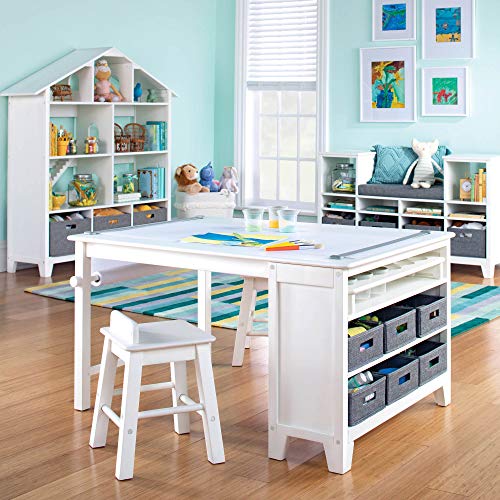
Ergonomics are often overlooked until you find yourself with wrist pain or a stiff neck after a marathon knitting session. The Martha Stewart station is built with a focus on human comfort, offering a generous height and a layout that keeps your elbows at a natural angle.
The surface is expansive, which is essential for those who knit large-scale projects like blankets or oversized cardigans. You need space to support the weight of the fabric so that you aren’t pulling on your needles, which can lead to uneven gauge.
The biggest trade-off is the aesthetic finish, which can be prone to scratching. Use a desk mat or a dedicated blocking mat on top of the surface to protect it from your needles and to provide a "grippy" base for your yarn.
How to Measure Your Space for Large Projects
When measuring, don’t just look at the floor space the table occupies; consider the "reach radius" you need for your yarn. You need at least three feet of clearance behind your chair to shift your weight and stretch your legs.
- Blocking footprint: Ensure the table can accommodate your largest blocking board.
- Vertical clearance: If you use a standing desk, check your ceiling height for overhead lamps.
- Traffic flow: Ensure you aren’t blocking the path to your yarn stash or your window for natural light.
Key Features to Prioritize in a Craft Table
For a knitter, the surface texture is the most critical feature. You want a finish that is smooth enough to let your yarn slide but not so slick that your tools go flying.
- Edge smoothness: No sharp corners that could snag delicate fibers like angora or alpaca.
- Weight capacity: It must hold the weight of a heavy, damp, wet-blocked garment without bowing.
- Adjustability: Height-adjustable legs are essential for long-term back health.
Stability and Weight: Essential Considerations
Stability is non-negotiable. If your table wobbles while you are working, your stitches will reflect that instability through inconsistent tension.
Heavy, solid wood or metal-frame tables are generally superior to lightweight, hollow designs. If you have a lighter table, you can stabilize it by placing it against a wall or using heavy-duty locking casters to keep it firmly in place.
Maintaining Your Workspace for Fiber Arts
Treat your craft table like a fine tool, just like you treat your favorite needles. Keep the surface free of dust, which can settle into your yarn and irritate your skin or cause fibers to pill.
- Regular dusting: Use a soft, lint-free cloth to avoid snagging.
- Surface protection: Always use a mat when blocking to prevent moisture from warping the wood.
- Tool organization: Store your needles in cases, not loose on the table, to prevent them from rolling off or becoming damaged.
Investing in a quality craft table is one of the best ways to honor your passion for fiber arts. By choosing a surface that supports your posture, your storage needs, and your project size, you are setting yourself up for years of comfortable, creative work. Remember that the best table is the one that disappears into the background, leaving you free to focus entirely on the rhythm of your needles. Happy knitting, and may your gauge always be consistent.