6 Best Claw Weights For Light Gauge Knitting Options
Discover the top 6 claw weights for light gauge knitting. This guide helps you choose the right tension tools to ensure smooth, professional fabric results.
Achieving the perfect stitch on a knitting machine is as much about the downward pull as it is about the needle action. Without the right tension, your fabric will drop stitches or produce uneven, messy loops. These six claw weights are essential tools for maintaining the consistent drag required for professional-quality results. Whether you are working with delicate lace or sturdy wool, choosing the correct weight is the secret to mastering your machine.
Silver Reed KA-61 Claw Weight: Best Overall Pick
The Silver Reed KA-61 is the gold standard for most modern machine knitters. Its balanced design provides just enough heft to keep the fabric flat against the needle bed without causing unnecessary strain on the yarn.
This weight excels because of its versatile hook shape, which grabs onto the cast-on comb or the edge of your fabric with ease. If you are working on a standard 4.5mm gauge machine, this weight feels intuitive and reliable.
The primary tradeoff is that it can feel slightly light for very heavy, multi-ply yarns. However, for the vast majority of your day-to-day knitting, it is the most dependable choice in your toolkit.
Brother/Knittax Standard Claw Weight: Best Value
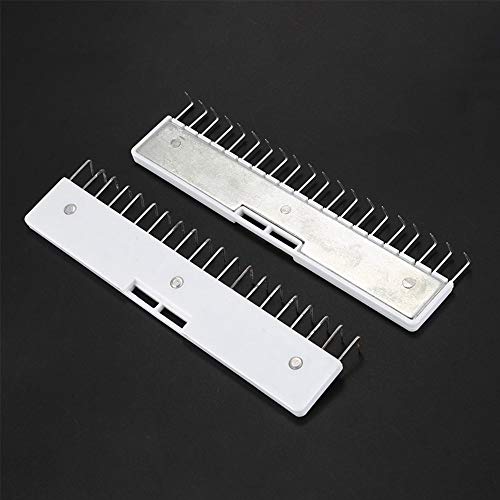

If you are building your collection on a budget, these standard claw weights are a fantastic investment. They are widely available on the secondhand market and are virtually indestructible due to their simple, robust construction.
These weights are perfect for beginners who need to buy in bulk to cover the width of a full sweater panel. Because they are smaller and easier to maneuver, they allow you to place tension exactly where you need it across the needle bed.
While they lack the ergonomic polish of newer models, their performance is identical for practical purposes. They are the workhorses of the knitting world, proving that you don’t need high-end equipment to achieve a professional finish.
Passap Duo 80 Claw Weight: Best for Fine Gauge
Passap machines are famous for their unique, precise nature, and their claw weights are designed with that same level of detail. These are narrower and more streamlined than typical weights, making them ideal for the tight tolerances of fine-gauge knitting.
When you are working with thin, fingering-weight yarns, you need a weight that doesn’t snag or pull unevenly. The Passap style distributes tension vertically, which helps prevent the "laddering" effect often seen in delicate, lightweight fabrics.
These are specifically engineered for the Passap system, so they may not play nicely with every machine bed. If you own a Passap, however, these are non-negotiable for achieving that signature, tight-knit look.
Singer/Studio 150g Claw Weight: Best for Stability
Stability is the name of the game when you are working on complex patterns like tuck stitch or slip stitch. The 150g Singer/Studio weight provides a consistent, heavy pull that keeps the needles from jumping during the carriage pass.
These weights are slightly heavier than the standard, which makes them excellent for controlling "springy" fibers like high-twist superwash wools. The extra mass ensures the loops fully clear the latches every single time.
Be careful not to over-weight your fabric, as excessive pull can distort your gauge or even damage your machine’s needle bed. Use these when the pattern specifically calls for extra drag or when your yarn is particularly prone to dropping.
Addi Express Machine Claw Weight: Best for Circular

Circular knitting machines have a completely different mechanical requirement than flatbed machines. The weights designed for the Addi Express are shaped to sit comfortably within the circular track, providing a steady downward pull as the machine rotates.
Without these weights, your circular tube will likely bunch up or fail to knit off the needles. Because these machines rely on gravity to pull the fabric through the center, the weight needs to be perfectly centered to avoid uneven tension.
These are lighter than flatbed weights, as the circular motion provides its own natural tension. They are essential for anyone using a circular machine to prevent the dreaded "dropped stitch" cycle that can ruin a project in seconds.
Artisan Heavy Duty Claw Weight: Best for Tension
When you are working with heavy, bulky yarns or thick, textured fibers, standard weights simply won’t cut it. The Artisan Heavy Duty claw weight is designed to handle the increased resistance of thicker yarn plies.
These weights are built for durability and feature a wider hook to accommodate thicker fabric edges. They provide the necessary force to pull the fabric down, ensuring that the heavy yarn doesn’t cause the carriage to jam.
The downside is that they are heavy and can be cumbersome to move frequently. Use these only when the fiber density demands it, as they can cause unnecessary fatigue if used on lighter, more delicate projects.
Why Claw Weights Are Essential for Machine Knitters
Claw weights serve one primary function: they provide the mechanical tension required to pull your knitted loops down past the needle latches. Without this downward force, the new yarn cannot form a proper loop, resulting in dropped stitches or "tuck" errors.
Think of the weight as your "third hand." As you knit, the machine’s carriage pulls the yarn across the needles, but the weight ensures that the previous row is held firmly in place so the new stitch can be pulled through.
Different fibers respond differently to this tension. A slippery silk yarn might require less weight to avoid stretching, while a coarse, sticky wool might need more weight to ensure it clears the needle bed smoothly.
How to Properly Balance Weights for Even Tension
The golden rule of machine knitting is to keep your weights distributed evenly across the width of your work. If you have a heavy weight on the left and nothing on the right, your fabric will skew and your edge stitches will become elongated.
Start by placing weights at the edges of your fabric, as these are the areas most prone to dropping stitches. As your piece grows in length, move the weights upward to maintain a consistent pull distance from the needle bed.
Always observe the "hang" of your fabric. If you see the fabric pulling away from the needles or bunching up, you either need more weight or a more balanced distribution. Adjusting as you go is a fundamental skill that separates novices from experts.
Troubleshooting Common Weighting Issues in Knitting
If you find that your stitches are consistently uneven, check your weight distribution first. Often, a single weight that is slightly heavier than the others can cause a vertical line of distorted stitches in your fabric.
Another common issue is "weight drag," where the weight is too heavy for the yarn, causing the stitches to stretch out and lose their elasticity. If your fabric feels thin or "gapped," try reducing the amount of weight you are using.
Conversely, if you are experiencing frequent dropped stitches, you likely don’t have enough weight. Don’t be afraid to add more, but do so incrementally; adding too much at once can cause the fabric to tear or the needles to bend.
Maintenance Tips for Your Machine Knitting Weights
Claw weights are simple tools, but they do require basic care to function properly. Ensure the hooks remain sharp and free of burrs, as a rough hook can snag your yarn and ruin your fabric.
Periodically wipe down your weights to remove any dust or fiber debris. If your weights are metal, a light coat of machine oil can prevent rust, especially if you live in a humid environment.
Store your weights in a dry, organized space where they won’t bang against each other. Keeping them in good condition ensures that your tension remains consistent project after project, giving you one less thing to worry about at the machine.
Mastering the use of claw weights is a rite of passage for every machine knitter. By understanding how these tools interact with your yarn and your specific machine, you gain total control over your final fabric. Start with a few standard options, observe how your tension changes, and don’t be afraid to experiment with placement. With the right weight in hand, you are well on your way to creating beautiful, consistent garments that look truly professional.