
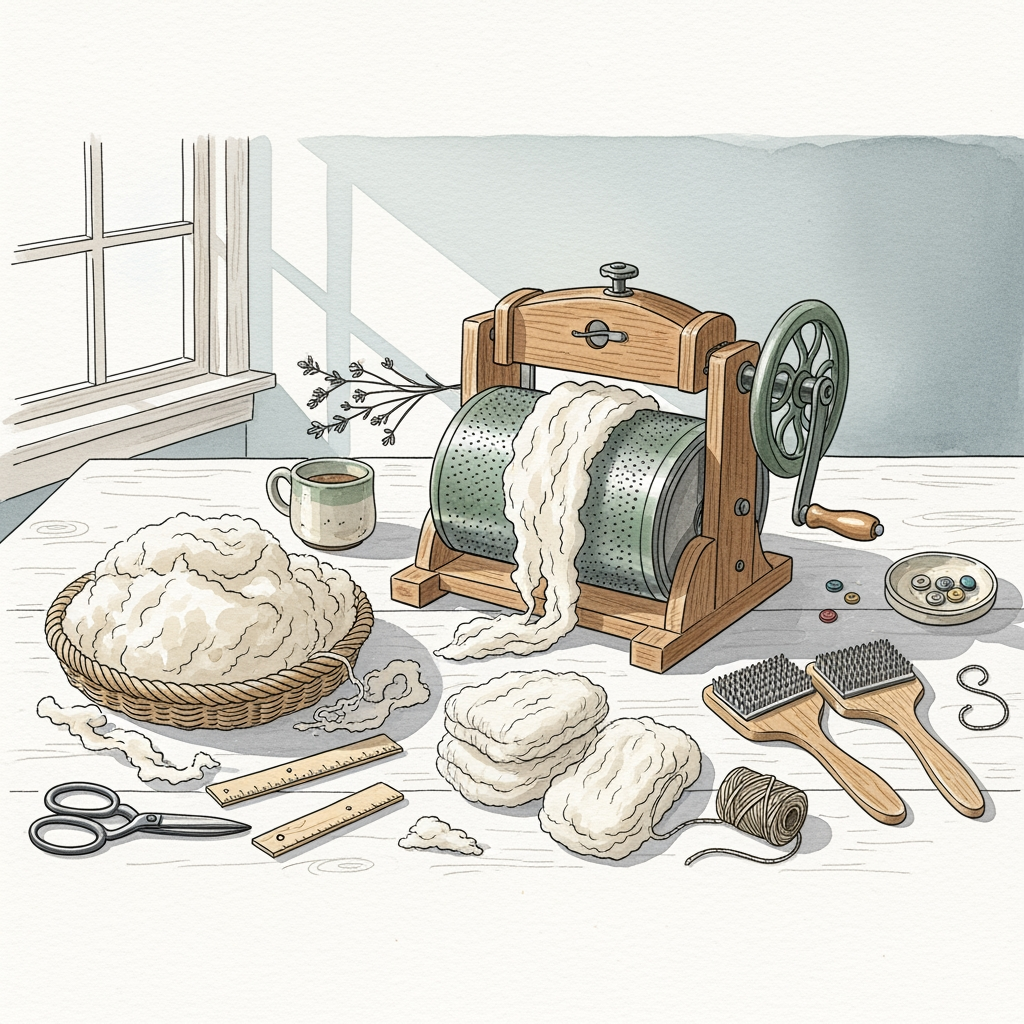
7 Best Fiber Combs For Angora Blending Worth Trying
Discover the 7 best fiber combs for blending Angora. This guide evaluates top tools to help you achieve consistent, high-quality textures in your spinning.
Blending delicate angora with wool requires a gentle touch and the right mechanical advantage to avoid breaking those precious, soft fibers. Fiber combs are the unsung heroes of the spinning room, turning tangled, fluffy clouds into organized, spinnable top. Choosing the wrong tool can lead to excessive waste or uneven yarn, but the right pair makes the process feel effortless. This guide breaks down the best options to help you achieve a professional-grade blend every time.
Strauch Petite Viking Combs: Best Overall Choice


These combs are a masterclass in balance, offering a perfect weight that doesn’t fatigue your wrists during long blending sessions. They feature high-quality steel tines that are spaced perfectly for the short, slippery nature of angora.
When you are working with a high-percentage angora blend, you need a tool that grips without shredding. The Strauch Petite Vikings handle this tension beautifully, allowing you to pull the fiber through with just enough resistance to align the hairs.
They aren’t the cheapest option on the market, but the durability and consistency they provide make them a lifetime investment. If you find yourself blending angora for entire sweater quantities, these are the gold standard for avoiding hand strain.
Patrick Green Single Row Combs: Best for Precision

If you are a spinner who obsesses over the alignment of your fibers, single-row combs offer a level of control that multi-row tools simply cannot match. They allow you to see exactly how much fiber is passing through the tines at any given moment.
This visibility is crucial when working with angora, as it helps you spot potential neps or clumps before they become part of your roving. Because they are single-row, they are inherently more forgiving, reducing the risk of "over-combing" and breaking the delicate angora guard hairs.
They do require a bit more practice to master the flicking motion compared to wider combs. However, for the knitter who wants to create a perfectly smooth, worsted-spun yarn, the precision control is well worth the learning curve.
Howard Brush Mini Wool Combs: Best for Angora

Howard Brush is legendary in the industry for a reason, and their mini wool combs are specifically sized for the smaller staple lengths often found in angora. The tine length is optimized to prevent the fiber from "bottoming out" against the wooden base.
When you are blending angora with a coarser wool, you need a tool that can navigate the difference in fiber diameter. These combs excel at marrying the two, ensuring the angora doesn’t just sit on the surface but is thoroughly integrated into the wool core.
The compact size makes them incredibly easy to maneuver, even if you have smaller hands. They are the go-to choice for angora purists who want to minimize waste and maximize the loft of their finished yarn.
Ashford Fine Fiber Combs: Best for Beginners

Ashford has built a reputation on accessibility, and their fine fiber combs are no exception. They feature a user-friendly design that helps a novice understand the mechanics of fiber alignment without feeling overwhelmed by complex hardware.
The spacing of the tines is slightly wider than professional-grade specialty combs, which is actually a benefit if you are just starting out. It prevents you from accidentally snagging and breaking your fiber while you are still developing the "feel" for the right amount of tension.
These are a fantastic entry point if you want to experiment with blending without committing to a high-end investment. Once you get the hang of the rhythm, you’ll find they produce remarkably consistent results for the price point.
Valkyrie Fine Tooth Combs: Best for Versatility

Valkyrie tools are renowned for their craftsmanship, and their fine-tooth combs are incredibly versatile for a wide range of fiber blends. Whether you are mixing angora with silk, alpaca, or fine Merino, these combs handle the transition with ease.
The tines are exceptionally smooth, which is vital when working with angora to prevent the fiber from clinging to the metal. This smoothness allows for a fluid, continuous blending motion that keeps your fiber moving through the tines without resistance.
While they are highly versatile, their real strength lies in their ability to handle high-loft blends. If you want a yarn that feels like a cloud but has the structure of a traditional wool yarn, these are your best bet.
Majacraft Fine Flick Carders: Best for Texture
Sometimes you don’t want a perfectly smooth worsted top; sometimes you want to retain the wild, fuzzy texture that makes angora so desirable. Majacraft’s flick carders are designed to tease and align the tips of the fiber without stripping away all the character.
These are excellent for "flicking" the ends of your angora locks before blending them into a batt. By working only the tips, you retain the loft and volume of the angora, which translates to a much warmer, fuzzier finished fabric.
They are not meant for deep, intensive combing, so don’t expect them to remove every bit of vegetable matter. However, for retaining that signature angora halo in your yarn, they are an essential addition to your toolkit.
Wingham Wool Wool Combs: Best Value for Money

Wingham offers a no-nonsense, functional design that prioritizes performance over fancy aesthetics. These combs are built to withstand heavy use, making them a reliable workhorse for any spinner who blends large quantities of fiber.
The tine strength is impressive, resisting bending even when you are working with tougher, coarser wools mixed with angora. You get a professional-grade tool that does exactly what it promises without the premium price tag of boutique brands.
If you are looking for a durable, budget-friendly option that doesn’t compromise on the quality of your blend, Wingham is a fantastic choice. They are the practical knitter’s secret to high-quality fiber prep on a budget.
Understanding TPI in Angora Blending Tools
TPI stands for "Tines Per Inch," and it is the most critical factor when selecting a comb for angora. Because angora fibers are fine and prone to breaking, you generally want a higher TPI to ensure the fibers are separated gently.
A lower TPI (fewer tines) is better for coarser wools, as it allows the fiber to pass through without getting stuck. However, if you use a low TPI tool on angora, the fibers will simply slip through the gaps without being properly combed.
Always check the manufacturer’s specifications for TPI before buying. For angora, look for a range between 4 and 6 TPI to strike the right balance between effective separation and fiber safety.
How to Properly Prep Angora for Smooth Blending
Preparation is the secret to a successful blend, and it starts long before the combs come out. Begin by gently teasing your angora locks apart with your fingers to remove any major tangles or debris.
When you load your combs, don’t overload them; angora needs room to move. If you pack the tines too tightly, you will create friction that causes the fibers to snap rather than align.
Work in small, thin layers, and always comb in one direction. By taking your time during this prep stage, you ensure that the angora is evenly distributed throughout the wool, resulting in a consistent, pilling-resistant yarn.
Essential Safety Tips for Using Fiber Combs
Fiber combs are essentially sharp, specialized tools, and they should be treated with the same respect as a pair of high-end knitting needles. Always store them with the tine guards on when they are not in use to prevent accidental injuries.
When you are combing, keep your fingers well away from the path of the tines. It is easy to get into a rhythm and lose track of where your hands are, especially when you are tired or working on a large project.
Finally, ensure your workspace is well-lit and stable. A slip during the combing process can lead to a nasty puncture wound, so keep your focus on the tool’s path at all times.
Blending angora is a tactile, rewarding process that elevates your knitting from simple craft to true fiber art. Whether you choose the precision of single-row combs or the efficiency of a high-TPI set, the right tool will transform your spinning experience. Remember that the goal is to honor the fiber, so take your time, keep your motions fluid, and enjoy the beautiful halo you create. Happy blending and even happier knitting!
