7 Best Spinning Wheel Upgrade Kits For Performance
Boost your fiber arts efficiency with our top 7 spinning wheel upgrade kits for performance. Compare the best parts to improve your yarn quality today. Read now!
Spinning wheels are precision machines where even subtle adjustments can transform the character of handspun yarn. Upgrading components like flyers, bobbins, and whorls shifts the focus from managing the wheel to refining the fiber. Choosing the right kit requires balancing technical specifications against personal spinning style and the specific weight of yarn intended for a project. This guide outlines the most effective performance upgrades to help spin more efficiently and achieve consistent results.
Woolee Winder: Best for Even Yarn Winding


The Woolee Winder is a mechanical marvel designed to solve the age-old problem of uneven bobbin buildup. By utilizing a sliding flyer mechanism that moves back and forth automatically, it eliminates the need to manually stop and adjust hooks.
This upgrade is essential for spinners who struggle with ridges or uneven tension during long sessions. When the fiber fills the bobbin evenly from flange to flange, the draw-in remains consistent, leading to a much more stable spinning rhythm.
Consider this upgrade if the primary goal is high-volume production or long, continuous spinning sessions. While it adds a bit of mechanical complexity to the flyer, the benefit of effortless, perfect bobbins is well worth the maintenance of keeping the sliding mechanism clean and lubricated.
Schacht High Speed Whorl: Top Pick for Speed
Spinners who gravitate toward fine, worsted-spun yarns often hit a wall when their wheel cannot match their desired twist-per-inch. A high-speed whorl is a smaller pulley that increases the ratio of flyer rotations to treadle strokes, allowing for faster insertion of twist.
This is the most cost-effective way to change the personality of a wheel without replacing the entire flyer assembly. If the goal is to spin cobweb-weight lace or fine, high-twist singles for sock yarn, a higher ratio is mandatory for productivity.
Be mindful that higher ratios require more effort to treadle and significantly increase the draw-in speed. Ensure the wheel’s drive band tension is adjusted precisely, as fine-tuning the ratio is only effective if the wheel itself can handle the increased drag.
Ashford Jumbo Flyer Kit: Best for Bulky Yarns
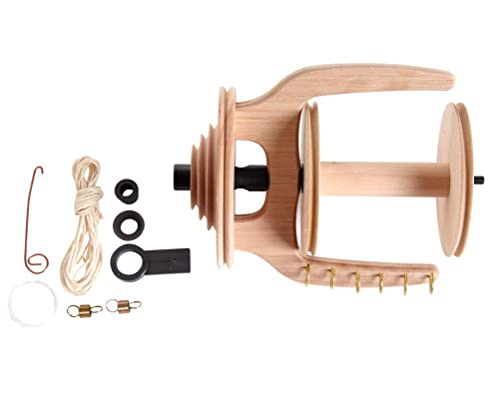
Bulky, textured art yarns demand more clearance between the flyer arms and the bobbin. The Ashford Jumbo Flyer kit provides a significantly wider orifice and larger bobbins, allowing for the inclusion of locks, beads, or thick slubs without snagging.
This kit is ideal for those who prefer spinning bulky wools for heavy winter sweaters or thick blankets. It effectively turns a standard wheel into a specialized tool for structural yarns, moving away from fine lace and toward expressive, tactile textures.
Understand that moving to a jumbo setup changes the physics of the wheel entirely. The heavier mass of the large bobbin requires more momentum to start and stop, so be prepared for a slightly different feel in the treadling motion.
Kromski Jumbo Flyer Kit: Great Versatility
Kromski offers a flexible approach to oversized spinning by providing a kit that is remarkably easy to swap onto their standard wheels. This kit is designed to hold large volumes of fiber, making it perfect for plying long, continuous yardage.
The key advantage here is the design of the orifice, which is generous enough for bulky spinning but polished enough to avoid snagging delicate fibers. It strikes a balance between industrial capacity and the refined aesthetics associated with the brand.
If the spinning library includes a mix of everything from lace to mohair bouclé, this is a top-tier choice. It allows for a quick transition between standard spinning and high-capacity plying without the need to buy a second, dedicated wheel.
Louët High Speed Kit: For Laceweight Spinners
Louët wheels are known for their sturdy, Irish-tension design, and the high-speed kit takes that reliability into the realm of extreme fineness. It provides the necessary ratios to spin gossamer-thin fibers that would otherwise remain under-twisted on a standard setup.
This kit is designed for the perfectionist who demands consistent, tight twist in laceweight projects. It transforms the wheel into a specialized tool for creating strong, high-twist singles that won’t fall apart during the blocking process.
Take care when installing this, as the higher ratios can be unforgiving with uneven treadling. It is best suited for those who have mastered a steady, rhythmic foot motion, as any hesitation will be immediately visible as a thick or thin spot in the yarn.
Majacraft Overdrive Head: Ultimate Speed Upgrade
The Majacraft Overdrive is not a standard flyer; it is a high-torque, high-speed system built for massive output. It uses a specialized drive system to allow for rapid, controlled spinning of heavy fibers at professional-grade speeds.
This is the gold standard for those who consider spinning a business rather than a hobby. It is engineered to handle the strain of spinning miles of yarn, offering unparalleled control over twist management even when the bobbin is nearly full.
The investment is significant, and the learning curve is steeper than standard flyer swaps. This upgrade is best reserved for those who have reached the technical limits of their current wheel and require professional-grade efficiency to reach their creative goals.
Lendrum Plying Head & Bobbin: Best for Plying
Plying requires a different set of mechanical needs than spinning, specifically the need for high-capacity bobbins and a smooth, consistent tension. The Lendrum plying head offers exactly this, allowing for the creation of heavy, multi-ply yarns without constant stopping.
The ease of switching between the standard spinning head and the plying head makes this system particularly user-friendly. By dedicating a specific setup to plying, the mechanical tension can be set specifically for the ply, resulting in a perfectly balanced yarn that won’t bias or twist when knitted.
Choose this if the spinning process involves frequent three- or four-ply projects. Reducing the number of times bobbins must be transferred during the plying process saves hours of labor and ensures the integrity of the finished yarn.
How to Match an Upgrade to Your Spinning Style
Identifying the right upgrade begins with an honest assessment of current frustrations rather than a desire for new gear. If the primary complaint is constant bobbin filling and manual stop-starting, a sliding flyer like the Woolee Winder is the logical path.
If the yarn is consistently under-twisted, focus on the whorl ratios first. Match the upgrade to the fiber type; fine silk and mohair require the stability of a high-speed kit, while art yarns using core-spinning techniques require the clearance of a jumbo flyer.
Always prioritize the weakest link in the current workflow. If the wheel itself is solid but the bobbin capacity limits the creativity, a jumbo kit provides the most value. If the spinning speed is fine but the yarn consistency is poor, a precision flyer or a better tensioning system is the priority.
Flyer vs. Whorl: Which Upgrade Do You Need?
A flyer upgrade is a comprehensive change that affects the orifice size, the bobbin capacity, and the overall physics of the spinning head. Use a flyer upgrade when the project requires a change in yarn structure, such as moving from fingering weight to bulky, or when the current flyer is causing snagging or uneven tension.
A whorl upgrade is purely about the ratio of twist-to-treadle. It does not change the physical capacity of the wheel but changes how quickly the fiber receives twist. Use a whorl upgrade when the wheel mechanics are perfectly fine, but the current speed ratios are too slow or too fast for the project at hand.
When in doubt, consider the weight of the fiber. Lightweight, airy fibers benefit from the speed of a smaller whorl, whereas bulky, heavy fibers require the structural support of a jumbo flyer. These two components work in tandem; a high-speed whorl is rarely effective on a heavy, bulky flyer, and a jumbo flyer may feel sluggish with a low-ratio whorl.
Checking Wheel Compatibility Before You Buy
Never assume that a flyer from one model will fit another, even within the same brand. Manufacturers frequently update design specifications, and a kit from five years ago might not fit a wheel purchased yesterday.
Always verify the spindle length and the bearing size of the current wheel against the specifications of the upgrade kit. Look for the serial number or production year of the wheel, as many companies categorize their parts by “generations” or date ranges.
If there is any uncertainty, reach out to the manufacturer or a specialist dealer with photos of the current setup. A small oversight in measurement can result in a part that wobbles or fails to seat properly, which at best causes frustration and at worst leads to premature wear on the wheel’s drive system.
Choosing the right upgrade kit is the definitive step in moving from a casual spinner to a craft-focused maker. By matching the mechanical capabilities of the wheel to the specific demands of the yarn, every spinner gains the control necessary to produce truly professional results. Evaluate the bottlenecks in the current process, verify the hardware specs, and select an upgrade that will grow alongside evolving technical skills.