6 Digital Calipers For Measuring Precision Needlework
Achieve perfect symmetry in your craft with these 6 digital calipers for measuring precision needlework. Explore our top expert recommendations and shop now.
Achieving consistent gauge is the holy grail of knitting, yet many crafters rely on inaccurate, mass-produced needle gauges that fail to account for manufacturer variations. Digital calipers provide the surgical precision required to identify the exact diameter of vintage needles, hand-carved wooden hooks, or mystery scrap yarn. By measuring with digital accuracy, the guesswork inherent in substituting materials vanishes. These tools turn the technical act of sizing into a simple, objective measurement.
Neiko 01407A: The All-Around Best Value Caliper
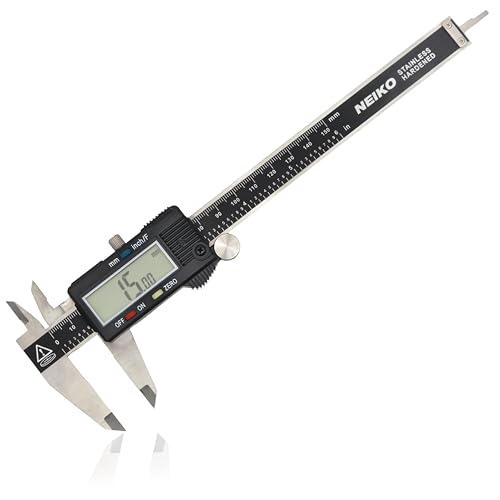

The Neiko 01407A strikes a perfect balance between price and professional utility. It features a hardened stainless steel frame that resists the occasional drop, which is a common hazard in a busy studio environment.
The large, high-contrast LCD screen ensures that measurements are readable even in low-light conditions, such as knitting at night. It is an excellent choice for those who want a reliable, daily-use tool without the premium price tag of high-end industrial brands.
iGaging EZ-Cal: A Reliable Precision Workhorse

The iGaging EZ-Cal is favored for its IP54 rating, meaning it provides solid protection against dust and moisture. This is particularly relevant if the workspace includes loose wool fibers or occasional steam from a nearby blocking board.
Beyond its durability, it features a smooth-sliding jaw that prevents the “stick-slip” motion found in cheaper alternatives. Precision is key when trying to distinguish between a 2.25mm sock needle and a 2.50mm standard, and this model delivers that level of granular accuracy.
Vinca DCLA-0605: Best Budget Pick for Accuracy

The Vinca DCLA-0605 proves that high-level measurement doesn’t have to be expensive. It offers the same basic functionality as more expensive tools, including a convenient unit conversion button that flips between millimeters and inches.
While the exterior housing is slightly less robust than professional-grade versions, the internal sensor is remarkably consistent. For the knitter who needs to check needle size once or twice a week, it provides the essential data without unnecessary investment.
General Tools 147: The Best Non-Marring Option

Measuring delicate vintage needles or polished ebony wood requires care to avoid scratching the surface. The General Tools 147, often made from carbon fiber composites, is the perfect solution for protecting high-end tool collections.
Since it does not rely on conductive metal jaws, it is inherently gentle on fragile materials. Using this tool eliminates the fear of introducing microscopic nicks into the finish of a favorite set of circular needles.
Mitutoyo 500-196-30: The Ultimate Pro-Grade Tool

For those who treat knitting as an exacting science, the Mitutoyo 500-196-30 is the gold standard of the industry. It features the patented AOS (Advanced Onsite Sensor) technology that is immune to oil, water, and shop-floor debris.
The build quality is legendary, offering a lifetime of consistent performance that justifies the high entry cost. If the goal is to create a professional archive of yarn thicknesses and needle variations, this is the only tool that will never need replacing.
Adoric Digital Caliper: Our Top Pick for Portability

The Adoric Digital Caliper is lightweight and slim, making it an ideal companion for a dedicated knitting notions pouch. It fits easily alongside stitch markers and measuring tapes, allowing for on-the-go precision.
It is particularly useful for measuring unknown knitting needles found at estate sales or flea markets. Because it is small and unobtrusive, it removes the barrier to checking sizing on the fly, which promotes better habits in the long run.
Why a Caliper Beats a Standard Needle Gauge
Standard plastic or metal needle gauges rely on fixed holes, which can be inaccurate due to casting tolerances or slight warping. A caliper, by contrast, measures the actual diameter of the needle at its widest point.
This is vital for identifying needles that have been sanded down over years of use. It also identifies needles that are labeled incorrectly, a surprisingly common issue with mass-produced knitting equipment.
How to Measure Needles, Yarn, and Gauge
To measure a needle, gently close the jaws around the thickest part of the shaft without applying excessive pressure. For yarn, the caliper should touch the fiber without compressing it; if the jaws squeeze the yarn, the reading will be artificially low.
Measuring yarn diameter, often used as an alternative to Wraps Per Inch (WPI), allows for a more objective comparison between different fiber blends. When comparing a fuzzy mohair to a smooth silk, the caliper helps determine the true “air” space the yarn will occupy in a stitch.
Metal vs. Carbon Fiber: Which Is Right for You?
Metal calipers offer the highest level of durability and are resistant to the wear and tear of a long career in fiber arts. They are, however, heavier and can leave light scratches on sensitive surfaces if the user is not careful.
Carbon fiber models are lightweight, non-conductive, and generally safer for delicate materials like tortoiseshell or hand-polished wood. Choose metal for long-term durability and carbon fiber if you frequently handle antique or highly finished tools.
Key Features to Look for in a Digital Caliper
- Resolution: Look for a measurement resolution of at least 0.01mm for high-precision fiber work.
- Auto-Off: A battery-saving feature that prevents the device from dying during a long project session.
- Zeroing Button: The ability to reset the measurement at any point is essential for comparative checks.
- IP Rating: An ingress protection rating ensures the tool lasts despite lint, dust, or moisture in the craft room.
Investing in a quality digital caliper is an act of commitment to one’s craft. By replacing subjective guesses with objective data, every project gains a layer of technical security that makes the finished garment look, feel, and fit better. While standard tools have their place, the caliper is the final word in precision fiber arts.