
6 Best Digital Infrared Thermometers For Temperature Calibration
Upgrade your accuracy with our top 6 digital infrared thermometers for precise temperature calibration. Read our expert guide to find the perfect tool today.
Achieving perfect color consistency in hand-dyed yarn requires more than just a keen eye for saturation; it demands precise temperature control of the dye bath. When working with delicate protein fibers like wool or alpaca, temperature spikes can lead to uneven uptake or premature felting. Digital infrared thermometers provide the instantaneous feedback necessary to keep your dye pots within a safe, steady range. Investing in a reliable tool ensures that your carefully sourced fibers remain intact and your colors strike exactly as intended.
Etekcity Lasergrip 774: Best Overall Value


This model serves as the industry standard for hobbyist dyers who need reliable readings without paying for professional-grade laboratory equipment. It balances accessibility and performance, making it an excellent choice for those just starting to build their dyeing studio.
The device features a clear, backlit LCD screen that remains readable even in a room full of rising steam. Its ergonomic handle feels secure in the hand, which is vital when moving quickly between multiple dye pots on a stovetop.
While it lacks the ultra-high temperature range required for industrial textile manufacturing, it handles standard wool dyeing temperatures with ease. For the average fiber artist, the Etekcity Lasergrip 774 provides the perfect intersection of affordability and essential functionality.
Fluke 62 MAX+: Pro-Grade for Serious Dyers

If the dye studio operates like a production line, the Fluke 62 MAX+ offers the ruggedness and precision required for consistent, high-volume work. Its dust and water resistance make it virtually indestructible in the damp, hectic environment of a kitchen-based studio.
Precision is paramount when working with high-cost luxury fibers like silk or cashmere, where a five-degree variance can ruin an entire batch. This thermometer offers a high distance-to-spot ratio, allowing for accurate measurements from a safe distance away from splashing dye water.
Expect a premium price tag, but recognize that this is a “buy once” tool for a lifetime of dyeing. If the goal is professional-level reproducibility in colorways, this is the gold standard for your kit.
Klein Tools IR1: Most Durable for Workshops
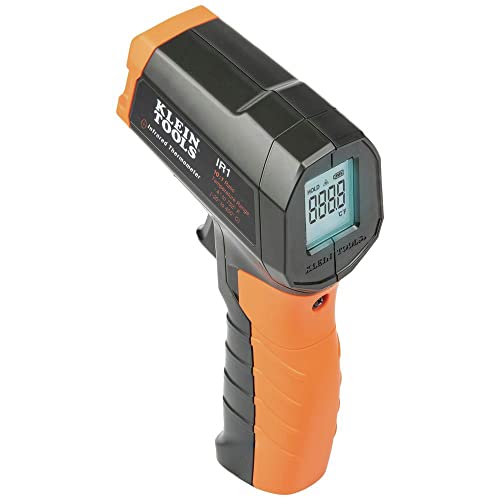
The Klein Tools IR1 is built for those who treat their dye studio like a workshop, prioritizing longevity and a sturdy build. It features a simple, intuitive interface that does not require a manual to operate, which is helpful when you have dye-stained hands and need a quick check.
This thermometer excels in high-contrast environments where visibility can be poor. The backlit display is exceptionally bright, ensuring that checking the status of a simmering kettle of yarn is never a struggle.
While slightly heavier than other models, the weight conveys a sense of quality and stability. For the fiber artist who values a tool that can survive being dropped on a concrete floor or buried in a bin of wool roving, the Klein Tools IR1 is the reliable companion of choice.
KIZEN LaserPro LP300: Easiest for Quick Checks

Speed is the priority for the KIZEN LaserPro LP300, which offers one of the fastest response times on the market. When juggling multiple pots at different stages of the mordanting or dyeing process, waiting for a sensor to settle is time the dyer simply does not have.
The interface is remarkably streamlined, stripping away complex settings that most fiber artists never utilize. This simplicity minimizes the risk of accidental setting changes, keeping the focus entirely on the yarn.
It is an ideal choice for the casual dyer or the beginner who wants to focus on the chemistry of the fiber rather than the technology of the tool. It is efficient, light, and gets the job done without any unnecessary friction.
ThermoPro TP30: Best for Wet & Steamy Areas
Steam can be the enemy of electronics, often fogging up sensors and leading to inaccurate, erratic readings. The ThermoPro TP30 is designed specifically to mitigate these issues, making it a favorite for dyers who work with deep, wide pots that produce significant vapor.
The compact design allows it to be tucked into a small apron pocket, keeping it handy but out of the way of boiling liquids. Despite its size, the sensor is sensitive enough to provide the consistent data needed to manage the delicate simmering process of superwash wool.
It provides a great return on investment for the artist who needs a specific solution for a humid workspace. If your dye room is frequently clouded by steam, this model will maintain its accuracy far longer than its competitors.
ennoLogic eT650D: Top Choice for High Accuracy
For the precision-obsessed dyer who records every data point in a project journal, the ennoLogic eT650D offers the most granular control. It features an adjustable emissivity setting, which is a critical feature for measuring the surface temperature of varying materials like stainless steel pots versus enamel kettles.
The wide temperature range ensures that whether you are doing a low-temperature protein dye or a higher-heat acid dye, the tool never flags or struggles. It is the most technically advanced option, rewarding the user who takes the time to learn its calibration capabilities.
This is not a “point and shoot” tool for the impatient; it is for the dyer who views their process as a science. When the margin for error is non-existent, the ennoLogic eT650D provides the high-level performance that top-tier projects demand.
Why Your Dye Pot Needs an Infrared Thermometer
Maintaining a stable temperature is the single most effective way to prevent patchy, uneven color absorption in protein fibers. Infrared thermometers allow you to monitor the thermal state of the dye bath without ever breaking the surface or risking cross-contamination with a traditional probe.
Traditional stick thermometers are prone to breakage and are difficult to sanitize between different color batches. An infrared thermometer stays clean, stays outside the pot, and keeps your process efficient and sanitary.
Without a constant temperature, you risk thermal shock to the fiber, which can alter the yarn’s luster or texture. Consistent heat ensures the dye molecules bond uniformly to the protein, resulting in the deep, rich colors that distinguish handmade yarn from mass-produced varieties.
What to Look for in a Fiber Artist’s Thermometer
When shopping for an infrared thermometer, consider the specific constraints of your workspace and the type of fiber you typically process. A high-quality model should prioritize durability against steam, as well as an ergonomic shape that allows for one-handed operation.
- Distance-to-Spot Ratio: Ensure the device can read accurately from at least 12 inches away to avoid steam burns.
- Backlit Display: Necessary for checking readings in dimly lit studios or rooms with inconsistent lighting.
- Temperature Range: Should at least cover the 32°F to 400°F range for all standard dyeing processes.
- Emissivity Settings: Look for adjustable settings if you want to switch between different pot materials like copper, steel, and enamel.
Ultimately, prioritize a tool that is easy to clean. Dyes can be messy, and you need a smooth, non-porous exterior that wipes down instantly to avoid transferring pigments to your next project.
Understanding Emissivity for Accurate Readings
Emissivity is a measure of a surface’s ability to emit infrared energy, and it varies significantly depending on the material of your dye pot. A shiny, polished stainless steel pot has very low emissivity, which can trick a standard infrared thermometer into giving a false, lower reading than the actual liquid temperature.
Most consumer-grade thermometers are set to a fixed emissivity of 0.95, which works perfectly for most matte or dark surfaces but struggles with reflective metals. If you are using shiny steel pots, you may need to apply a small piece of heat-resistant, matte-finish tape to the side of the pot to get an accurate reading.
Understanding this technical detail differentiates the expert dyer from the amateur. By compensating for the material of your vessels, you ensure the internal temperature of the dye bath is exactly where it needs to be for the fiber type in your hands.
FAQ: Infrared Thermometers for Fiber Arts
Can I use these to check the temperature of the yarn itself? Infrared thermometers read surface temperature, so they provide the temperature of the dye liquid, not the internal core of the fiber bundle. This is generally sufficient for managing dye uptake.
Do I need an industrial-grade thermometer? Only if you are working with large commercial vats or need extreme precision for historical textile recreation. For standard hobbyist dyeing, a mid-range model is more than sufficient.
Is it safe to point the laser at the yarn? Yes, the laser is purely a targeting guide and does not heat the yarn or affect the dye chemicals. It is perfectly safe to use throughout the entire dyeing process.
Why does my reading change when I move the thermometer? The distance-to-spot ratio means the thermometer captures a larger area the further back you hold it. Move closer to the surface of the liquid to ensure you are only measuring the pot and not the surrounding air or burner.
The right infrared thermometer transforms the uncertainty of the dye pot into a controlled, professional process. By choosing a device that matches your specific dyeing needs, you gain the confidence to experiment with complex color palettes and sensitive fibers alike. Investing in these tools is not merely about equipment; it is about protecting your materials and ensuring the longevity of your finished knitwear.