7 Rotary Mats For Safe Fabric Cutting To Consider
Protect your workspace and achieve precise results with our top 7 rotary mats for safe fabric cutting. Explore our expert recommendations and shop your pick now.
Precision in cutting is as vital to a finished garment as accurate gauge is to a sweater. When preparing fabric for a quilt backing or cutting pattern pieces for a tailored skirt, a high-quality rotary mat acts as the foundation for every crisp edge and clean line. Relying on an inadequate surface often leads to frayed fabric edges or, worse, premature dulling of rotary blades. These seven mats represent the gold standard for those who treat their fabric preparation with the same rigor as their stitch tension.
Olfa Self-Healing Mat: The Industry Standard Pick


The Olfa self-healing mat is arguably the most recognizable surface in any professional sewing room. Its reputation is built on a specialized surface that allows rotary blades to glide through fabric without leaving deep, obstructive grooves.
For the maker working with delicate silk or dense wool coating, this mat provides a consistent, smooth resistance. When cutting pieces for a complex patchwork project, the clear grid lines ensure that geometric precision remains uncompromised.
The primary trade-off is the price point, as this mat carries a premium reflecting its longevity. However, for those who spend hours each week cutting fabric, the ability to avoid deep “healed” scars that could snag fine fibers makes it a sound investment.
Fiskars Cutting Mat: Best for All-Around Crafting

Fiskars mats are designed with the general hobbyist in mind, offering a versatile surface that handles both paper and fabric with ease. The grid markings are bold and high-contrast, which helps prevent eye strain during long cutting sessions.
This mat works exceptionally well for those who oscillate between garment sewing and other crafts like paper piecing or applique. Because the surface is slightly softer than industry-grade mats, it remains gentle on blades, extending their sharpness through multiple projects.
Be mindful that heavy-duty cutting with very sharp blades can create surface texture over time. If the workspace is frequently used for high-pressure tasks, expect to replace this mat sooner than a industrial-grade alternative.
Arteza Rotary Mat: The Top Budget-Friendly Option

The Arteza mat offers a surprising level of quality for those establishing a new sewing space on a restricted budget. It features a dual-sided design, allowing for extended wear before the surface inevitably degrades from repeated blade passes.
It is particularly suitable for beginners who are still mastering the mechanics of rotary cutting. A smaller investment here allows for a larger budget to be allocated toward higher-quality fabric or specialized notions, such as ergonomic seam rippers or precision measuring tools.
Understand that the “self-healing” properties are less aggressive than premium counterparts. While it performs admirably for standard cottons and linens, it may show wear faster if subjected to heavy, repetitive cutting of thick denim or multiple layers of batting.
Martelli Round-About: Best Rotating Mat for Quilters

The Martelli Round-About eliminates the need to physically shift or turn heavy fabric bundles while cutting. By rotating the surface under the fabric, the cutter maintains a safe, ergonomic angle for their wrist and arm.
For quilters working on intricate patterns, this functionality is a game-changer. It ensures that the rotary cutter stays in the strongest, most stable position throughout the entire arc of the cut, preventing the blade from veering off-course.
While the rotating mechanism is incredibly efficient, it does require a dedicated footprint on the cutting table. Ensure the workspace accommodates the diameter of the round base before committing to this specialized tool.
Dahle Vantage Mat: Most Durable for Heavy-Duty Use
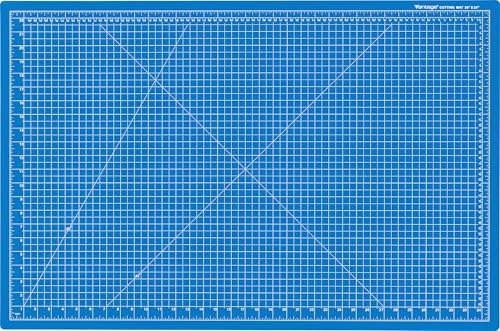
The Dahle Vantage mat is constructed with a multi-layered, rigid core that sets it apart from standard vinyl mats. It is specifically engineered to withstand aggressive pressure, making it the preferred choice for those working with heavy upholstery fabrics or thick interfacings.
Fiber artists who frequently cut dense, bonded fabrics will appreciate the stability this mat provides. It resists warping and curling, which is a common complaint with thinner, lighter-weight cutting surfaces.
Because it is exceptionally durable, the mat is also heavier and less portable than other options. It is best treated as a permanent station rather than a tool meant to be transported to classes or sewing groups.
Cricut Self-Healing Mat: Perfect for Machine Crafters
The Cricut mat is specifically calibrated to integrate with digital cutting workflows. Its surface is optimized for the light-to-medium pressure of electronic blades, though it performs just as well with manual rotary cutters for hand-trimming fabric blocks.
If the cutting workflow involves both a machine and manual touch-ups, this mat provides a seamless bridge between the two. The grid markings align perfectly with common digital project templates, reducing the risk of measurement errors.
Note that the adhesive backing found on some machine mats is absent here, as this is designed as a standalone work surface. It is a reliable, utilitarian choice for those who value consistency across multiple mediums.
US Art Supply Mat: The Best Value for New Sewists
The US Art Supply mat is a staple in starter kits, providing a generous surface area for a fraction of the cost of professional-grade equipment. It is lightweight, easy to store, and features high-visibility markings that simplify the process of squaring up fabric blocks.
For those just learning how to handle rotary equipment, this mat is an excellent training ground. It provides a forgiving surface that won’t punish the user for slightly uneven pressure while they develop muscle memory for their blade strokes.
Keep in mind that durability is lower than that of professional mats. It serves as a perfect stepping stone for the first few years of sewing, but eventually, as skills and project volume increase, it will likely be replaced by a more robust model.
How to Choose the Right Mat Size for Your Projects
Selecting a mat size should be dictated by the largest standard cut required for a project. If the primary focus is garment construction, a 24-inch by 36-inch mat is essential for laying out full pattern pieces without excessive shifting or overlapping.
Small project makers, such as those focusing on quilting blocks or small accessories, can find success with a 12-inch by 18-inch mat. This size is easier to store and maneuver but will inevitably cause frustration if used for cutting long strips of fabric for quilt binding.
Always consider the dimensions of the workspace before buying the largest available mat. A mat that hangs over the edge of the table will lose its stability and risk bowing, which negatively impacts the accuracy of every cut.
Key Safety Tips for Using Your Rotary Cutter
Safety with a rotary cutter begins with the understanding that a sharp blade is safer than a dull one. A dull blade requires extra pressure, which increases the likelihood of slipping and cutting into fingers or the ruler.
Always use a dedicated acrylic quilting ruler as a guide, ensuring fingers are placed well away from the edge. When not actively cutting, engage the safety lock on the rotary cutter immediately, treating it with the same respect as a sewing machine needle.
Finally, keep the cutting hand behind the ruler edge at all times. Never reach across the path of the blade, and if the blade feels like it is “skipping” or dragging, replace it immediately rather than forcing the cut.
How to Clean and Store Your Self-Healing Mat
To maintain the integrity of the self-healing surface, keep the mat away from direct heat sources like radiators or prolonged sunlight. Heat causes the mat to warp, which creates uneven surfaces that make precision cutting impossible.
Clean the mat periodically by wiping it down with a mixture of water and a small amount of mild dish soap to remove lint and debris. Once clean, allow it to air dry completely before resuming use to prevent moisture buildup.
Store the mat flat whenever possible. If space constraints force vertical storage, lean it against a sturdy surface to prevent bowing, as a permanently curved mat will never provide the perfectly flat foundation required for accurate fiber work.
Choosing the right rotary mat is a fundamental step in ensuring your projects remain accurate and professional from the first cut to the final stitch. By balancing durability with the specific demands of your crafting habits, you can build a reliable foundation that supports years of creative output. Whether you prioritize industrial toughness or budget-friendly versatility, the right surface will make every project flow with significantly more precision.