
7 Best Pencil Sharpeners For Soft Core Wax Pencils
Stop breaking your leads with these 7 best pencil sharpeners for soft core wax pencils. Discover our top-rated picks and upgrade your drawing kit today.
Working with soft-core wax pencils is much like choosing the right needle for a delicate lace project. Just as a blunt needle splits fine silk or bamboo fibers, a dull or poorly sharpened pencil ruins the precision required for charting complex colorwork patterns. Achieving a perfect point requires tools that respect the soft, buttery nature of wax-based pigments. Without the right sharpener, these expensive tools often break, leading to frustration and wasted material.
KUM Long Point Sharpener: Best for Control


Precision is the hallmark of this two-stage sharpener. It excels because it carves away the wood casing first, then hones the wax core separately.
For those charting intricate Fair Isle motifs or marking fine gauge swatches, this level of control prevents the core from snapping under pressure. It provides a long, slender taper that stays sharp through multiple rows of complex pattern documentation.
Be aware that the two-step process requires a steady hand. If the pencil is moved too aggressively, the soft wax might score against the internal blade before it is ready.
M+R Brass Bullet Sharpener: Most Durable

A solid brass sharpener is the “interchangeable needle set” of the stationery world—built to last a lifetime. Its sheer density provides a stable, vibration-free sharpening experience that protects fragile, high-pigment cores.
The weight of the brass ensures the sharpener remains stationary in the palm, minimizing the risk of the pencil core snapping inside the chamber. It is an ideal companion for a project bag, as the casing is virtually indestructible.
While the small profile is perfect for portability, the reservoir-less design means shavings must be cleared frequently. It is a trade-off between compact design and convenience.
Dahle 133 Rotary Sharpener: Top Desktop Pick
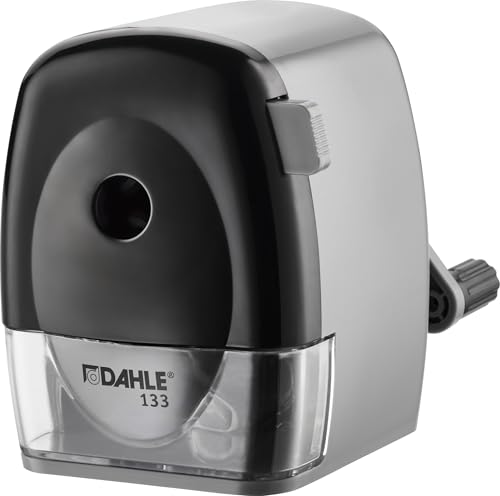
When working on large-scale colorwork charts, efficiency is paramount. This rotary model utilizes a high-quality cutting mechanism that produces a consistently sharp point without the erratic manual twisting of handheld blades.
The manual crank allows for a slower, more controlled pace than electric alternatives. This prevents the wax core from overheating—a common issue that causes wax to turn mushy and break off inside the sharpener.
Consider the footprint on your workspace before investing. This unit is best for a dedicated crafting station where you regularly refine your color palette notes.
T’GAAL Multisetting Sharpener: Most Versatile
Flexibility matters when you rotate between different pencil brands, each with varying levels of core softness. The T’GAAL features a sliding dial that adjusts the angle of the blade, catering to both steep, needle-like tips and broader, more durable points.
For softer, waxier pencils that require a shorter, sturdier tip to prevent breakage, simply set the dial to a shallower angle. This level of customization mimics the choice between using a blunt-tipped tapestry needle for seaming and a sharp circular needle for tight gauge work.
It is an excellent choice for a diverse collection of sketching tools. However, the plastic housing is less robust than metal alternatives and should be handled with care.
Bostitch QuietSharp Glow: Best Electric Option
Electric sharpeners are often avoided for wax pencils due to the aggressive nature of their motors. The QuietSharp Glow avoids the “shredding” effect by using a stall-free motor that stops automatically when the point reaches the desired sharpness.
This automatic stop is critical for expensive wax pencils. It eliminates the human error that leads to over-sharpening, which is the primary cause of internal lead fracture in soft-core materials.
Ensure you empty the shavings bin regularly, as the soft wax debris can accumulate and clog the cutter. It is a powerful tool for high-volume sketching but requires periodic maintenance to remain effective.
Prismacolor Premier Sharpener: Brand-Specific
This sharpener is engineered specifically for the unique diameter and core composition of its namesake pencils. When you rely on a specific brand of wax-based pigment, using a proprietary tool often yields the most consistent results.
The compact, dual-blade design offers a standard point and a wider point for different line weights. It is essentially the “pattern-specific tool” of the stationery world—optimized for one specific job.
Do not be tempted to use this on varying pencil sizes or wood densities. It is a specialized instrument meant for high-performance wax cores and should be kept exclusively for that purpose.
Faber-Castell Grip Trio: Best for Multi-Size
The Grip Trio handles everything from standard hexagonal drawing pencils to thicker, jumbo-sized coloring tools. Its versatility makes it the most reliable “all-in-one” choice for a varied pencil collection.
The design features three distinct holes with varying blade angles optimized for different pencil sizes. This ensures that a jumbo pencil—which has a different wood density—does not get mangled by a sharpener designed for standard lead.
If you maintain a workspace with multiple pencil types, this eliminates the need for a cluttered desk drawer. It is a practical, space-saving solution that does not compromise on build quality.
How to Choose the Right Sharpener for You
Selecting the right sharpener depends on how often you sharpen and the specific “hand” of your pencils. A pencil with a high wax content—comparable to a loosely plied, high-twist yarn—is inherently more prone to snapping and requires a sharpener with a high-quality steel blade.
Consider the frequency of your sharpening sessions. If you only sharpen once per project, a portable metal sharpener is sufficient. If you are constantly switching colors, a desktop rotary model will save time and reduce the likelihood of accidental drops.
Finally, prioritize blade quality over fancy aesthetics. A dull blade is the single greatest enemy of a soft-core pencil, leading to “chewed” wood and frequent core breakage.
Tips for Sharpening Without Breaking Your Pencils
Never force the pencil into the sharpener with excessive downward pressure. The blade should be doing the work; if you find yourself pushing hard, the blade is likely dull and needs replacing.
Keep your sharpening rhythmic and slow. Think of it as maintaining a consistent tension in your knitting; even, steady rotations produce the best results and prevent the internal core from fracturing against the blade edge.
Empty your sharpener frequently to prevent wax buildup. If wax shavings become compacted against the blade, they create a slippery, uneven surface that causes the pencil to catch and snap.
Manual vs. Electric: Which Is Better for Wax?
Manual sharpeners offer better tactile feedback, allowing you to “feel” if the wood is beginning to split or if the core is hitting a rough patch. This sensory input is invaluable for protecting soft-core pencils.
Electric models provide consistency but can be aggressive. If you opt for an electric sharpener, look for models with an automatic shut-off feature to prevent over-sharpening.
Ultimately, the choice comes down to your personal workflow. If you prefer the control of a hand-cranked spinning wheel, manual is best; if you value the efficiency of a high-speed winder for bulk yarn, an electric sharpener will suit your needs.
A great sharpener is as essential to your craft as a well-calibrated set of needles. By choosing a tool that respects the softness of your pencils, you ensure your charts and sketches remain as crisp and accurate as your tensioned stitches. Invest in quality blades, keep them clean, and your pencils will last through many successful projects.