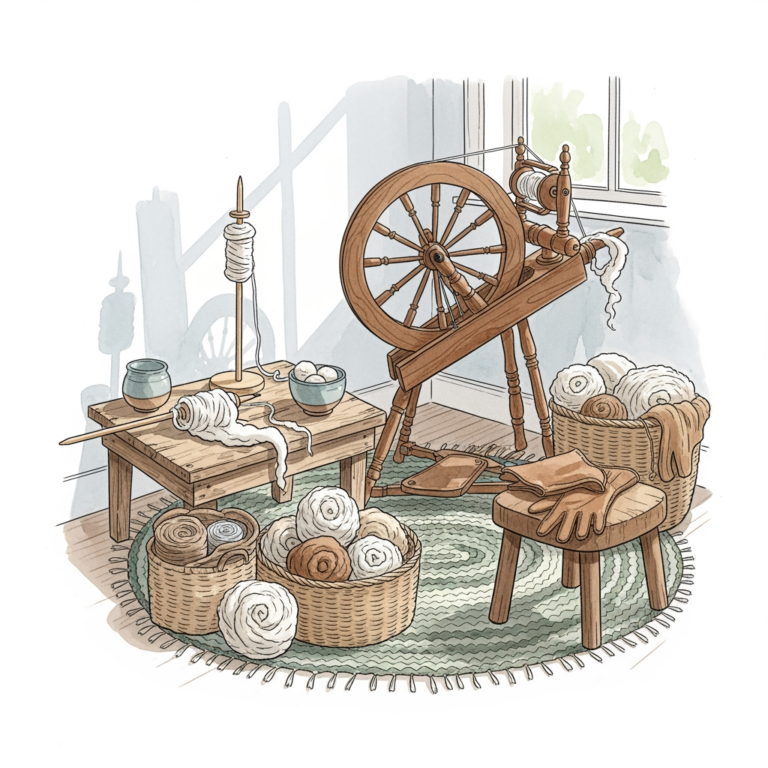
6 Best Spinning Wheel Foot Pedals For Ergonomic Use
Upgrade your craft with the 6 best spinning wheel foot pedals for ergonomic use. Discover comfortable, stress-free options to improve your spinning flow today.
Spinning a consistent yarn requires a rhythmic, meditative connection between the fiber and the wheel. When that rhythm is interrupted by stiff joints or an unresponsive pedal, the quality of the singles inevitably suffers. Achieving a perfect twist per inch (TPI) depends as much on the ergonomics of the feet as it does on the hands. Investing in the right interface between the spinner and the wheel transforms a fatiguing chore into a seamless, hours-long creative session.
Ashford E-Spinner Controller: Most Versatile
The Ashford E-Spinner controller shines for those who prioritize fine-tuned speed control over mechanical treadling. By decoupling the spinning motion from physical footwork, it allows for a stationary, relaxed posture.
This controller is particularly beneficial for spinners with limited mobility or those who prefer to focus entirely on fiber drafting. The dial-based interface offers precise increments, ensuring that delicate lace-weight singles remain consistent throughout the entire bobbin.
While electric controllers lack the tactile feedback of a mechanical treadle, they provide unmatched stability. Consistency is the primary advantage here, especially when working with challenging fibers like silk or slippery mohair that require constant, unwavering RPMs.
Schacht Matchless Treadles: Smoothest Action


The Schacht Matchless is widely regarded as the gold standard for mechanical responsiveness. Its treadles utilize a unique linkage system that creates a fluid, almost weightless motion during operation.
For long spinning sessions, this lack of resistance significantly reduces calf and ankle fatigue. When you are working on a massive spinning project, such as gathering enough yardage for a cabled-aran sweater, this mechanical ease is a game-changer.
Because the movement is so light, it requires very little physical force to maintain momentum. Opt for this system if joint health is a priority and you intend to spend hours at the wheel without experiencing the “stiffness” often associated with heavy-duty spinning.
HansenCrafts miniSpinner Switch: Top Choice
HansenCrafts provides a compact, highly responsive foot switch that bridges the gap between manual and electric spinning. It allows the spinner to maintain a hands-free start-stop mechanism without the footprint of a traditional treadle wheel.
This switch is a top choice for those who value floor space and portability. It functions with a simple, high-quality tactile response that prevents the “jerkiness” often found in cheaper electronic pedals.
When managing high-twist yarns, the ability to instantly kill the motor is a safety feature that shouldn’t be overlooked. It is the most efficient solution for the modern spinner who demands precision in a small, organized studio space.
Kromski Fantasia Treadles: Great for Portability
Kromski treadles are designed with a focus on geometric balance and ease of transport. They feature a dual-treadle setup that allows for a natural, alternating walking motion that keeps the body aligned.
Portability does not come at the cost of stability with these treadles. They are weighted perfectly for those who attend retreats or guild meetings where moving the wheel is a regular occurrence.
The design encourages a centered, symmetrical posture, which prevents the hip-tilting that often occurs with single-treadle wheels. If you travel to fiber events frequently, these treadles offer the best balance of travel-friendly dimensions and ergonomic support.
Lendrum Double Treadle: Best Folding Design
The Lendrum double treadle system is famous for its space-saving engineering. It allows the wheel to be folded entirely while keeping the drive system intact, making it an architectural feat in the spinning world.
The treadles provide a smooth, circular motion that feels more like walking than pushing. This helps maintain a steady rhythm, which is essential when spinning long-draw techniques or working with high-loft wools like Corriedale or Rambouillet.
Reliability is the hallmark of the Lendrum design. The mechanism is robust, ensuring that the treadles remain silent and smooth even after years of heavy, daily use.
Daedalus Starling Pedal: For Tech-Savvy Spinners
The Daedalus Starling pedal system is built for the spinner who views their wheel as a precision instrument. It features highly customizable sensitivity, allowing the user to map the pedal’s output to their own specific spinning speed.
This is the ultimate tool for those who spin high-speed bobbins or complex novelty yarns that require rapid fluctuations in speed. It offers a level of granularity that mechanical treadles simply cannot replicate.
Be prepared for a learning curve, as the digital interface requires some time to master. However, for those who spin for production or design, the control provided is unparalleled.
Choosing Your Pedal: Treadle vs. E-Spinner
Selecting between a manual treadle and an electronic pedal depends on your physical stamina and your spinning style. Manual treadles require engagement of the core and legs, which can be an excellent physical workout but may lead to fatigue during marathon sessions.
Electronic pedals, by contrast, offer total physical freedom. They are ideal for spinners who want to focus exclusively on the drafting triangle—the space where the fibers leave the hands and enter the orifice.
- Choose a Treadle if: You value the mechanical, rhythm-based tactile connection of traditional spinning.
- Choose an E-Spinner Pedal if: You suffer from repetitive strain injuries or want to maximize consistency in your twist.
Tips for Ergonomic Treadling and Posture
Ergonomics in spinning start with the chair height. Your hips should be slightly higher than your knees, creating a downward slope that prevents lower back strain.
Always ensure the wheel is positioned so that your arms remain at a comfortable, open angle. Over-stretching the arm can lead to shoulder tension, which manifests as uneven drafting and broken singles.
- Keep feet flat: Always use the ball of your foot for the treadle, never just the toes.
- Alternate legs: If using a single treadle, switch legs periodically to prevent muscle imbalances.
- Mind the gaze: Look ahead, not down at the orifice, to prevent neck tension.
Single vs. Double Treadle: Which Is Better?
Single treadles are often lighter and offer a slightly higher gear ratio for some wheels, but they can create an uneven distribution of effort. If you find yourself favoring one side of your body, your hips may become misaligned over long periods.
Double treadles mimic the natural gait of walking, which is generally more ergonomic for the hips and lower back. They also make starting the wheel significantly easier, as the motion is inherently more balanced.
Most advanced spinners eventually gravitate toward double treadles for their superior ability to start and stop the wheel smoothly. The transition to double treadling is usually worth the minor adjustment in coordination.
Setting Up Your Wheel for Maximum Comfort
The final piece of the ergonomic puzzle is the relationship between the wheel height and your eye level. If you are constantly hunching over your work, your hands will inevitably move too fast, leading to thin, brittle yarn.
Take the time to adjust your wheel’s height if the model permits. If it does not, invest in a chair with adjustable height or a seat cushion to align your body properly.
Listen to your body. If you feel strain in your wrists, look at your drafting tension; if you feel it in your back, look at your chair. A properly set up station will allow you to spin for hours, producing yards of perfectly balanced, beautiful yarn without pain.
Mastering the mechanics of your spinning wheel is an investment in your longevity as a fiber artist. By prioritizing ergonomic alignment and choosing a pedal system that complements your body’s unique needs, you ensure that every yard of yarn is a pleasure to produce. Experiment with these setups to find the perfect rhythm, and your spinning will become as effortless as it is rewarding.