6 Best Rotary Cutter Mats For Large Scale Projects
Tackle your biggest sewing and quilting tasks with ease. Discover the 6 best rotary cutter mats for large-scale projects and upgrade your workspace setup today.
When preparing fabric for a quilt backing or cutting yardage for garment lining, the surface beneath the blade is just as important as the rotary cutter itself. A quality mat prevents dulling blades prematurely and ensures precise, clean cuts through multiple layers of fabric. For large-scale projects, stability and surface area are non-negotiable requirements for success. Invest in a mat that matches the scale of the work to avoid frustrating, uneven seams.
Olfa Folding Cutting Mat: Best for Portability


Large mats are often cumbersome to store, but the Olfa Folding Cutting Mat addresses this by featuring a specialized hinge system. This design allows the mat to fold down to half its size, making it a perfect fit for makers who commute to knitting circles or have limited workspace.
The folding mechanism is surprisingly smooth and flat when opened, ensuring that rotary blades do not catch on the seam during use. This is crucial when trimming long, straight edges for a complex pieced project or squaring up a massive quilt top.
However, the seam remains the most vulnerable point of the mat. Over time, consistent pressure at the hinge can result in a slight ridge, so keep the heavier cutting tasks centered on the solid panels rather than the fold.
Fiskars Self Healing Rotary Mat: Top All-Rounder

Fiskars is a staple in the fiber arts world, and their self-healing mat is consistently reliable for everyday studio use. It offers a balance of firmness and flexibility that keeps the blade tracking straight without requiring excessive downward force.
The surface is printed with clear, high-contrast grid lines that simplify the process of measuring bias strips or cutting fabric blocks to size. If the project requires precise geometric shapes—like those found in intricate quilt patterns—the grid becomes an essential reference guide.
While these mats are resilient, they are not invincible. Avoid using dull blades, as they tend to tear the surface rather than slice through it, which ruins the self-healing properties of the mat over time.
Sullivans Cutting Edge Mat: Best for Durability
Durability is the primary focus of the Sullivans Cutting Edge Mat, which utilizes a thicker, multi-layered construction. For those who frequently work with heavy-duty fabrics like denim or canvas, this mat stands up to repeated, high-pressure cuts better than thinner alternatives.
The mat features a non-slip backing that prevents the surface from shifting while cutting, which is a major advantage when working on slick tabletops. It minimizes the risk of fabric sliding out of alignment, ensuring the final piece matches the intended pattern exactly.
This added thickness does come with a weight penalty. It is best suited for a permanent studio station rather than a setup that needs to be moved or packed away frequently.
Dahle Vantage Self-Healing Mat: Premium Choice
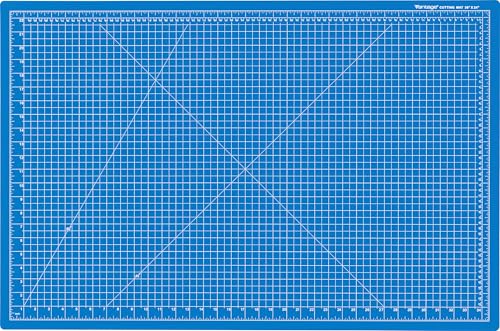
The Dahle Vantage mat earns its reputation as a premium option through its superior internal structure and finish. It is exceptionally dense, which provides a satisfying, stable feeling under the blade that promotes cleaner cuts and longer blade life.
The surface is engineered to withstand deep cuts without warping or cracking, even under the intense pressure of repeated use. It serves as a professional-grade foundation for makers who view their tools as long-term investments rather than temporary supplies.
Because it is designed for heavy use, the mat requires a bit more care to keep clean. Wipe it down periodically with a damp cloth to remove microscopic fabric fibers that can get trapped in the surface over time.
Arteza Rotary Cutting Mat: Best for Budget Option

The Arteza mat offers a high-value proposition for those who need a large surface area without a significant upfront cost. It provides a standard, reliable self-healing surface that performs perfectly well for routine garment sewing and quilting tasks.
Despite the lower price point, it features clear, easy-to-read markings that are essential for accurate cutting. It is an excellent choice for a beginner building a home sewing kit who does not yet need the heavy-duty features of a professional-grade mat.
The tradeoff lies in the long-term longevity of the self-healing layer. It may show deeper grooves sooner than a premium mat, so rotate the cutting position frequently to spread the wear evenly across the surface.
U.S. Art Supply Mat: Largest Single Surface

For projects requiring massive, continuous cuts without the distraction of a seam, the U.S. Art Supply mat is the industry standard. This mat provides a cavernous workspace that allows for full-length cuts on large fabric pieces without needing to reposition the material.
The mat is firm yet forgiving, protecting your blades while providing enough resistance for precise measurement. It is especially useful for makers who specialize in large-scale quilts or home decor projects like curtains and tablecloths.
Ensure the surface underneath the mat is perfectly flat and free of debris. On a mat this large, even a small grain of sand or a stray pin left on the table can create a bump that compromises the accuracy of the entire cut.
How to Choose Your Ideal Cutting Mat Size
- Measure your workspace: Ensure the mat is at least two inches smaller than your table surface on all sides.
- Consider your primary project: If you make large quilts, a 24×36 inch mat is the minimum recommended size for ease of movement.
- Factor in storage: If space is at a premium, look for folding options or mats that can be hung vertically.
- Account for margins: Always opt for the largest size that fits your table, as it is easier to work on a larger surface than to maneuver fabric on a cramped one.
What Does “Self-Healing” Actually Mean?
“Self-healing” refers to the mat’s ability to pull itself back together after being sliced by a rotary blade. The mat is composed of high-density layers that are designed to close the gap created by the blade tip.
It is important to understand that the mat does not literally heal itself like biological tissue. If you cut too deeply or use a dull blade that forces the mat to tear, the grooves will remain permanently open.
Use sharp blades and consistent, light pressure to maintain the surface. Think of the blade as gliding across the top of the mat rather than digging into it; a light touch is the secret to a long-lasting surface.
Keeping Your Mat Flat and Clean for Life
Never roll your cutting mat for storage, as this creates a permanent curl that is nearly impossible to correct. If a mat arrives curled, lay it flat in a warm room or out in the sun briefly—never direct heat—to allow the material to relax.
Clean the mat regularly by wiping it down with a mixture of water and a tiny drop of mild dish soap. This removes thread lint and fabric dust that can make the surface feel “sticky” or dull the blade prematurely.
Avoid using harsh chemicals or solvents, as these can break down the proprietary materials that give the mat its self-healing properties. A clean mat is a precise mat.
Folding vs. Solid Mats: The Big Trade-Off
Folding mats offer the convenience of portability but always present a seam that requires navigation. While high-end folding mats are engineered to minimize this, the physical break in the surface remains a reality of the design.
Solid mats provide a seamless, continuous workspace that is ideal for precision cutting and long, uninterrupted lines. The disadvantage is their lack of mobility; they require dedicated storage space and can be cumbersome to move from room to room.
If the majority of the work takes place at a stationary table, prioritize a solid mat for its structural integrity. If the studio space is shared or nomadic, a folding mat is a necessary compromise that maintains productivity.
Choosing the right rotary cutting mat transforms a potentially tedious, inaccurate process into a seamless part of the craft. Whether prioritizing the portability of a folding mat or the expansive, seamless surface of a large solid model, the goal remains the same: accuracy, efficiency, and the protection of tools. Invest in a mat that respects the time and materials committed to every project, and it will serve the studio for years to come.