6 Leather Edge Slickers For Smooth Finished Seams
Achieve professional results with our guide to the 6 best leather edge slickers for smooth finished seams. Read our expert reviews and upgrade your kit today.
Leatherwork and knitting share a common obsession with the final finish, where the quality of the edge dictates the longevity and professional appearance of the piece. Just as blocking a lace shawl transforms a crumpled swatch into a crisp, geometric masterpiece, burnishing a leather edge elevates a simple strap into a refined accessory. Choosing the right tool for this process is as critical as selecting the correct needle size for a specific yarn weight. The following guide breaks down the essential leather slickers, ensuring every project receives the polished treatment it deserves.


Tandy Cocobolo Slicker: The Classic Choice

This traditional hardwood tool remains a staple for a reason. Its dense, oily grain makes it exceptionally resistant to wear, much like how high-quality ebony knitting needles offer a consistent, smooth surface for decades of use.
The varied grooves are designed to accommodate different leather thicknesses, similar to how a knitter selects a specific needle gauge based on a yarn’s WPI (wraps per inch). It is a reliable, no-nonsense tool that provides enough friction to generate the heat needed to compress leather fibers.
Bottom line: If you prefer a manual, tactile approach that mirrors the rhythmic satisfaction of hand-knitting, this slicker is the industry standard.
WUTA Multi-Size Slicker: Versatile Grooves
Precision is the hallmark of the WUTA multi-size slicker, offering a wide array of slot widths. This versatility is essential when switching between projects, such as moving from a delicate, single-ply lace yarn to a bulky, multi-ply wool.
The tighter tolerances in the grooves allow for a more uniform burnish on thinner leather edges. This reduces the risk of marring the surface, much like using a smaller, sharper needle tip prevents splitting plied yarn.
Bottom line: For the maker who toggles between varied leather weights, this tool eliminates the need for an entire collection of individual wooden dowels.
Flickering Llama Glass: For a Mirror Shine

Glass slickers operate on a completely different principle than wood, focusing on friction and surface pressure rather than heat-induced compression. They are favored for achieving a glass-like, high-gloss finish that wood simply cannot replicate.
Because glass is non-porous, it does not absorb burnishing agents like gum tragacanth, keeping the tool perfectly clean. Think of this as the difference between knitting with polished stainless steel needles versus wooden ones; one provides glide and clarity, while the other offers control.
Bottom line: Choose glass if the final aesthetic goal is a sleek, modern, mirror-like edge that stands out against the matte texture of the leather.
KemovanCraft Electric: Power and Precision
An electric edge burnisher functions like a power-assisted knitting machine, drastically reducing the physical effort required for long, continuous seams. It utilizes a motor to spin a wooden attachment, creating rapid, consistent heat through constant friction.
This tool is invaluable for high-volume production or when working with thick, vegetable-tanned leathers that require immense pressure to fully compress. It is the practical choice for those who find manual burnishing exhausting, much like transitioning to a knitting loom for a blanket project.
Bottom line: If your workflow involves long belts or thick bag straps, the time saved by an electric slicker justifies the investment.
YISTAR Dremel Tips: A Rotary Tool Upgrade
These tips allow you to convert a standard rotary tool into a professional-grade burnishing station. They are compact, easily swapped, and provide the high-speed friction necessary for rapid edge finishing.
However, caution is required, as the high speed can easily burn the leather if not managed correctly. Just as high-twist, superwash wool can become singed or damaged if caught in a friction-heavy environment, leather can lose its finish if the tool lingers too long on one spot.
Bottom line: This is a modular, space-saving solution for the knitter who already has a rotary tool on hand for other craft-related repairs.
Basic Hardwood Slicker: Budget-Friendly Start
A basic hardwood slicker is often little more than a shaped piece of oak or maple, yet it performs the fundamental task of fiber compression flawlessly. Beginners often overcomplicate their tool kit, forgetting that the quality of the finish depends more on the technique than the price tag.
Much like a pair of basic aluminum knitting needles can yield a perfect stockinette stitch when wielded by a skilled hand, a simple wood slicker creates a beautiful edge with enough elbow grease. It is an affordable entry point for those just beginning their leatherworking journey.
Bottom line: Save the budget for high-quality leather and thread; the basic slicker is all a novice needs to get started.
Choosing the Right Slicker for Your Project
Selecting the correct slicker depends entirely on the thickness of the leather and the desired final texture. For light-weight, delicate leather, opt for a narrow-grooved wooden slicker to avoid over-stretching the material.
If you are working with thick, heavy-duty leather, a wider groove or an electric attachment provides the force needed for deep compression. Always consider the scale of your project: a handheld wooden tool suffices for a wallet, while an electric motor is a boon for heavy luggage straps.
Bottom line: Match the tool to the leather density and the scale of the project, just as you would match a needle material to the grip and weight of your yarn.
How to Burnish Edges: A Step-by-Step Guide
- Sand the edge: Start with a high-grit sandpaper to smooth out uneven edges, similar to removing pilling from a finished sweater.
- Apply agent: Apply a small amount of gum tragacanth or water to the edge with a wool dauber or cloth.
- Burnish: Select the appropriate groove on your slicker and move it back and forth with steady, firm pressure until the edge is smooth and shiny.
- Repeat: If necessary, sand lightly and repeat the process for a deeper, more refined look.
Bottom line: Consistency in technique, rather than speed, is the secret to a professional result that stands the test of time.
Wood vs. Glass Slickers: Which Is Better?
Wood slickers excel by creating friction that generates heat, which effectively fuses leather fibers together. This is ideal for most projects, offering a natural, matte-to-satin finish that feels organic and soft to the touch.
Glass slickers, conversely, are best suited for achieving a high-shine, clinical finish. They are easier to keep clean and do not leave behind wooden fibers or splinters, but they lack the organic “bite” that some wood tools provide during the initial burnishing phase.
Bottom line: Wood is the superior all-rounder for most fiber-adjacent crafters, while glass is a specialized tool for that specific, ultra-polished look.
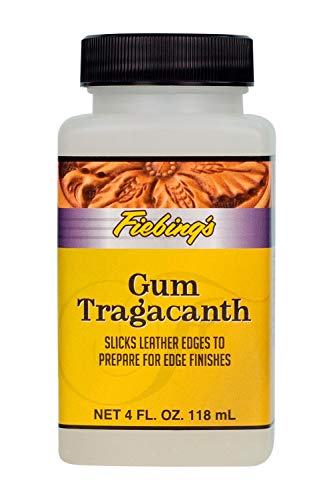
Do You Need Gum Tragacanth for a Pro Finish?
Gum tragacanth is a plant-based agent that acts as a lubricant and binder for leather fibers. While water can be used for basic burnishing, gum tragacanth provides a superior, long-lasting seal that is resistant to moisture and wear.
Think of it as the difference between blocking a piece with plain water versus using a delicate wool wash; both work, but the latter provides a finish that is more durable and pleasant to handle. For high-end projects, the minimal cost of the agent is worth the professional durability it imparts.
Bottom line: While optional for practice pieces, a burnishing agent is essential for any item intended for frequent, daily use.
Investing in the right edge-finishing tools transforms your leather projects from handmade curiosities into durable, professional accessories. By understanding how friction and pressure interact with leather, you can achieve results that complement the longevity and care you already pour into your knitting.