7 Best Craft Station Lights For Evening Projects To Try
Brighten your workspace with our top 7 best craft station lights for evening projects. Choose the perfect lighting to improve your precision and shop now.
Late-night knitting sessions often lead to eye strain, especially when working with dark-colored yarns or intricate lace charts. Choosing the right light source transforms these evening hours from a struggle against shadows into a productive, relaxing experience. Proper illumination highlights stitch definition and prevents the common mistake of missing a yarn-over or dropping a stitch. Investing in quality lighting is just as critical for your craft as selecting the right needle material or yarn weight.
Brightech Litespan: Best All-Purpose Floor Lamp
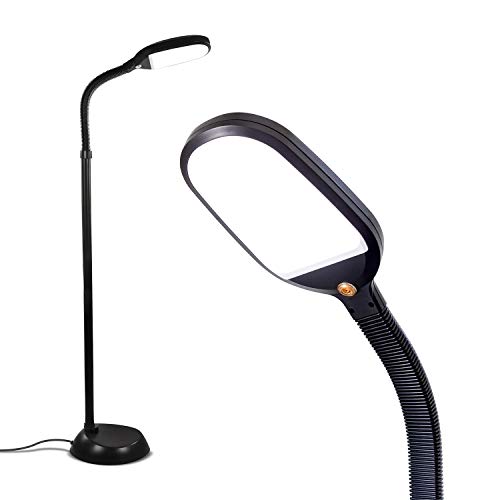

The Brightech Litespan offers a clean, neutral glow that mimics natural daylight, which is essential when tracking your progress on complex cable patterns. Its adjustable gooseneck allows for precise positioning, meaning you can direct the light exactly onto your lap without creating glare on your needles.
For knitters working with dark navy, black, or charcoal wool, this lamp provides the necessary clarity to see each individual loop. It effectively reduces the squinting that leads to headaches during long hours of evening project work.
While it lacks the heavy industrial look of some studio lamps, its footprint is remarkably small, making it ideal for tight spaces. Consider this a reliable workhorse for general knitting needs.
Daylight Omega 7: Best Magnifying Task Lamp

When dealing with fine lacework or fixing a dropped stitch in a delicate mohair project, standard lighting often falls short. The Daylight Omega 7 integrates a high-quality magnifying lens that brings every stitch into sharp focus, significantly reducing the mental fatigue associated with tight gauge work.
The large lens provides a wide field of view, so you do not have to constantly adjust your positioning as you move across a row. This is particularly helpful when checking your work against a printed chart or counting rows in a complex transition.
This lamp is a significant investment, but the reduction in eye strain is worth the cost for those who knit regularly with fingering weight yarn or smaller. It effectively acts as an extra pair of eyes for the meticulous maker.
Glocusent Neck Light: Best for Knitting Anywhere
The Glocusent Neck Light provides a hands-free solution that moves with the knitter, making it the perfect companion for reading or knitting on the sofa. Because the light source follows your gaze, it illuminates the area directly between your hands without bothering others in the room.
Different color temperature modes allow for a warmer light if you find cool tones too harsh during late-night hours. It is lightweight and doesn’t interfere with your arm movement, even when knitting with longer circular needles.
Keep in mind that while portable, it will never match the raw power of a dedicated desk or floor lamp. Use it for relaxed, meditative knitting rather than precision technical work where you need to see every fiber.
BenQ e-Reading Lamp: The Ultimate Splurge Light

The BenQ e-Reading Lamp utilizes a curved head design that illuminates an incredibly wide area, perfect for makers who spread their patterns, needles, and notions across a large table. Its sensor technology automatically adjusts brightness based on ambient conditions, ensuring consistent lighting as the evening progresses.
This lamp is designed to eliminate flicker, which is a major contributor to eye fatigue during high-focus sessions like stranded colorwork. The build quality is exceptional, offering a stability that cheaper plastic alternatives lack.
While the price point is high, the durability and visual comfort make it a lifetime tool. It is the premier choice for serious knitters who treat their workspace as a dedicated studio.
OttLite 13w Craft Lamp: Top Compact Desk Light
The OttLite 13w Craft Lamp is a staple for a reason: it delivers consistent, balanced lighting in a compact package that fits easily on a bedside table or end table. Its specialized bulbs are engineered to simulate natural daylight, which is crucial for distinguishing between similar shades of yarn.
If you keep a dedicated “knitting corner” in your home, this lamp provides enough coverage to see your stitch definition clearly without overwhelming the space. It is simple, effective, and free of unnecessary bells and whistles.
Note that the bulbs will eventually need replacing, so factor the cost of replacement tubes into your long-term budget. It remains one of the most reliable options for small-space crafters.
LuminoLite Clip-On: Your Best Travel Companion

For knitters who take their projects on long car rides or airplane trips, the LuminoLite Clip-On is an essential accessory. It attaches securely to your favorite knitting bag or a book, providing a concentrated beam exactly where you need it.
It is small enough to fit into a project bag pocket, ensuring you are never caught without light during a dark commute. While it won’t replace your main lamp at home, it serves its purpose perfectly as a portable light for finishing a few rows of a sock heel.
Battery life is generally sufficient for several evenings of knitting, but always keep a spare set on hand. It is the practical choice for the knitter on the go.
DEWENWILS Floor Lamp: A Solid Budget-Friendly Pick
The DEWENWILS Floor Lamp offers a straightforward, adjustable design that delivers excellent value for the price. It provides a focused light stream that is perfect for highlighting your work without casting distracting shadows across your yarn.
This lamp is ideal for beginners who are building their toolkit but are not yet ready to invest in premium high-end lighting. It covers the basics reliably and features a stable base that won’t tip over easily.
While the materials might feel more utilitarian than luxury, the functional performance is high. It is a fantastic entry point into better craft lighting that prioritizes performance over aesthetics.
How to Choose the Right Light for Your Craft Space
When evaluating a lamp, consider the physical layout of your knitting chair and the type of projects you typically finish. A lamp that works for a chunky, light-colored wool blanket may be insufficient for a black lace shawl.
- Reach and Adjustability: Ensure the lamp can sit behind or beside you to avoid glare hitting your eyes.
- Weight and Stability: A floor lamp should have a heavy enough base to remain steady if it is accidentally bumped by a ball of yarn.
- Dimming Capabilities: Adjustable brightness levels are essential for managing eye fatigue over long periods.
Always measure the distance between your sitting position and the potential lamp location before purchasing. The right light should illuminate your hands and needles comfortably without creating a “hot spot” that washes out the texture of your yarn.
Lumens vs. Kelvin: What Knitters Need to Know
Understanding two key terms is vital: Lumens measure how bright the light is, while Kelvin measures the color temperature. For knitting, you want enough lumens to see details, but you need the right Kelvin to see colors accurately.
- Lumens: Look for 400 to 800 lumens for most craft tasks.
- Kelvin: Aim for a range between 4000K and 5000K for “daylight” balance.
Avoid lamps that fall into the “warm” (below 3000K) range, as they can make it difficult to distinguish between subtle color shifts in your yarn. Conversely, anything over 6000K can feel harsh and clinical, turning your cozy knitting space into an office environment.
Does Your Light Show True Yarn Colors? About CRI
The Color Rendering Index (CRI) is a scale from 0 to 100 that indicates how accurately a light source reveals colors compared to natural daylight. A higher CRI is critical for knitters, especially when working on colorwork or matching dye lots for a large sweater project.
Look for a lamp with a CRI of 90 or higher. At this level, deep blues, dark greens, and subtle purples will appear as they truly are, rather than appearing muted or shifted toward gray.
Ignoring CRI can lead to expensive mistakes, such as unknowingly pairing two slightly different shades of the same color. Always check the product specifications for CRI, as it is the most honest indicator of color accuracy in artificial lighting.
Finding the perfect light for your knitting space is a process of balancing your specific project needs against your available space and budget. Whether you choose a high-end magnifying lamp for fine lace or a simple, portable clip-on for travel, the goal is always to keep your stitches visible and your eyes comfortable. By prioritizing color accuracy and flicker-free illumination, you ensure that every stitch you make is as beautiful as you intended, regardless of the time of day.