6 Precision Calipers For Measuring Antique Jewelry Components
Find the best precision calipers for measuring antique jewelry components. Compare our top six recommendations and improve your restoration accuracy today.
Precision measurement is just as vital for the vintage lace restorer or the jewelry-making crafter as it is for the knitter checking needle diameter. When dealing with antique components, fractions of a millimeter determine whether a clasp will seat correctly or a precious bead will stress a delicate wire. Accuracy prevents the frustration of mismatched parts that don’t quite fit the heirloom piece. Selecting the right caliper transforms a guessing game into a repeatable, professional process.
iGaging OriginCal: The Best Overall Value Pick


The iGaging OriginCal stands out because it offers an absolute scale, meaning it remembers its zero position even after the display turns off. For a crafter measuring a series of vintage findings, this eliminates the constant need to re-calibrate between measurements.
It bridges the gap between affordable hobbyist tools and high-end shop equipment. The construction feels substantial in the hand, providing the stability needed when holding tiny, slippery antique metalwork.
While not as rugged as industrial-grade tools, its precision is more than adequate for non-structural jewelry components. It remains the top choice for those who want professional-grade reliability without paying for redundant industrial certifications.
Mitutoyo 500-196-30: The Professional’s Choice

Mitutoyo remains the industry standard for a reason: the build quality is unmatched, and the sliding movement is exceptionally smooth. When measuring antique components where even slight pressure could scratch a delicate finish, this smoothness allows for an incredibly light, precise touch.
The measurement repeatability is absolute, providing peace of mind when assessing expensive vintage findings. If the task involves high-stakes restoration where accuracy simply cannot be compromised, this is the investment to make.
The trade-off is the significant price point, which may be overkill for casual hobbyists. However, for those who demand a tool that will last for decades, the cost per year of use becomes negligible.
Neiko 01407A: The Best Precision Budget Option
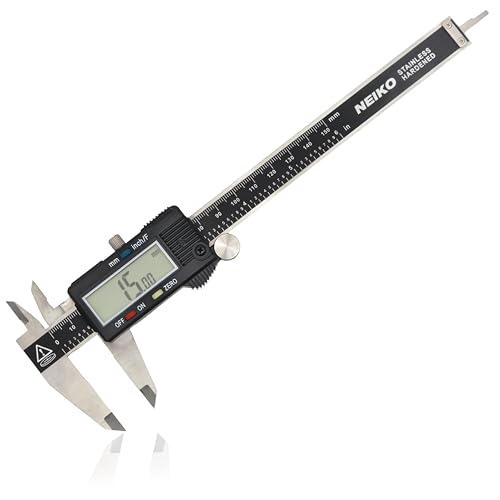
The Neiko 01407A is a functional, no-frills digital caliper that excels at basic measurement tasks. It is ideal for the beginner who needs to verify findings or bead sizes occasionally but does not require laboratory-grade data.
The display is large and easy to read, which is a major benefit when working under magnifying lamps. While the build materials are lighter than more expensive models, the accuracy remains surprisingly high for its price bracket.
Be aware that battery drain can be faster than with premium brands, so keep a spare on hand. For infrequent use, it is an efficient and cost-effective addition to the workbench.
Fowler Dial Caliper: Top Choice for Analog Fans
Dial calipers offer a mechanical simplicity that many experienced makers prefer over digital displays. There are no batteries to die mid-project, and the visual feedback of the sweeping needle provides an intuitive sense of scale.
Fowler manufactures these with excellent gear-tooth precision, resulting in a smooth dial movement that doesn’t hang or skip. The clear, high-contrast face makes reading measurements under low light very straightforward.
Some users find the dial slightly slower to read than a digital screen, requiring a bit of practice to interpret the secondary marks. For those who enjoy tactile, mechanical tools, however, it is the gold standard for analog measurement.
VINCA DCLA-0605: A Solid Pick for Daily Use

The VINCA DCLA-0605 occupies the middle ground, offering a solid stainless steel body and reliable digital accuracy. It serves as an excellent “workhorse” tool that won’t require babying during daily bench sessions.
The inclusion of an RS232 data port is a niche feature, but the overall ergonomics are what really count for the average user. It feels balanced in the hand, reducing fatigue during long sessions of sorting through collections of antique jewelry parts.
It is a dependable tool that balances cost and durability effectively. It is the perfect choice for the maker who wants a step up from budget models but isn’t ready for the Mitutoyo price tag.
General Tools 1271: A Classic Vernier Caliper
Vernier calipers are the original precision instrument, relying entirely on the user’s eye to align scale markings. They are practically indestructible, with no electronics or delicate gears to fail.
Using a Vernier caliper requires a steeper learning curve, but it teaches a deep understanding of scale and measurement. It is an excellent choice for a dedicated maker who appreciates the craft of manual precision.
If you struggle with fine print, the small scale markings on a Vernier can be challenging to read. However, for those who value tradition and simplicity, it is a timeless, reliable tool that will never need a software update.
Digital vs. Dial vs. Vernier: Which is for You?
Digital calipers provide the fastest results and are the easiest to read, making them perfect for high-volume sorting. Dial calipers offer a reliable, battery-free experience with a tactile feel that many makers find more satisfying. Vernier calipers are the most durable, but they demand the highest level of manual skill and keen eyesight.
- Digital: Best for efficiency, quick checks, and users who prefer large, clear displays.
- Dial: Ideal for those who dislike batteries and prefer a smooth, mechanical gear movement.
- Vernier: Superior for long-term reliability in environments where electronics might be sensitive or batteries are unavailable.
Consider your work environment and your own patience levels. If you are prone to misplacing batteries or prefer tools that feel like fine instruments, choose a dial model.
How to Measure Gemstones Without Damaging Them
When measuring antique gemstones, always apply the lightest pressure possible to avoid chipping edges or stressing old settings. Digital calipers with a “hold” function are particularly useful here, as they allow the measurement to be locked and read away from the stone.
Always ensure the jaws are clean and free of grit before coming into contact with the piece. Using a protective thin layer of jeweler’s cloth over the jaws can provide extra security for brittle materials like opal or soft pearls.
Measure twice to confirm the reading, rather than squeezing harder to “check” the fit. Gentle handling is the hallmark of a skilled restorer.
Caring for Your Calipers: A Quick Maintenance Guide
Keep your calipers stored in their protective case to prevent impact damage to the precision jaws. Dirt, dust, and moisture are the enemies of both digital and mechanical calipers; a quick wipe with a dry, lint-free cloth after each session preserves their longevity.
For digital models, remove the battery if the tool will be stored for several months to prevent leakage. If the slide feels stiff, a tiny drop of instrument oil applied to the tracks can restore its smooth action.
Never use your calipers to force a measurement. If a component does not fit easily between the jaws, use a different part of the gauge or reassess the fit rather than pushing.
Reading Caliper Jargon: ID, OD, and Depth Explained
Understanding the three main measurement modes allows you to utilize your tool to its full potential. OD (Outside Diameter) is used for the majority of jewelry tasks, such as measuring the width of a bead or the thickness of a wire. ID (Inside Diameter) utilizes the smaller, top jaws to measure the interior space of a ring shank or a tube setting.
The Depth rod, which extends from the bottom of the caliper, is essential for measuring the height of a setting or the depth of a drill hole in a gemstone. Mastering these three positions makes you far more versatile than a maker who only uses the primary OD jaws.
Always check the orientation of the jaws before closing them to ensure you are getting an accurate reading. A clear grasp of these functions is the difference between a rough estimate and a precision fit.
The right measuring tool is the silent partner in every successful restoration or jewelry project. By selecting a caliper that matches your patience for maintenance and your need for accuracy, you ensure that every antique component finds its rightful place. Precision is not just about the numbers; it is about the care and respect for the materials you handle every day.