7 Best Steamer Units For Refreshing Costume Wrinkles
Refresh your wardrobe with ease. Discover the 7 best steamer units for removing costume wrinkles and keep your favorite outfits looking sharp. Shop our top picks!
Costumes and intricate knit garments often arrive from storage with stubborn creases that threaten to derail the drape of a finished piece. While traditional blocking is essential for establishing final dimensions, a reliable steamer serves as the primary tool for daily maintenance and quick refreshes before a showcase. Choosing the right unit prevents moisture damage to delicate fibers while ensuring that structural elements, like cables or pleats, remain crisp. The following guide highlights the most effective steaming solutions tailored for the unique requirements of fiber arts and wearable textiles.
Conair Turbo ExtremeSteam: Best Overall Power


The Conair Turbo ExtremeSteam earns its reputation through sheer output, making it ideal for thick wools or multi-layered costume pieces. Its high-heat setting produces a consistent flow of steam that penetrates heavy fibers without requiring multiple passes.
This model is particularly effective when working with high-twist yarns that tend to hold memory in their folds. The built-in metal plate acts as an iron to flatten stubborn wrinkles, though caution is required to avoid compressing the loft of delicate mohair or brushed fibers.
- Key Advantage: Rapid, high-volume steam output.
- Best For: Heavyweight fabrics and structured, multi-layer garments.
Hilife Handheld Garment Steamer: Top Budget Pick
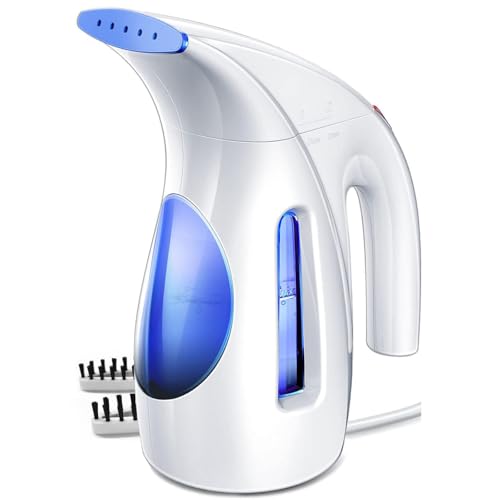
For makers who prioritize portability without sacrificing essential functionality, the Hilife Handheld represents a sensible entry point. It is lightweight, intuitive, and handles standard garment weights with ease.
While it lacks the pressure intensity of professional-grade units, it is perfectly suited for removing light wrinkles from finished scarves or delicate silk-blend garments. Be mindful that its smaller reservoir requires more frequent refills, which may interrupt long steaming sessions.
- Key Advantage: Compact size and ease of use.
- Best For: Quick touch-ups on smaller projects or lightweight accessories.
Polardo Travel Steamer: Best for On-the-Go Fixes

Travel steamers need to be leak-proof and reliable, especially when transporting finished garments to shows or events. The Polardo is designed specifically to prevent the dreaded water spotting that can ruin a fragile knit.
The unit’s construction is robust enough to survive being packed in a project bag. It strikes an excellent balance between heating time and steam duration, ensuring that a last-minute wrinkle in a delicate shawl is smoothed out moments before stepping onto the stage.
- Key Advantage: Leak-proof performance in a travel-ready design.
- Best For: Transporting finished items safely and refreshing them upon arrival.
J-2000 Jiffy Garment Steamer: The Pro’s Choice

When a project reaches professional scale, the J-2000 Jiffy stands alone as the industry standard. This stationary unit is built for durability and can run for extended periods, making it the preferred choice for those managing large wardrobes.
The steam quality here is superior, offering a soft, consistent flow that respects the integrity of natural fibers. While it represents a significant investment in both cost and space, its longevity and performance are unmatched for those who treat garment care as a serious craft.
- Key Advantage: Unmatched durability and steam consistency.
- Best For: Studio settings and frequent, high-volume steaming.
Pure Enrichment PureSteam Pro: For Big Projects
The PureSteam Pro features a large reservoir that eliminates the need for constant pauses during a steaming session. This is a game-changer when working through a collection of garments that all require the same level of attention.
Its design focuses on stability, providing a steady base that prevents tipping—a critical feature when working near finished, damp textiles. It provides a gentle, wide-angle steam output that covers surface area efficiently without saturating the fabric.
- Key Advantage: Large water capacity and stable, safe operation.
- Best For: Steaming multiple garments in a single sitting.
Electrolux Portable Handheld Steamer: Heats Fastest
Time is often the scarcest resource for a maker, and the Electrolux handheld minimizes the wait between deciding to steam and taking action. It reaches operating temperature in seconds, allowing for rapid deployment.
Because it heats so quickly, it is a favorite for those who prefer to steam a garment immediately after donning it. The ergonomic grip ensures comfort during use, which is a subtle but vital feature for those with wrist fatigue from long hours of knitting.
- Key Advantage: Near-instant heat-up time.
- Best For: The maker who needs to refresh a garment right before wear.
Nori Press Steam Iron: Best for Crisp Details
The Nori Press occupies a unique space, functioning more like a specialized clamp than a traditional steamer. It is designed to press both sides of a fabric simultaneously, making it ideal for collars, cuffs, or pleated skirts.
This tool provides the precision necessary for achieving sharp, professional edges that a hanging steamer simply cannot reach. It is the perfect companion for garments that rely on architectural lines and crisp finishes to look their best.
- Key Advantage: Dual-sided pressing for architectural details.
- Best For: Garments with sharp pleats, cuffs, or intricate tailoring.
How to Pick the Right Steamer for Your Costumes
Selecting the appropriate unit depends primarily on the weight and fiber content of the costume. Heavy, dense fibers like wool felt require the high-heat, high-pressure output found in professional units, whereas thin silks or synthetic blends risk damage if the steam is too aggressive.
Consider the physical space available, as a large stationary unit is rarely the right choice for a small apartment or a crowded studio. Evaluate how often the unit will be used; a high-end investment is justified for daily maintenance, but a portable model suffices for seasonal needs.
- Checklist for Selection:
- Portability: Will it live in a travel bag or on a dedicated rack?
- Heat Control: Does the unit offer variable settings?
- Water Capacity: How many garments can be refreshed on one fill?
- Weight: Can the tool be held comfortably at arm’s length?
Steaming Delicate Fabrics: A Fiber-by-Fiber Guide
Not all fibers respond to steam in the same way, and understanding these interactions prevents accidental felting or fiber distortion. Wool, for instance, thrives on steam for shaping, while acrylic can melt if direct heat is applied for too long.
Always keep the steamer head at least two inches away from the surface of delicate fibers to prevent “flattening” the yarn’s ply. When working with vintage pieces, proceed with extreme caution, as the heat can accelerate the degradation of weakened, aged structural fibers.
- Fiber Considerations:
- Protein Fibers (Wool, Silk): Respond well to steam but must be handled carefully to avoid over-stretching while damp.
- Cellulosic Fibers (Cotton, Linen): Require higher heat and sometimes direct contact to remove deep wrinkles.
- Synthetics (Acrylic, Polyester): Use caution; keep the heat low to avoid permanently melting the fiber structure.
Distilled vs. Tap Water: What’s Best for Your Unit?
The choice of water is the single most important factor in the longevity of any steamer. Tap water contains minerals that create limescale, which eventually clogs the heating element and can deposit crusty residue onto clean costumes.
Using distilled water is non-negotiable for those who want their units to last. While it requires an extra trip to the store, it keeps the internal components clean and ensures the steam remains pure, avoiding the risk of mineral staining on light-colored fibers.
- Maintenance Tip: Empty the reservoir after every use to prevent stagnant water from harboring bacteria or mineral buildup.
Investing in a quality steamer is a commitment to the longevity of your finished work. By matching the right tool to the fiber and project type, you ensure that every piece looks as intentional as the day it was finished.