6 Best Knitting Needle Gauges For Identifying Vintage Sizes
Struggling with mystery needles? Discover the 6 best knitting needle gauges for identifying vintage sizes accurately. Shop our top picks and organize your stash.
Finding a mystery needle at the bottom of a knitting bag is a universal experience for any enthusiast. Without a reliable gauge, determining if that unmarked metal stick is a 3.25mm or a 3.5mm becomes a guessing game that can ruin a project’s tension. This guide breaks down the best tools to help identify vintage needles and ensure your stitch count remains accurate. Investing in a proper gauge is the quickest way to stop second-guessing your tools and start knitting with confidence.
Susan Bates Knit-Chek: The All-Around Classic
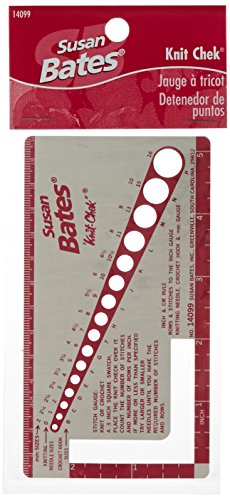

The Susan Bates Knit-Chek remains a staple in knitting kits because it combines simplicity with utility. It serves as both a needle sizer and a ruler, allowing for quick checks of both diameter and gauge swatches.
Its flat, compact metal design makes it virtually indestructible. This tool is ideal for knitters who need a no-nonsense, affordable option that slips easily into any notions pouch.
Because it is made of aluminum, it won’t warp or snap like plastic alternatives. Relying on this tool ensures that basic needle sizes are identified correctly, provided the needle isn’t bent or damaged.
Clover Swatch Ruler & Gauge: Best for Swatching

Clover’s entry into the sizing market focuses on the dual needs of the modern knitter. It accurately measures needle sizes while simultaneously providing a cutout for checking stitch gauge.
This tool is particularly useful when working with slippery needles or fine-gauge yarns where tension control is critical. By placing the swatch frame over a finished piece, a knitter can quickly verify if they have achieved the required stitches per inch.
The plastic material is lightweight, though it lacks the rigidity of metal. For those who frequently check their work against a pattern’s recommended density, this is an essential companion.
Katrinkles Sheep Gauge: A Durable, Precise Tool

Katrinkles gauges are crafted from wood, providing a tactile, aesthetically pleasing experience. Beyond their charm, these tools are laser-cut for high precision, making them excellent for identifying older, potentially worn needles.
The natural grain of the wood provides a grip that prevents the tool from sliding around while measuring. It is a favorite among knitters who appreciate tools that are as beautiful as they are functional.
Keep in mind that wood can be sensitive to moisture or extreme heat. Storing this gauge away from direct sunlight will prevent warping, ensuring it remains an accurate reference for years.
Knit Picks View Sizer: Best Multi-Function Tool

The Knit Picks View Sizer stands out for its versatility, incorporating a needle gauge, a ruler, and a magnifying lens. This is a game-changer for identifying vintage needles where the size markings have long since worn away.
The built-in magnifier allows for a closer look at the needle tip or the yarn’s ply structure. It is an excellent choice for knitters who struggle with small print or need to inspect vintage needle integrity.
This tool simplifies the process of checking multiple needle sizes in rapid succession. It is particularly helpful when sorting through a inherited collection of mixed-material needles.
ChiaoGoo Metal Needle Gauge: Ultimate Durability

ChiaoGoo is known for precision engineering, and their metal needle gauge reflects this reputation. It is a heavy-duty tool designed to handle the rigors of frequent use without bending or scratching.
The holes are clearly marked with high-contrast lettering, making them easy to read even in low-light conditions. If you work primarily with metal or coated needles, this gauge offers the most consistent results.
While it lacks the extra features like a ruler or magnifier, its focus is singular and effective. This is the choice for the knitter who wants a reliable tool that will never need to be replaced.
TKGA Master Gauge: The Professional’s Choice
The The Knitting Guild Association (TKGA) Master Gauge is built for accuracy and accountability. It provides a standardized reference point that many professional knitters and designers use to ensure consistency across their work.
This gauge is more than just a measurement tool; it is a reference for understanding the evolution of needle sizing. It handles a wide range of sizes, including those that are common in older, international patterns.
Using this gauge aligns your work with established industry standards. It is an investment in professional-grade tools for those who take their craft seriously.
Why Vintage Needle Sizing Is So Inconsistent
Vintage needle sizing is notoriously unreliable because standardized sizing did not exist in the early 20th century. Different manufacturers often used their own scales, meaning a “size 3” from the 1940s might differ significantly from a “size 3” produced today.
Furthermore, material degradation plays a massive role. Over time, plastic needles can shrink or warp, and metal needles can lose their factory coating, slightly altering their effective diameter.
Always check a vintage needle against a modern gauge before starting a project. Never assume that the label or the stamp on an old needle is accurate.
How to Properly Use a Needle Sizing Gauge
To accurately gauge a needle, slide it through the holes until it fits snugly without force. If the needle slides through easily but leaves a significant gap, move down to the next hole size.
Never force a needle into a hole that is too small. This can damage both the needle and the gauge, leading to false readings in the future.
If a needle is slightly larger than one hole and slightly smaller than the next, it is likely a metric-sized needle that doesn’t align with standard US sizing. In these instances, relying on the millimeter measurement is always safer than guessing the US size.
Choosing a Gauge for Your Vintage Needle Sizer
When building your collection, prioritize material and readability. Metal gauges are generally more stable, while wood gauges offer better grip for delicate needles.
Consider how you store your tools. If your project bag is always stuffed to the brim, a durable metal or high-quality plastic gauge will survive better than a thin or fragile one.
If you struggle with eye strain, choose a gauge with high-contrast, etched markings. A tool that is difficult to read is a tool that will eventually be left at the bottom of the drawer.
When Your Needle Doesn’t Fit: What to Do Next
If you find a needle that doesn’t fit into any standard gauge hole, it may be a specialty tool or a non-standard vintage size. In this case, use a digital caliper to get an exact millimeter reading.
For odd-sized needles, conduct a small swatch test to determine the resulting stitch density. If the needle performs well with your yarn, the exact “size” name matters far less than the fabric it produces.
Ultimately, your goal is to achieve the desired drape and tension for your specific pattern. If the needle creates the fabric you want, it is the right size for that project, regardless of what the gauge says.
Mastering the use of a needle gauge is the hallmark of a knitter who prioritizes quality and consistency. By integrating these tools into your workflow, you eliminate the guesswork of vintage sizing and ensure every project starts on the right foot. Trust your gauges, check your tension, and enjoy the process of bringing order to your needle collection.