6 Best Soft Jaw Clamps For Holding Wire To Use
Discover the 6 best soft jaw clamps for holding wire securely in your workshop. Improve your precision and workflow by choosing the right tools for your projects.
Working with delicate metallic wires, structural armatures for knit accessories, or intricate wire-wrapped jewelry requires tools that provide a firm grip without compromising the surface integrity of the material. Traditional metal pliers are often the enemy of high-quality wire, as they leave marring, scratches, and unwanted dents that ruin the finish of precious metals or coated copper. Investing in dedicated soft-jaw tools ensures that the structural integrity and aesthetic beauty of every wire component remain pristine. This guide outlines the essential soft-jaw clamps necessary to transition from frustration to professional-grade results in any wire-integrated project.
Beadsmith Nylon Jaw Pliers: Best Overall


Beadsmith Nylon Jaw Pliers serve as the industry benchmark for general wire manipulation. The wide, flat nylon surfaces provide a generous contact area, which is vital when straightening or bending thicker gauge wires without leaving a single mark on the surface.
These pliers excel when the task involves working with argentium silver or gold-filled wire, where surface protection is paramount. Because the jaws are broad, they distribute pressure evenly, preventing the “kinking” effect that often occurs when using pointed, unpadded steel pliers on softer, malleable metals.
The bottom line for any serious maker is reliability. These pliers offer the most consistent performance across a variety of wire gauges and shapes, making them the first tool to reach for in a studio setting.
Xuron TweezerNose Pliers: For Detail Work
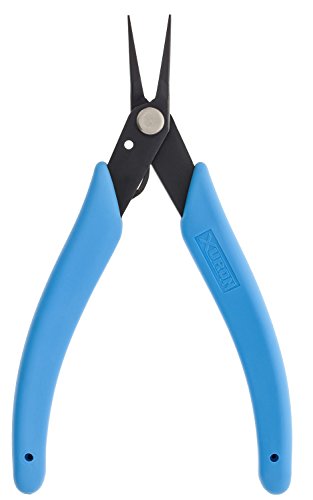
When the project requires precision—such as tightening small loops on wire-wrapped knitting needles or securing ends on a delicate wire frame—the Xuron TweezerNose Pliers are unmatched. Their fine, tapered profile allows for access into tight spaces that standard nylon-jaw pliers cannot reach.
These are particularly effective for work involving high-tensile wire where slippage is a constant risk. The specialized grippy tips provide enough friction to hold wire securely without the need for excessive hand pressure, which prevents hand fatigue during long sessions.
Choose these when detail and maneuverability are more critical than raw leverage. They represent the perfect intersection of delicate touch and firm holding power for intricate fiber-meets-metal work.
EURO TOOL Parallel Pliers: Top Budget Pick
Parallel action pliers operate on a unique mechanical principle that keeps the jaws perfectly flat against each other throughout the entire range of motion. Unlike standard pivot pliers, which open in a wedge shape, these apply pressure uniformly across the entire length of the jaw.
For those just beginning to incorporate wire into their fiber art, these provide a professional result at an accessible price point. They are ideal for pressing wire components flat or creating crisp, 90-degree bends in thicker gauge framing wire.
While they may lack the ergonomic flair of more expensive sets, their functional performance is difficult to beat. Invest in these if the goal is to master basic wire shaping techniques without a significant upfront expenditure.
Wubbers Large Nylon Pliers: Most Versatile
Wubbers are designed with ergonomic comfort in mind, making them a favorite for those who spend hours manipulating structural elements. The large nylon jaws provide an immense surface area that is perfect for flattening, shaping, and holding wire bundles together during complex weaving processes.
The handle geometry is crafted to minimize wrist strain, which is a major advantage when working with heavy-gauge materials. Because the jaws are so substantial, they can act as a clamp for holding multiple strands of wire in place while wrapping or braiding.
The added leverage provided by the longer handles allows for more force with less effort. If the projects involve substantial structural armatures or multi-strand wire work, these pliers are an indispensable asset.
Beadalon Ergo Pliers: Replaceable Jaw Champ
Maintenance is a key concern for any tool that sees heavy use, and the Beadalon Ergo Pliers solve the problem of worn surfaces with a simple, modular design. Once the nylon tips become grooved or flattened from prolonged use, they can be swapped out in seconds.
This feature is particularly valuable for those who work exclusively with coated copper or artistic wire, where even a slight imperfection in the jaw can transfer a scratch to the wire’s finish. Having a fresh, smooth surface is the only way to guarantee a flawless, mirror-like finish on every piece.
These are a sound long-term investment. By keeping a stash of replacement tips on hand, the original tool investment remains functional for years, outlasting fixed-jaw alternatives that must be discarded once the nylon wears down.
A-Team Mini Clamps: Best for Hands-Free Use
Sometimes, the hands are fully occupied holding knitting needles or guiding yarn, leaving no one to hold the wire in place. Mini spring-loaded clamps are the perfect solution for creating a “third hand” that maintains tension on a wire start or holds a junction point steady.
These are essential for complex weaving or when working with tension-heavy wire structures that tend to spring back. Simply clamp the wire to the work surface or a frame to keep everything exactly where it needs to be while the hands are free to manipulate the fiber or the next wire segment.
Because they are small and lightweight, they do not add unnecessary weight or drag to the project. Use these whenever the project calls for precision that exceeds the capabilities of a two-handed approach.
What to Look For in a Soft Jaw Wire Clamp
The most critical factor is the material and density of the jaw. High-quality nylon is preferred because it is soft enough to protect precious metals but firm enough to hold its shape under pressure. Avoid cheap, soft plastics that deform permanently after a single squeeze.
Consider the following technical specifications before buying: * Jaw Geometry: Flat jaws are best for shaping, while rounded jaws are necessary for creating loops. * Pivot Smoothness: Ensure the pliers move without grinding; a sticky pivot is a recipe for broken wire. * Spring Tension: Look for a return spring that feels responsive but not so stiff that it causes hand fatigue. * Handle Grip: Soft-touch, rubberized grips are far superior to slick metal for maintaining control during repetitive motions.
Why Soft Jaws Are a Must for Delicate Wire
Wire, much like high-twist silk or delicate mohair, is incredibly sensitive to surface damage. When a metal-jaw plier bites into a piece of wire, it creates a “stress riser”—a tiny nick that significantly weakens the wire at that point.
When that wire is later bent or put under tension in a finished project, those stress risers become the primary site for snapping. Using soft jaws maintains the wire’s diameter and surface finish, ensuring the longevity of the final piece.
Beyond strength, there is the aesthetic consideration. A perfectly smooth wire loop catches the light and looks professional, whereas a marred, scratched loop looks like a hobbyist error. Protecting the finish is as much about the final look as it is about the structural integrity of the project.
How to Maintain and Replace Your Nylon Jaws
Regular maintenance keeps tools performing at their peak. After every session, wipe the nylon jaws with a soft cloth to remove any metal dust, copper shavings, or wire coatings that may have transferred.
If the jaws develop deep grooves or nicks, do not continue using them, as these imperfections will telegraph onto every subsequent piece of wire. Most nylon tips can be lightly sanded with a fine-grit abrasive pad to restore a smooth surface, but once they lose their shape, they should be replaced.
Keep spare tips organized and readily available. A tool is only as good as its contact point, and having a fresh set of jaws ready to go means never having to compromise on quality when in the middle of a project.
Clamp Uses in Beading, Weaving, and Fiber Art
The intersection of wire and fiber offers infinite creative possibilities, from beaded wire-knit chains to rigid, fiber-wrapped sculptural elements. Soft-jaw clamps are used to tension warp wires for intricate wire weaving or to crimp findings securely onto the ends of delicate knitted wire cords.
In fiber arts, these tools are indispensable for creating custom hooks, clasps, or internal support structures that keep heavy beadwork from sagging. They allow for the integration of jewelry-making techniques with soft-goods crafting, pushing the boundaries of what is possible in textile design.
Whether setting stones into a woven mesh or bending armature wire for a textile sculpture, the ability to manipulate wire without damaging it is a foundational skill. Master the use of these tools, and the complexity of projects can expand well beyond traditional fiber work.
By integrating the right soft-jaw tools into your toolkit, you elevate the quality of your wire work from experimental to expert level. These tools protect your materials, save your hands, and ensure that every delicate detail of your project survives the journey from design to final display.