6 Needle Threaders For Sewing Projects To Consider
Struggling with tiny eyes? Explore our top 6 needle threaders for sewing projects to make threading effortless. Read our expert guide and pick the right tool.
Struggling to thread a needle is a universal frustration that can halt even the most productive knitting or embroidery session. Whether anchoring a loose end on a mohair blend or grafting delicate silk socks, the quality of the threader dictates the efficiency of the task. Relying on the wrong tool often leads to frayed fibers or damaged needle eyes. Choosing the right needle threader ensures that finishing work feels like a natural extension of the craft rather than a chore.
Dritz Looped Needle Threaders: A Classic Staple


These wire-loop threaders are the industry standard for a reason: simplicity and accessibility. They consist of a thin, flexible diamond-shaped wire set into a flat metal handle, allowing the wire to collapse easily as it passes through the eye of a needle.
They excel when working with standard sewing needles for basic garment repairs or attaching buttons. However, the delicate wire can easily kink or snap when forced through the tiny eyes of lace-weight tapestry needles.
Always keep several on hand because these are disposable tools that fatigue over time. If a wire looks bent or begins to lose its shape, discard it rather than risking damage to the yarn being threaded.
Clover Desk Needle Threader: For Tired Hands

This tabletop device removes the manual dexterity required to align a thread with a needle eye. By placing the needle into the slot and pressing a button, the mechanism guides the thread through for you.
It is particularly useful for makers who struggle with fine motor control or experience hand fatigue after hours of intricate colorwork. It functions best with a specific range of standard needle sizes, making it a reliable fixture for a dedicated craft desk.
The trade-off is the lack of portability compared to smaller handheld tools. Because it relies on a specific alignment mechanism, it may not accommodate specialty heavy-duty needles used for thick wool roving or upholstery projects.
Bohin Automatic Threader: The Premium Pick

Bohin offers a more robust, professional-grade solution that balances automation with durability. The design is engineered to withstand frequent use, making it an excellent investment for those who finish dozens of projects per year.
The mechanism is precise, minimizing the potential for friction-induced fraying on delicate fibers like silk or high-twist merino. It provides a consistent “click” that confirms the thread has passed through, which is helpful when working in lower light conditions.
While the price point is higher, the build quality justifies the cost for active makers. It is an ideal choice for someone who values long-term reliability over cheap, multi-pack alternatives.
Dritz Hummingbird Threader: A Fun, Cute Tool
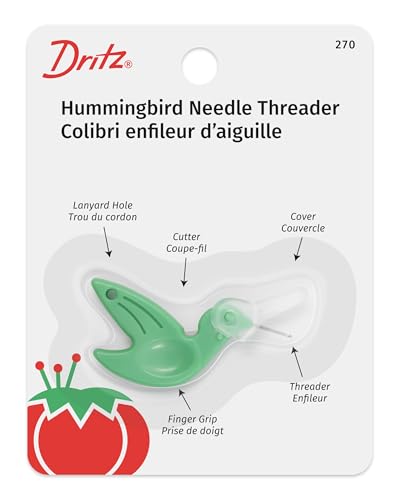
This stylized threader serves as a charming addition to any notions kit while performing the same basic function as a standard wire loop. Its whimsical design makes it easy to locate in a cluttered sewing bag, preventing it from getting lost among scissors and stitch markers.
The sturdy plastic handle provides a better grip than the thin metal tabs found on traditional loop threaders. This makes it easier to manipulate if your hands are slick from hand cream or slightly stiff from a long day of knitting.
Like all wire-based tools, it is best suited for general sewing needles. It is not designed for heavy, thick-gauge yarn needles, so keep expectations managed regarding the size of the eye it can accommodate.
Colonial Latch Hook Threader: For Thick Yarn
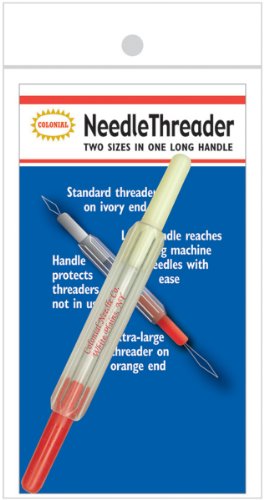
Standard wire threaders often fail when threading heavy yarn for finishing bulky blankets or rug-making. The Colonial latch hook threader uses a latch-style mechanism that grips the yarn securely, pulling it through the eye of large tapestry needles.
It is an essential tool for working with chunky weight yarns or textured art yarns. Because the latch closes around the yarn, it prevents the thread from slipping out halfway through the process.
Be mindful of the gauge of the needle eye. The hook must be able to pass through the needle comfortably, so ensure the needle eye is large enough to accommodate both the hook and the thick yarn strand.
Clover Double Threader: Two Sizes, One Tool

This tool offers versatility by featuring two different sizes of threaders on one handle. It accommodates both fine sewing needles and slightly larger embroidery or tapestry needles without needing to switch devices.
It is a space-saving solution for knitters who maintain a small, travel-sized notions tin. Having two options readily available reduces the time spent searching for the right tool when transitioning from weaving in ends to sewing on buttons.
The design is compact and durable, standing up well to the rigors of travel. It is a highly practical choice for makers who prefer to streamline their kits by choosing multi-functional tools.
Choosing a Threader for Your Specific Project
- For Fine Lace Weight: Use a high-quality, fine-wire threader to prevent snags on delicate fibers like lace-weight alpaca or mohair.
- For Bulky Yarns: Opt for a latch-hook style threader to securely manage heavy, multi-ply strands.
- For Frequent Finishing: Invest in an automatic desktop unit to save time and reduce hand strain.
- For Portable Knitting Kits: Choose a dual-ended threader or a robust, easy-to-locate plastic-handled option.
Wire vs. Automatic: Which Threader Is Best?
Wire loop threaders are inexpensive and highly portable, making them ideal for field repairs or travel projects. Their primary limitation is their fragility; the wire is prone to breaking, which necessitates regular replacement.
Automatic threaders provide superior consistency and ease of use, especially for those with vision impairments or reduced hand strength. However, they are generally stationary and incompatible with non-standard needle sizes.
The “best” tool is the one that stays in your bag and works consistently with your preferred needle brand. Evaluate how often you finish projects and how much space you have in your notions kit before committing to a specific style.
How to Use a Simple Wire Loop Needle Threader
- Insert the loop: Push the wire loop through the eye of the needle until the handle rests against the needle base.
- Pass the yarn: Insert your yarn or thread through the wire loop, ensuring at least an inch of tail is pulled through for security.
- Pull through: Carefully pull the wire loop back out of the needle eye, bringing the yarn with it.
- Finish: Remove the threader from the yarn and proceed with your finishing work.
Tips for Threading Needles with Tiny Eyes
When working with tiny needle eyes, the “lick and stick” method is often ineffective because it can make fibers swell and tangle. Instead, cut the yarn at a sharp 45-degree angle to create a tapered point.
If the fiber is particularly fuzzy, such as a loosely spun wool, use a tiny drop of water or beeswax to smooth the fibers together into a single, cohesive point. Hold the needle against a neutral, high-contrast background to better visualize the eye.
Always work in a well-lit area, preferably using a dedicated craft lamp. If the needle eye is truly too small for the yarn, do not force it; doing so will likely break the yarn or cause it to pill, which will weaken your final result.
Finding the right needle threader is as much about your personal comfort as it is about the project requirements. By balancing the delicacy of your chosen fiber with the mechanical reliability of these tools, you can ensure your finishing work is as polished as your stitch patterns. Once you settle on the tools that suit your rhythm, weaving in ends will become a seamless part of your craft.