7 Best Loom Sets For Tapestry Weaving To Consider
Discover the 7 best loom sets for tapestry weaving to elevate your craft. Explore our top expert-recommended picks and find the perfect frame for your projects.
Tapestry weaving offers a meditative tactile experience that complements the rhythmic nature of knitting. Selecting the right loom is the foundational step in transitioning from simple fiber experiments to creating complex, gallery-worthy wall hangings. While a beginner might be tempted by the cheapest frame available, the tension quality and warp spacing provided by a purpose-built loom drastically improve the outcome of every project. This guide breaks down the best options currently available to ensure the investment supports a growing craft practice.
Schacht School Loom: Top Choice for Beginners


The Schacht School Loom provides a solid, intuitive introduction to weaving without the frustration often caused by flimsy, unstable frames. Its sturdy wooden construction holds tension well, which is critical when working with different weights of wool or cotton.
Because this loom is designed for educational environments, it is built to withstand repeated use. The notched beams allow for consistent warp spacing, preventing the uneven selvedges that often plague first-time weavers.
If the goal is to master basic techniques like soumak or plain weave before moving to complex tapestry, this loom offers the perfect constraint. It keeps the project manageable and focused on learning the structural mechanics of warp and weft.
Beka Original Rigid Heddle Loom: Most Versatile

Rigid heddle looms bridge the gap between simple frame looms and complex multi-shaft floor looms. The Beka Original allows for both standard tapestry techniques and faster plain-weave production by using a heddle to lift warp threads.
This versatility makes it an excellent choice for those who want to weave functional items, such as scarves or table runners, alongside their decorative tapestries. The ability to control the shed—the space between warp threads—significantly speeds up the weaving process.
However, keep in mind that the rigid heddle mechanism creates specific limitations regarding pattern complexity. It is an ideal tool for those who value speed and structural consistency over the free-form, shape-heavy approach of traditional tapestry.
Lost Pond Looms Lap Loom: Best Portable Option

Portability is a major factor for those who enjoy crafting while traveling or in limited living spaces. The Lost Pond Looms Lap Loom is designed specifically to be lightweight without sacrificing the structural integrity required to keep warps taut.

The craftsmanship of these hand-made looms often features smooth finishes that prevent snagging delicate fibers. This is particularly important when working with single-ply yarns or mohair, where friction can lead to unwanted pilling.
Consider this loom if the workspace changes frequently, such as moving from the kitchen table to the sofa. Its compact nature ensures that a project can be stowed away quickly, keeping the warp clean and protected from household dust.
Mirrix Lani Loom: Best for Serious Weavers
Mirrix looms are the industry standard for those who intend to transition from hobbyist to professional-grade tapestry work. The Lani is a sophisticated piece of equipment that features a shedding device and a robust tensioning system.
The primary advantage of the Lani is its ability to hold very high tension, which is essential for fine-detail weaving with thin warp threads. For someone accustomed to the precision of fine-gauge knitting, this level of control is indispensable.
Investing in a Mirrix is a long-term decision. While the learning curve is steeper than a simple frame, the capability to execute intricate, high-density designs makes it a permanent fixture in any serious fiber studio.
The Unusual Pear Weaving Kit: Best All-In-One

For those who feel intimidated by sourcing individual supplies, an all-in-one kit removes the guesswork. The Unusual Pear kits provide a curated selection of looms and coordinated fiber palettes that work harmoniously together.
These kits are excellent for beginners who want to complete their first project without spending hours researching compatible warping threads or shuttles. The included instruction manuals usually focus on color theory and basic composition, which are just as vital as technical skill.
The downside is that these kits are often limited in size. If the intention is to scale up to large wall hangings, a dedicated kit serves as a great starting point but may eventually require an upgrade to a standalone, larger frame.
Glimakra Freja Tapestry Loom: Best Upright
Upright looms change the way a weaver interacts with their work, allowing for a vertical orientation that is easier on the back and shoulders. The Glimakra Freja is an exceptional piece of Swedish engineering designed for stability and longevity.
Working vertically allows the weaver to step back and assess the design from a distance, much like a painter with a canvas. This perspective is vital when working on large-scale tapestries where proportions can shift as the fabric grows.
Because of its size and design, the Freja is intended for those with a dedicated studio space. It is a heavy-duty tool meant for the weaver who is fully committed to producing large-format art on a consistent basis.
Funem Studio XL Weaving Loom: For Large Pieces

The Funem Studio XL loom is designed for the weaver who wants to make a statement with expansive wall art. Its extra-large frame provides the necessary width to create impressive, room-filling textiles.
The frame’s stability ensures that the tension remains uniform across the entire width of the loom, which is notoriously difficult to achieve on smaller, improvised frames. Even with large projects, the warp will not sag, provided it is warped correctly.
If you are planning to incorporate mixed-media elements like thick roving or found objects, this loom provides the space required for those textures to shine. It is the perfect choice for creating modern, high-impact decor.
How to Choose Your First Weaving Loom Set
Choosing a loom depends entirely on the desired output rather than just the price tag. First, identify the scale of the work intended; small looms are perfect for practice, but they will frustrate anyone attempting to weave a large wall hanging.
Consider the tensioning mechanism. A loom with a turn-key tension system allows for more consistent work than one that relies on simple notches or fixed wooden pegs.
Also, look at the shed-making capacity. If the goal is rapid production, a loom with a shedding device will save hours of manual effort. If the goal is slow, rhythmic, and intricate tapestry, a simple frame often provides more creative freedom.
Frame Loom vs. Rigid Heddle: What’s Best?
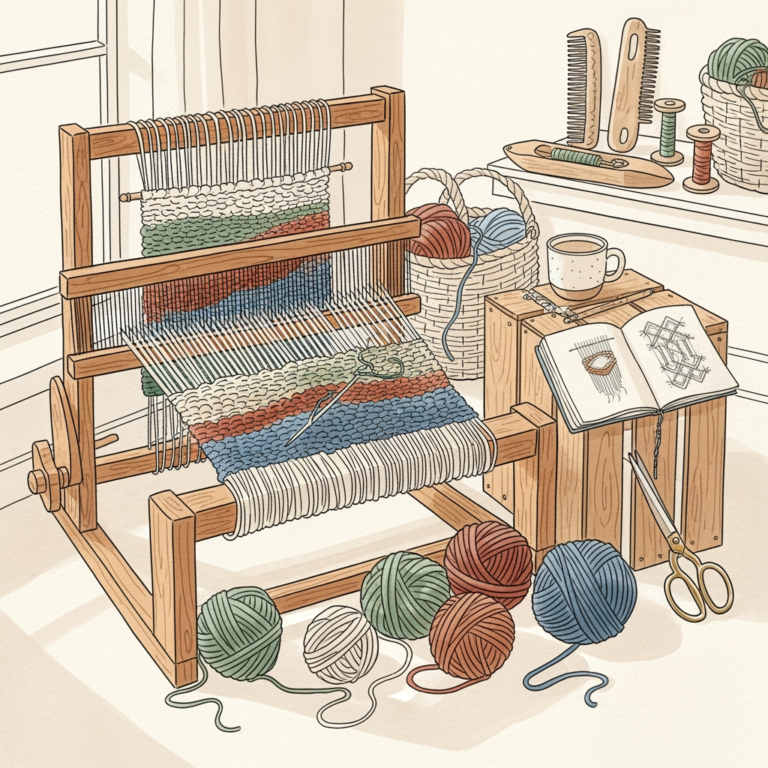
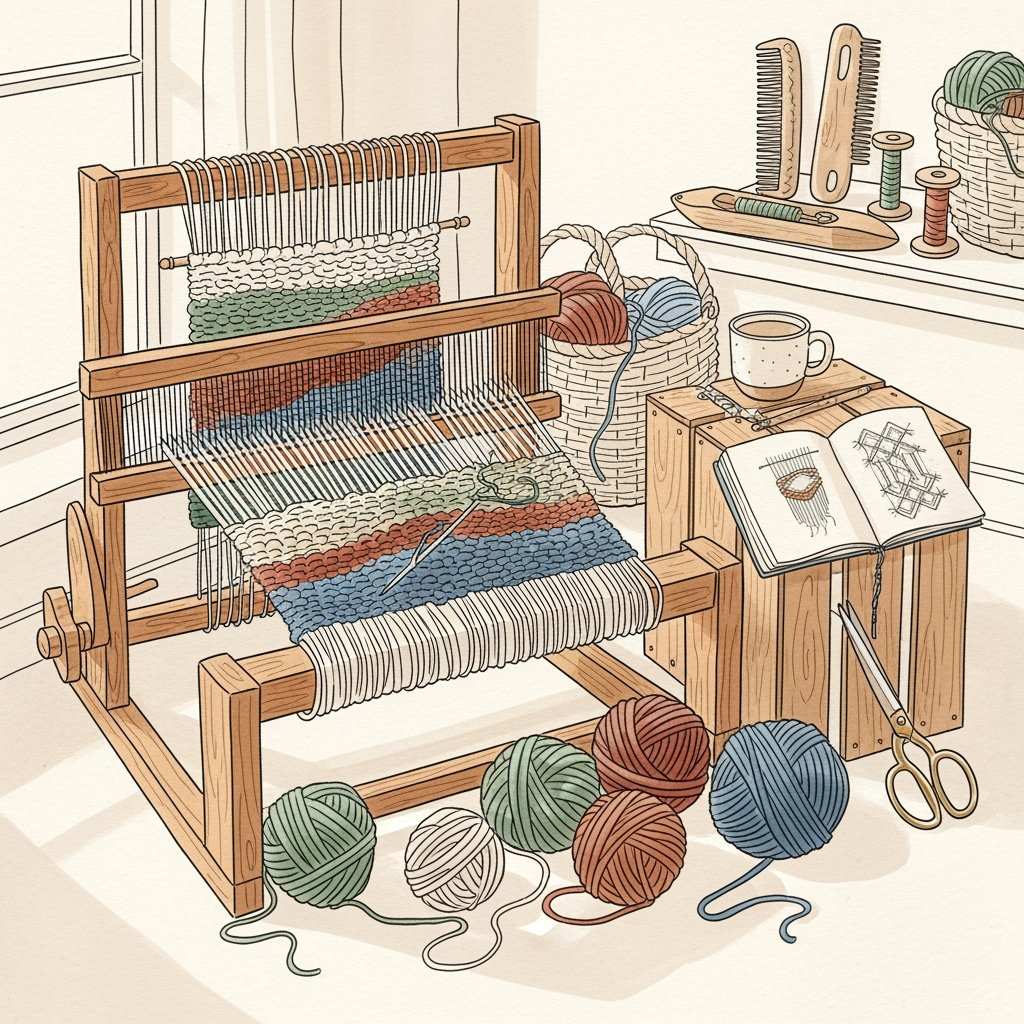
A frame loom is essentially a rectangle that holds the warp in place, allowing the weaver to manually pick threads to create patterns. It is the most direct way to learn tapestry weaving, as there are no mechanical barriers between the hands and the threads.
A rigid heddle loom uses a frame that controls every other thread, allowing for a mechanical “shed” to be opened instantly. This is superior for plain weaves and striped patterns, but it can actually make complex, multi-colored tapestry techniques more cumbersome.
Choose a frame loom for pictorial work, soumak, and experiments with texture. Choose a rigid heddle loom if the goal is to produce fabric, yardage, or simple repeat patterns quickly.
Essential Tools for Your Tapestry Weaving Kit
A successful weaving kit goes beyond the loom itself. You will need a variety of shuttles to carry the weft; small stick shuttles are best for detail, while larger ones are efficient for solid background sections.
A sturdy tapestry fork or a specialized weaving comb is required to “beat” down the weft, ensuring the warp is completely covered. If you plan on using wool, a metal fork is preferable as it can withstand the pressure needed to pack the fibers tightly.
Finally, keep a sharp pair of embroidery scissors and a tapestry needle on hand for finishing ends. Much like weaving in ends on a sweater, the cleanup phase of a tapestry determines the final polish of the piece.
Mastering the loom is a journey of understanding tension, fiber behavior, and structure. Whether choosing a simple frame for its tactile intimacy or a professional-grade vertical loom for its structural precision, the right tool acts as an extension of the weaver’s intent. By carefully matching the equipment to the project goals, every weaver can find the rhythm that makes the craft truly rewarding.