6 Best Finger Guides For Early Learners To Try
Help your child build essential motor skills with these 6 best finger guides for early learners. Explore our top recommendations and start practicing today!
Struggling to maintain even tension is the universal rite of passage for every new knitter. While some hands naturally find a rhythmic flow, others require a mechanical nudge to keep stitches consistent across a row. Finger guides act as an external anchor for the yarn, effectively stabilizing the flow from the ball to the needle. Choosing the right tool can transform a frustrating, uneven swatch into a professional-looking finished fabric.
Clover Knitting Thimble: The Simple, Reliable Start

The Clover Knitting Thimble is often the first encounter a beginner has with tension aids. It features a straightforward design with a single wire loop that acts as a guide, keeping the yarn from slipping off the finger.
Because it is made of plastic with a flexible band, it accommodates various finger sizes without feeling restrictive. It is particularly effective for knitters who find themselves constantly adjusting their grip to prevent yarn from sliding around too much.
However, the simplicity of the design means it lacks the complexity required for multi-colored work. It is an excellent choice for mastering basic stockinette, but it serves a singular purpose. If the goal is consistent tension on a basic scarf or hat, this is the most approachable starting point.
Susan Bates Yarn Stranding Guide: Two-Yarn Control

When a knitter moves from basic projects to simple stranded colorwork, managing two strands of yarn simultaneously often leads to tangled fingers. The Susan Bates Yarn Stranding Guide solves this by providing two distinct slots to keep yarns separated.
By keeping colors parallel, the guide prevents the yarns from twisting around each other behind the work. This keeps the floats—the unused yarn carried across the back of the knitting—even and prevents the dreaded “puckering” effect that can ruin a colorwork pattern.
This guide is best for those working on hats or mittens where two colors are used per round. It requires a bit of dexterity to feed two yarns into the slots, but the efficiency gains in speed and neatness are immediate.
Prym Ergonomics Knitting Thimble: Best for Comfort

The Prym Ergonomics Knitting Thimble shifts the focus from simple guidance to physical comfort. Its contoured shape sits naturally against the finger, reducing the repetitive strain that sometimes accompanies long knitting sessions.

This tool is ideal for knitters with sensitive skin or those who notice their knuckles aching after working with heavy wool or cotton. The smooth edges prevent the yarn from snagging or fraying, which is a major concern when working with delicate, single-ply fibers.
The trade-off for this high-level ergonomics is a slightly larger footprint on the finger. If the hands are small, the bulk may feel like an adjustment initially. Nevertheless, for long-term projects, the comfort factor often outweighs the learning curve.
Knitter’s Pride Mindful Ring: Stylish Tensioner

Functionality does not have to sacrifice aesthetics, and the Knitter’s Pride Mindful Ring proves this by blending jewelry-like design with practical tensioning. This guide works by looping the yarn through a decorative metal centerpiece, providing a smooth path for the yarn to travel.
Metal guides are inherently smoother than plastic, which helps when working with “grabby” fibers like high-twist wool or sticky mohair. Because it is adjustable like a standard ring, it can be sized to fit precisely, ensuring it does not spin or shift during a long session.
It is a sophisticated option for the knitter who wants a permanent, durable tool rather than a piece of plastic equipment. It is particularly effective for knitters who prefer a lighter touch, as the metal allows the yarn to glide with minimal friction.
The Yarn Valet Adjustable Metal Ring: Best for Fit

The Yarn Valet Adjustable Metal Ring stands out for its low profile and highly customizable nature. Unlike bulky thimbles that cover the entire fingertip, this acts more like a ring, keeping the finger pad clear for picking up dropped stitches or manipulating the needles.
This is the preferred choice for knitters who feel “cluttered” by standard knitting thimbles. It provides enough tension to keep the yarn taut without feeling like an obstacle to manual dexterity.
Because it is made of metal, it is essentially indestructible. If the tension starts to feel too loose, a quick adjustment of the metal band ensures it remains snug against the skin. It is a workhorse tool that fits seamlessly into any knitting bag.
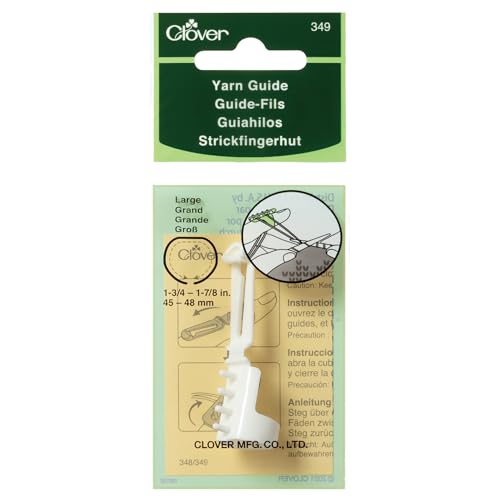
Clover 4-Yarn Guide: For Ambitious Beginners
The Clover 4-Yarn Guide is the ultimate tool for those diving head-first into complex projects like Intarsia or intricate Fair Isle. With four separate slots, it allows for multiple colors to be managed with surgical precision.
Managing four strands requires a high degree of focus, so this is not a tool for someone still struggling with the basic knit stitch. It is, however, the most efficient way to keep multiple colors from turning into a knotted disaster.
For those attempting a complex geometric blanket or an intricate sweater, this guide is a game-changer. It turns a chaotic multi-color project into a manageable, organized process.
How to Pick the Right Finger Guide For Your Style
Choosing the right guide depends almost entirely on the type of projects you prioritize. If you are a sock knitter, you need something low-profile like the Yarn Valet ring; if you are an Intarsia enthusiast, the 4-Yarn guide is non-negotiable.
Consider these factors when narrowing your choice: * Project Complexity: Are you using one color or four? * Fiber Texture: Sticky mohair requires a smooth metal finish to prevent dragging. * Hand Sensitivity: Does a bulky plastic thimble cause discomfort after an hour? * Finger Size: Adjustable metal rings often offer a more precise fit than one-size-fits-all plastic options.
Ultimately, the best guide is the one you forget you are wearing. If a tool constantly requires adjustment or feels like it is fighting your natural rhythm, move on to a different design.
Metal vs. Plastic Guides: Which Is Best for You?
Metal guides offer durability and a slick surface that reduces friction, making them ideal for heavy or textured yarns. They are usually adjustable, meaning they offer a more custom fit, though they can be cold to the touch in drafty rooms.
Plastic guides are typically lighter and provide a “grippier” surface. This added friction can actually benefit beginners who struggle with yarn slipping off their needles too easily. They are often more affordable and come in ergonomic shapes that are gentler on the skin.
There is no “better” material, only a better fit for your current project. Use metal for speed and long-term use; use plastic for learning and extra control over slippery fibers like silk or bamboo.
Getting Used to Your New Knitting Finger Guide
Integrating a guide into your workflow requires a brief “training period” of about 20 to 30 minutes. Initially, the extra weight or object on the finger will feel unnatural, but this sensation fades as muscle memory takes over.
Start by knitting a simple square to get accustomed to the new tension. Pay attention to whether you are “choking” the yarn by holding it too tight against the guide. The goal is to let the guide do the heavy lifting, not to compensate for it with a tight grip.
Avoid trying to learn a complicated stitch pattern at the same time you are learning to use a guide. Master the mechanics of the tool with a basic, familiar stitch before attempting cable work or lace.
What If a Finger Guide Doesn’t Fix Your Tension?
If your tension remains uneven despite using a finger guide, the issue may not be the yarn flow, but rather the needle choice. Using slick metal needles with slippery yarn can cause stitches to loosen, while wooden needles can provide the necessary “bite” to keep stitches in place.
Also, examine your needle size. If you are consistently knitting too tight, moving up a half-size in needles often fixes the gauge more effectively than any tension tool. Sometimes, the most professional solution is simply to adjust the hardware rather than changing your hand mechanics.
Finger guides are tools, not cures. Use them to assist your process, but keep a close eye on your gauge swatches to ensure the result matches the project requirements.
Whether you are seeking the simplicity of a basic plastic thimble or the precision of a four-strand metal guide, there is a solution to suit every hands-on style. By experimenting with different materials and designs, you will eventually find the mechanical partner that makes your knitting feel effortless. Embrace the learning process, keep your needles moving, and let these small accessories bridge the gap between a novice’s effort and an expert’s consistency.