6 Best Sewing Timers For Establishing Habits To Use
Boost your productivity and consistency with these 6 best sewing timers. Choose the perfect tool to help establish your daily sewing habits and start crafting.
Staring at a complex cable chart or a tedious row of stockinette can make time feel like it is stretching into infinity. Establishing a consistent knitting rhythm prevents project fatigue and ensures that those long-term heirloom projects actually reach completion. A simple timer serves as an external trigger to break through creative ruts and maintain physical comfort. Selecting the right tool turns a daunting mountain of yarn into a series of manageable, rewarding sessions.
The Time Timer: Best Visual Habit Builder


The Time Timer is essential for those who need to see the passage of time rather than just counting down seconds. A vibrant red disk disappears as time elapses, providing a constant visual reference for how much progress remains in a stitching session.
This is particularly useful when working on repetitive sections, such as a long cardigan body or a simple ribbed hem. Seeing the red disk shrink provides a subconscious push to finish the current round before the buzzer sounds.
Because the visual display is so intuitive, it avoids the mental fatigue caused by checking digital clocks. It creates a “closed loop” environment where the focus remains entirely on the needles rather than the hour.
Taylor Digital Timer: A Reliable Workhorse

Reliability is the hallmark of the Taylor Digital Timer, a device that has stood the test of time in many craft rooms. It features a clear, high-contrast screen that is readable even from a distance, which is ideal if the timer is placed on a bookshelf across the room.
If the goal is to set a hard limit for a focused knitting hour, this device excels through its simplicity. There are no complex menus to navigate, which prevents frustration when hands are busy with yarn or needles.
The magnetic back allows for easy attachment to metal project carts or lamps. It stays out of the way while providing a consistent, no-nonsense countdown.
Hexagon Sand Timer: Best for Short Sprints
The Hexagon Sand Timer brings an analog, tactile quality back into the modern crafting space. It is perfect for those who struggle with “all or nothing” thinking, as it encourages short, five-to-ten-minute bursts of activity.
When tackling a physically taxing technique like stranded colorwork, these short sprints prevent hand cramping and tension issues. Once the sand runs out, it serves as a gentle prompt to set the work down, stretch the wrists, and re-evaluate hand posture.
While it lacks the precision of a digital device, its lack of electronic noise is a welcome reprieve for those who want a silent environment. It serves as a decorative reminder to keep moving, without the jarring interruption of a digital alarm.
Forest App: Best for Ditching Phone Distractions
The Forest app gamifies the process of staying off the phone while knitting by growing a virtual tree during your focused time. It is an excellent deterrent for those who find themselves reflexively scrolling through social media feeds while they should be working on a lace pattern.
If the phone is picked up to check a message, the virtual tree withers, providing an immediate negative reinforcement. This keeps the attention focused squarely on the stitches and the pattern instructions.
It is particularly effective for those working on complex charts that require intense focus and mental clarity. By locking the phone away, you create a dedicated “analog sanctuary” for your fiber arts practice.
Datexx Miracle TimeCube: Best for Quick Flips
The Miracle TimeCube is a gravity-based timer that removes the friction of programming a device. By simply flipping the cube to a specific side, such as 5, 15, or 30 minutes, you start a countdown instantly.
This is the ultimate tool for “just one more row” syndrome. If you have limited time before dinner or an appointment, a quick flip ensures you make measurable progress without overextending your schedule.
The lack of buttons is a major advantage for those with limited dexterity or those who prefer to keep their hands free of electronics. It is a seamless, distraction-free way to manage time while working with fibers.
Wrenwane Digital Timer: Best Loud Alarm Option
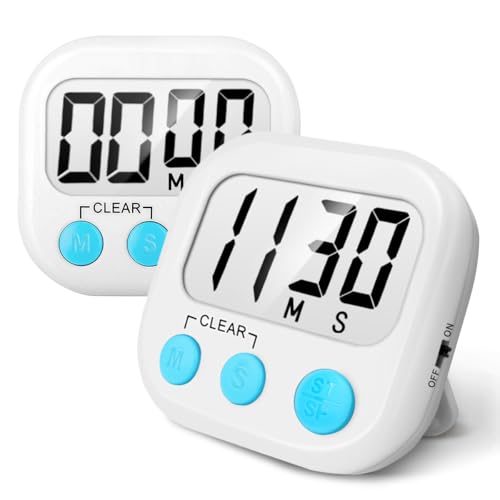
The Wrenwane Digital Timer is designed for the knitter who tends to get lost in the “zone” and fails to hear subtle alerts. Its loud, clear beep ensures that even the most immersive knitting session is punctuated by a firm reminder to take a break.
This is especially helpful for those working in rooms with background noise or those who enjoy listening to audiobooks while they knit. You will not miss the alert, ensuring you stay on schedule with your planned breaks.
The large, bold digits are a significant benefit for anyone who needs high visibility. It is a utilitarian tool that focuses entirely on function, reliability, and ensuring you never miss a milestone.
How to Choose a Timer for Your Sewing Style
Choosing the right timer depends on whether you value visual cues, auditory reminders, or physical engagement. If you are prone to wrist strain, prioritize a timer that forces frequent, short breaks rather than one that allows for long, uninterrupted stretches.
Consider the environment in which you stitch. If you knit in a quiet, contemplative space, a soft sand timer is superior to a loud, piercing digital alarm.
Always prioritize ease of use over complex features. If a timer is too difficult to set, it will inevitably end up sitting in a drawer rather than helping you build a lasting habit.
Using the Pomodoro Technique for Sewing Habits
The Pomodoro Technique—twenty-five minutes of focused work followed by a five-minute break—is a gold standard for project management. For knitting, this interval is perfect for finishing a set number of rounds or a specific section of a chart.
During the break, physically stand up and stretch. This resets your posture and reduces the risk of long-term repetitive stress injuries that can plague dedicated knitters.
This structure helps quantify progress over time. You will quickly learn how many “pomodoros” it takes to complete a sleeve or a sock, which makes estimating future project timelines much more accurate.
Digital vs. Analog: Which Timer Is Right for You?
Digital timers offer precision and features like memory settings or multiple alarms, which are ideal for managing complex, multi-stage projects. They are the logical choice for the data-driven knitter who likes to track exactly how much time is spent on a garment.
Analog timers, such as sand or mechanical wind-up models, provide a sensory connection to the passage of time. They are often less intrusive and fit better into a cozy, meditative knitting aesthetic.
The choice ultimately comes down to your personal workflow. If you want to remove all distractions, choose a simple mechanical or gravity-based tool. If you need strict accountability, opt for a digital device with a clear, loud alert.
Why a Timer Helps Beat Project Procrastination
Procrastination in knitting often stems from the overwhelming scale of a project. A timer breaks the massive goal into small, non-threatening units of time.
It provides a psychological “start” signal, which is often the hardest part of any task. Once the timer is set, the resistance to beginning a row of knitting drops significantly.
By focusing on the clock rather than the end result, you stay present in the act of making. Consistent, short efforts will eventually result in a finished garment, regardless of how long the initial task felt.
Establishing a habit with a timer is not about turning a hobby into a race. It is about creating structure that respects your time, protects your body, and ensures your creativity remains a source of joy rather than a source of stress. Whether you choose the visual clarity of a Time Timer or the gamified focus of a mobile app, the right tool is the one that actually gets used. Keep your needles clicking, your breaks regular, and your projects moving toward the finish line with intention.