6 Best Beading Mats For Keeping Beads In Place
Stop beads from rolling away with our top 6 beading mats. Discover the best surfaces to keep your projects organized and secure. Shop our expert guide today!
Maintaining a consistent workflow is just as vital in beadwork as it is in managing a complex lace chart or keeping track of a fair isle pattern. A stray seed bead rolling onto the floor can derail a multi-hour project just as quickly as a dropped stitch mid-cable. Investing in the right surface ensures your components remain exactly where they belong until they are needed on the needle. This guide examines the top mats to help streamline the process of incorporating embellishments into your fiber projects.
The Beadsmith Bead Mat: A Classic for a Reason


The Beadsmith mat serves as the standard starting point for most makers, offering a reliable, soft surface that prevents beads from skittering away. Its flocked texture provides enough friction to catch even the smallest glass beads, acting much like the grip of a wooden needle compared to slick metal.
Because it is lightweight and flexible, this mat is ideal for those who prefer to keep their workspace mobile. Whether tucked into a knitting bag or laid out on a cramped coffee table, it does not occupy unnecessary real estate.
However, it lacks the tackiness of more specialized synthetic mats, meaning beads can still shift if the mat is tilted. It remains the most utilitarian choice for general beading tasks.
Beadalon Tacky Bead Mat: For Tiny Seed Beads

When working with delicate glass seed beads—especially those in sizes 11/0 or 15/0—a standard fabric mat may not provide enough security. The Beadalon Tacky Mat utilizes a specialized surface that grips components, preventing them from bouncing or wandering off the edges.

This is the equivalent of using a high-friction silicone needle grip during a long day of working with slippery silk yarn. It holds beads firmly in place, even if the mat experiences a slight bump or accidental jostle.
Keep in mind that highly tacky surfaces are dust magnets. They require more frequent cleaning to maintain their grip, similar to how one must clean high-quality needles to prevent residue buildup from affecting stitch tension.
Bead On It Board: Best Portable Beading Surface
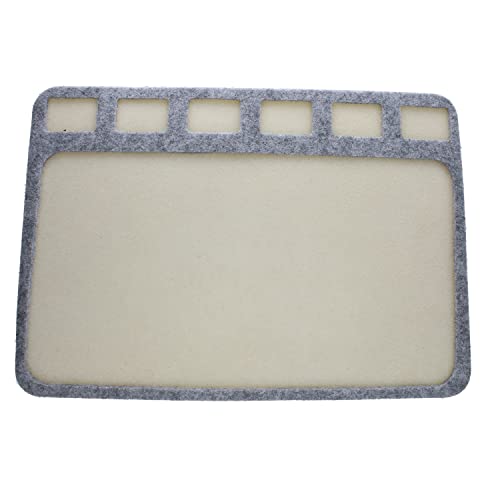
The Bead On It board distinguishes itself by offering a structured frame rather than a simple fabric sheet. This rigidity provides a defined, secure boundary that is particularly beneficial when sorting multiple colorways for a complex bead-knitting project.
Many knitters struggle with organization when working with several bead colors simultaneously. This board allows for distinct sections, much like having separate yarn bowls or bobbins for each color in an intarsia project.
The board is designed to be easily portable without sacrificing the stability of the beads. It is a premium investment for the serious maker who prioritizes an organized, mess-free environment.
Artbeads Designer Beading Board: All-in-One Hub
This board is less a simple mat and more a complete workstation for planning layouts and bead placement. It features molded channels and compartments, allowing for the pre-sorting of components before the knitting begins.
It functions similarly to a project board or a blocking station, where visualization of the final piece is paramount. By organizing your beads into the designated channels, you can verify your pattern sequence before committing to the cast-on.
Because of its size, this is a stationary tool intended for a permanent crafting desk. It is best suited for makers who prefer to do their prep work in a dedicated space before taking their knitting on the go.
Tulip Bead Weaving Mat: Premium Non-Slip Option
The Tulip mat is highly regarded for its refined, durable texture that feels significantly more substantial than basic craft store versions. It strikes a precise balance between grip and mobility, ensuring that beads stay put without feeling like they are glued down.
This mat is akin to choosing a set of high-end carbon needles; the materials are specifically engineered to optimize the interaction between the tool and the medium. The non-slip backing ensures the mat stays firmly attached to your desk, preventing accidental slides.
It is an excellent choice for long-term projects where consistency in your setup is required over several weeks or months. Its durability ensures it will outlast cheaper, thinner alternatives.
Velvet Flocky Bead Mats: Most Budget-Friendly
Velvet mats are the accessible workhorses of the beading world, offering a soft, plush surface that mimics the friction of high-quality fabrics. They are incredibly gentle on delicate materials, ensuring that fragile glass beads do not chip upon contact.
If you are just beginning to incorporate beads into your knitting, these mats offer a low-stakes way to organize your workspace. They are soft enough to fold or roll up, fitting perfectly alongside your favorite set of circular needles in your project bag.
While they lack the advanced grip of tacky mats, their affordability makes them easy to replace. Keep a few on hand for different projects so you can rotate them as needed without breaking the bank.
What to Look For in a Quality Beading Mat
When selecting a mat, consider the surface texture first. A high-quality mat should provide enough resistance to keep a single bead stationary, yet remain smooth enough that you can easily scoop it up with your needle.
- Size and Portability: Ensure it fits your primary workspace.
- Surface Friction: Test whether beads slide under slight pressure.
- Material Durability: Look for fabrics that resist pilling or fraying.
- Backing: Non-slip rubber or silicone backings are essential for stability.
The best mat for your kit depends on your specific work style. If you tend to move your project between rooms, prioritize a lightweight, foldable mat; if you have a dedicated studio, a larger, rigid board is superior.
Tacky vs. Fabric Mats: Which Surface Is for You?
Tacky mats act as a security measure, literally grabbing the beads and locking them into position. They are indispensable for high-volume bead work or when using very tiny, difficult-to-handle components that roll away at the slightest nudge.
Fabric or velvet mats rely on friction and surface nap, offering a more forgiving interaction. They are better suited for those who find the “stickiness” of tacky mats to be a distraction, preferring a surface that feels more natural and less restrictive.
Ultimately, this is about personal preference—much like choosing between wood, metal, or carbon fiber needles. Some makers want the highest level of control, while others value the ability to move their beads effortlessly across the mat surface.
How to Clean and Care for Your Beading Mat
Maintenance is critical to preserving the life of your mat, especially with tacky versions that attract dust and fiber lint. A dirty mat loses its grip, much like a pair of needles coated in hand lotion loses its slip.
For fabric mats, a light dusting with a lint roller is usually sufficient to remove stray yarn fibers. Tacky mats should be rinsed with water and allowed to air dry; this process restores the adhesive properties that diminish over time.
Avoid harsh chemical cleaners, as these can break down the materials or leave a residue that affects your beads. Keep your mat stored flat whenever possible to prevent permanent creases that create uneven surfaces.
Raised Edges vs. Flat Mats: A Key Decision
Raised edges are a game-changer for those who find themselves chasing beads across the floor after an accidental swipe of the hand. They provide a physical boundary that acts as a safety net, containing your components within a manageable area.
Flat mats, conversely, offer a seamless transition between your tools and your workspace. They are excellent if you need to use your hands to push beads directly onto your needles without an edge getting in the way.
If you are prone to spills or work in a chaotic space with pets or children, choose the raised edge for peace of mind. For the focused, minimalist knitter, a flat mat often feels less intrusive and more streamlined.
Choosing the right beading mat is a small but impactful upgrade to your fiber arts practice. By selecting a surface that complements your specific workflow, you remove the common frustrations that often lead to abandoned projects. Take the time to consider how you organize your space, and you will find that a more intentional workstation leads to more enjoyable, efficient crafting sessions.