
7 Best Hair Decorative Beads For Embellishing Styles
Elevate your look with our top 7 hair decorative beads for embellishing styles. Discover the best accessories to add flair to your braids today. Shop now!
Adding decorative beads to your finished fiber projects or incorporating them directly into your knitting is a brilliant way to elevate a standard accessory into a high-end heirloom piece. Just as the choice between a crisp mercerized cotton and a soft, lofty wool defines the drape of a garment, the material and weight of a bead fundamentally change how a piece settles and hangs. Proper selection prevents the common pitfalls of sagging fabric or weighted-down lace, ensuring your embellishments complement rather than compromise the structural integrity of the yarn. Mastering the application of these small accents creates a sophisticated aesthetic that distinguishes artisanal work from mass-produced goods.
LUBERDUSH Wood Beads: Best Overall Versatility


Wood beads provide an organic, earthy finish that pairs exceptionally well with rustic wools like Highland or Shetland. Their lightweight nature ensures they won’t distort the tension of even the most delicate lace patterns, making them a safer bet than heavy metal or dense glass.
Because wood is porous, these beads have a subtle grip that keeps them from sliding down loose yarn plies. This is a massive advantage when working with single-ply yarns that have a tendency to shift; the wood surface provides just enough friction to hold the position without requiring aggressive knotting.
Choose these if the goal is a grounded, natural look for hats, cowls, or garment edges. They serve as a perfect neutral base that won’t distract from intricate cable work or complex stitch patterns.
Aneco Metal Cuffs: Top Pick for Braids & Locs

Metal cuffs are a game-changer when you need to secure yarn ends or add structure to tassels and fringe. Unlike rigid beads, these can be gently pried open and clamped shut, allowing for precision placement after the knitting is already complete.
The metal construction adds a slight weight that is useful for “blocking” fringe or weighted edges. If a shawl corner is curling or a tassel feels too flyaway, these cuffs provide the necessary gravity to keep the fibers hanging straight.
Keep in mind that metal on yarn requires caution. Always ensure the edges of the cuff are smooth; if the metal has burrs, it can fray delicate mohair or high-twist merino fibers over time.
King Ropes Viking Beads: Best Themed Set
The intricate, cast designs of Viking-style beads add instant personality to project borders or knitted accessories. These are best utilized as a singular focal point rather than distributed evenly throughout a garment, as their weight can cause localized sagging.
These beads are ideal for use on larger diameter yarns like worsted or bulky wools. Because the internal bore—the center hole—is typically larger, they accommodate the thickness of a chunky yarn without requiring the knitter to force the fiber through a tight gap.
Use these for decorative drawstrings on hoodies or as weight-adding anchors on the corners of heavy blankets. They are not recommended for fine gauge lacework where weight distribution is critical to the shape of the piece.
PH Pandahall Glass Beads: Best for Color Play
Glass beads bring an unmatched luminosity to colorwork projects, acting much like a polished finish on a high-sheen silk. Their refractive quality catches light, which helps draw the eye toward specific transitions in your knitting.
The primary tradeoff here is weight and breakage risk. In long-term wearables like sweaters, glass beads can be heavy; if incorporated into the main body, they might pull at the fabric and cause the stitch gauge to stretch out of shape.
Limit their use to high-contrast edges, cuffs, or non-load-bearing areas. Because glass is non-porous and slick, always double-check the security of your knots or stitching to ensure the beads don’t migrate away from their intended positions.
Cowrie Shell Beads: Best Natural Hair Accent
Cowrie shells offer a unique, curved geometry that works beautifully with linen or cotton-blend yarns. These shells have a distinct profile that stands out against flat, matte textures, providing a tactile contrast that makes a piece feel curated rather than merely finished.
The shape of the shell can be tricky to incorporate directly into the knitting process. Instead, use them as decorative drop accents on cord-ends or as surface embroidery after the primary knitting is finished.
Note that shell can vary slightly in size, which may introduce subtle imbalances in weight if you are adding them to every stitch of a border. Grouping them at intervals provides a more balanced distribution.
The Beadery Pony Beads: Best Budget-Friendly Fun
Pony beads are the workhorse of the crafting world, offering a vast array of bright, saturated colors that are perfect for younger knitters or casual accessory projects. Their plastic composition makes them essentially weightless, meaning they won’t alter the drape of even the finest fingering-weight yarns.
Because these are manufactured in bulk, they are highly consistent in size and hole diameter. This reliability is vital when you need to maintain a uniform look across a large knitted hem or a long row of fringe.
While they may not offer the sophisticated “fine craft” look of wood or metal, they are excellent for practicing technique. Use them to learn how to incorporate beads into your knitting without the financial risk of wasting premium materials.
Kaletine Silver Charms: Best Premium Option
Sterling silver or plated charms are the gold standard for luxury finishing, particularly for high-end accessories or gifting. These pieces are meant to be seen as jewelry, turning a simple knit scarf into a keepsake item.
The material density of premium charms necessitates a sturdy yarn base. Using them on soft, loose-twist wool might result in the charm pulling a “ladder” into your stitch work; aim for a firm, tight gauge or reinforce the attachment point with a secondary thread.
Consider these an investment that justifies the time spent on finishing. They are not mere embellishments but central design features that require careful, clean attachment to showcase their quality.
Choosing Your Bead: A Guide to Size and Material
Choosing the right bead is a balancing act between the “weight” of the material and the “stretch” of your yarn. A heavy metal charm on a delicate silk-lace shawl will inevitably cause the yarn to sag and distort over time.
Consider the internal diameter of the bead hole relative to your yarn’s weight. If the yarn struggles to pass through the hole, the friction will shred the fibers; if the hole is too large, the bead will slide uncontrollably.
- Lace/Fingering: Stick to plastic, seed beads, or lightweight wood.
- Worsted/Bulky: Heavier metal or large-bore wood beads are appropriate.
- Structure: If the bead acts as a weight, ensure the yarn is high-twist and resilient to prevent stretching.
How to Securely Attach Beads to Hair and Yarn
There are two primary methods for attaching beads: threading them into the yarn before starting the project, or adding them as a surface embellishment after the work is off the needles. Threading beads onto the yarn ahead of time (pre-stringing) is the preferred method for integrated patterns, though it requires a bit of math to ensure you have enough beads for the final rows.
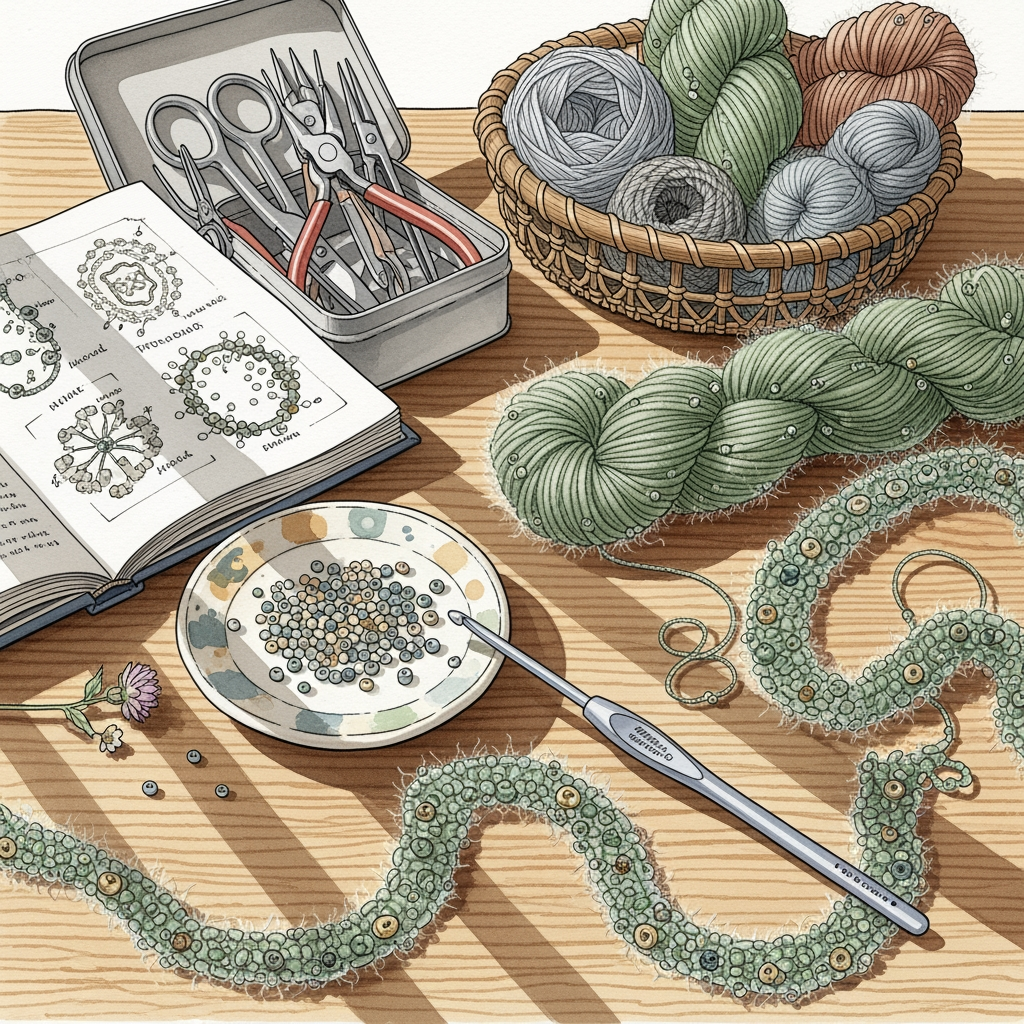
For surface application, a crochet hook is your most valuable tool. Pull a loop of yarn through the bead, catch that loop with a working strand, and secure it with a small knot or a whipstitch at the back of the work.
Always check the tension of your attachment. A bead that sits too far away from the knitted fabric will snag on clothing and eventually break the yarn or the bead itself.
Bead Safety: Preventing Hair Damage and Breakage
While beads add flair, they also introduce stress points to your knitting. Every bead is a potential friction point; as the fabric moves, the edges of the bead bore can slowly saw through fibers if the yarn is not robust enough.
Avoid sharp edges by inspecting every bead before application. If you feel a rough edge, use a small file to smooth it out before the bead touches your finished fiber.
Finally, consider the washability of your finished piece. Metal can tarnish or rust if left wet, and some painted plastic beads may lose their finish in a standard machine wash. Hand washing and laying items flat is the safest approach to maintain the integrity of both the yarn and the beads.
Selecting the right beads is about respecting the relationship between the fiber you have chosen and the hardware you add. By balancing weight, size, and material, you ensure that your projects remain as durable as they are beautiful. Take the time to test your chosen beads on a swatch first, and you will find that these accents transform every stitch into a intentional, polished work of art.

