
6 Best Cable Needles For Complex Patterns To Own
Struggling with intricate designs? Discover the 6 best cable needles for complex patterns to simplify your knitting and improve your stitch precision. Shop now!
Tackling complex cabling patterns requires more than just patience; it demands the right set of tools to navigate intricate crossings without dropping stitches. A reliable cable needle acts as a temporary resting place, ensuring that held stitches remain secure while others are worked. Choosing the wrong tool can lead to stretched, uneven fabric or the frustration of stitches slipping at the most critical moment. This guide explores the best options available to help maintain tension and clarity in even the most elaborate cable designs.
Clover “U” Stitch Holders: Best for Security
These U-shaped holders are a godsend when working on heavy-weight sweaters or blankets involving large, multi-stitch cables. The unique shape acts as a cradle, allowing the held stitches to rest securely in the bend while the needles work the remaining cable sequence.
Because the stitches sit deep in the U-curve, they are highly resistant to sliding off during the tension changes that occur when maneuvering through a crossing. This is particularly advantageous for beginners who may find the transition from the cable needle back to the main needle daunting.
However, the bulk of these holders can be a nuisance when working on tight-gauge projects or fine-weight yarn. They are best reserved for worsted or chunky weight projects where the weight of the fabric helps anchor the needle in place.
CocoKnits Stitch Holders: Best Minimalist Design
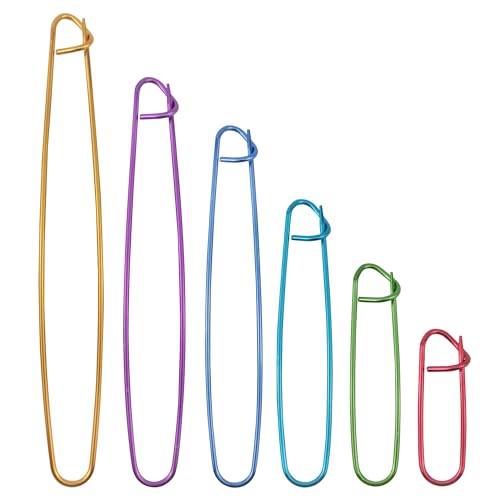

CocoKnits stitch holders prioritize a sleek, snag-free profile that avoids the clutter often associated with traditional cable needles. These are essentially small, smooth needles with a slight depression or “ditch” in the center that prevents stitches from migrating.
The minimalist design makes them perfect for those who dislike the mechanical distraction of a bent tool hanging from the work. They are light enough that they do not drag on the fabric, which helps in maintaining an even gauge across the cable crossing.
Keep in mind that these require a bit more manual control than a U-hook, as the stitches are not “cradled” by a physical barrier. They are an excellent choice for experienced knitters who prefer a seamless, fluid motion while working intricate patterns.
KnitPro Symfonie Cable Needles: Most Versatile

Crafted from polished laminated birch, these needles offer the perfect balance of grip and slide. The smooth, tapered ends allow for easy insertion into stitches, while the naturally grippy texture of the wood ensures that stitches stay put without being overly “tacky.”
The warm feel of the wood is gentle on the hands, making these ideal for long, marathon knitting sessions. They are remarkably versatile, handling everything from slippery silk blends to rustic, high-twist wools with equal reliability.
These needles often come in sets of varying diameters, which is vital when moving between different yarn weights. Selecting the right diameter ensures the cable needle doesn’t distort the tension of the neighboring stitches.
Brittany Birch Cable Needles: Best Traditional Feel

Brittany Birch needles are the gold standard for those who appreciate natural materials and craftsmanship. The wood provides a slight resistance that acts as a natural safeguard against stitches sliding off, which is a common complaint with slick metal needles.
The ergonomic, hand-finished tips are gentle on the fiber, making these a great choice for delicate, high-end yarns like alpaca or cashmere. They do not snap or bend under pressure, offering a sturdy, dependable feel that lasts for years.
While wood offers excellent control, these needles can sometimes feel “slow” if the goal is rapid-fire knitting. They are best suited for projects where precision and stitch integrity take precedence over speed.
The Indian Lake Artisans Necklace: Most Innovative
This unique tool transforms a cable needle into a wearable accessory, utilizing a charm-based system that stays tethered to the knitter. It removes the risk of losing the needle between the sofa cushions, which is a frequent plight for anyone working in a busy household.
The design is particularly helpful for knitters who find that dangling tools interfere with their rhythm. By keeping the needle close to the work but out of the way, it streamlines the cabling process significantly.
While the novelty is high, it is a specialized tool that may take some adjustment to master. It is an investment for the dedicated cable-knitter who values organizational convenience as much as functional performance.
Addi Metal Cable Needles: The Durable Workhorse
For those who knit with high-tension yarns or abrasive fibers, Addi metal cable needles provide unmatched durability. The nickel-free finish is incredibly smooth, allowing stitches to slide effortlessly from the cable needle back onto the main needle.
The weight of the metal can be a benefit or a drawback depending on personal preference; some find the slight heft helps keep the tool steady during complex maneuvers. Because they are thin and rigid, they are excellent for tight, dense cables where a thick wood needle might cause the fabric to stretch.
Note that because of their slick surface, stitches can slide off if not positioned carefully. They are highly recommended for the confident knitter who values speed and requires a tool that will never snap or warp.
Choosing Your Cable Needle: Shape and Material
Selecting the right tool involves balancing the needs of the yarn with the mechanics of the pattern. A cable needle generally comes in three primary configurations:
- J-Hook/U-Hook: Provides deep security; best for large, heavy cable twists.
- Straight/Double-Pointed: Allows for the most freedom of movement; best for complex, multi-cross patterns.
- Twisted/Spiral: A hybrid that uses a kink to hold stitches in place without the bulk of a hook.
Material selection is equally critical. Use wood for slippery yarns like bamboo or silk to provide extra grip. Use metal for high-friction, “sticky” wools that are difficult to move on wooden surfaces.
How to Select the Right Cable Needle Size
The cardinal rule of selecting a cable needle is to choose one that is equal to or slightly smaller than the size of your main knitting needles. Never choose a needle significantly larger than your working needles, as this will stretch the stitches and create unsightly gaps in the cable motif.
If the cable pattern is exceptionally tight or uses a complex “twisting” technique, dropping down by 0.25mm can make the transfer of stitches much easier. Conversely, if you notice the cable looks “pinched” or pulled, move up to a needle that matches your main needle size exactly to allow the stitches more room to breathe.
The “Cabling Without a Needle” Technique
For experienced knitters working with cables that cross only two to four stitches, the “needle-less” method is a time-saving game changer. This involves carefully sliding the target stitches off the left needle and holding them in front or back of the work using only the tension of the yarn and the tips of the fingers.
While this technique significantly speeds up the knitting process, it carries a higher risk of dropped stitches. It is best practiced on “sticky” wool yarns that have a natural “halo” or crimp, which prevents the stitches from unraveling immediately upon release.
Managing Cables: Front vs. Back Crosses
Whether a cable crosses to the front (a “left cross”) or the back (a “right cross”) changes the visual direction of the stitch. A front cross usually results in a cable that leans toward the left, while a back cross leans toward the right.
Regardless of the direction, the real challenge is managing the tension of the “floating” stitches. Always ensure the cable needle is positioned snugly against the main needle to avoid creating an elongated stitch at the point of the cross. Consistent tension at this transition point is the secret to professional-looking, crisp cable definition.
Finding the right cable needle is a journey of matching your personal tension and rhythm with the right material and shape. Whether you prefer the security of a U-hook or the speed of a straight metal needle, the goal is to make the process as seamless as the final fabric. Experiment with different styles to see which best complements the way your hands move across the needles.
