6 Best Backing Boards For Wall Mounting Worth Installing
Discover the 6 best backing boards for wall mounting to ensure a secure, professional finish for your projects. Read our expert guide and choose the right fit.
After spending dozens of hours perfecting the tension on a complex lace shawl or a stranded colorwork sweater, the final step of displaying that textile art is often the most overlooked. A proper backing board preserves the integrity of the fibers while providing a rigid, clean canvas that highlights the intricate structure of the stitches. Choosing the right mounting surface ensures that gravity does not distort the carefully blocked shape of the piece over time. Selecting the appropriate material transforms a finished project from a pile of yarn into a sophisticated piece of wall art.
Lineco Archival Board: Best for Heirloom Textiles


Archival-grade mounting is non-negotiable for hand-dyed wools or delicate silk blends that are prone to yellowing or fiber degradation. Lineco boards are acid-free and buffered, meaning they actively neutralize atmospheric acids that would otherwise migrate into natural fibers like merino or alpaca.
This board is the gold standard for preserving projects meant to last for generations, such as christening gowns or heirloom lace doilies. Because the material is chemically stable, it prevents the brown spots—or foxing—that often appear when fabric touches acidic cardboard or cheap wood frames.
If the goal is long-term conservation, the extra cost is a small insurance policy for months of labor. Always pair this board with stainless steel pins to prevent rust, as standard hardware can react poorly with even the most stable backing materials.
Elmer’s Foam Board: Top Pick for Easy DIY Mounting
For the knitter who frequently updates gallery walls with seasonal projects or finished swatches, standard foam board offers the perfect balance of weight and utility. It is incredibly lightweight, making it easy to hang with simple adhesive strips that won’t damage wall paint.
The foam core provides just enough depth to sink pins securely into the surface without pushing all the way through to the wall. This is ideal for mounting light-to-medium weight projects like a single block of a sampler afghan or a decorative wall hanging.
Do not expect this board to hold up under the weight of heavy, super-bulky wool blankets or oversized tapestries. Use it for what it is: a quick, accessible, and temporary solution that allows for frequent re-pinning as your collection of projects evolves.
U-Brands Cork Board: Best for Casual, Rustic Display

Cork provides a natural, textured aesthetic that complements the organic feel of wool and linen fibers. Because cork is self-healing, it is perfect for pinning and re-pinning different swatches without leaving visible holes in the background material.
This option is particularly effective for displays of experimental swatches or “process art” where the knitter wants to see the evolution of their technique. The rustic look works beautifully with chunky garter stitch projects or undyed, raw wool textures.

One common mistake is using low-quality cork that flakes or crumbles after a few pin cycles. Ensure the board is mounted on a dense backing to keep the pins perpendicular to the wall, preventing the fabric from sagging or pulling away at the top edge.
Gatorfoam Gatorboard: Most Rigid for Heavy Pieces
When the project involves heavy materials like cotton rope, macramé, or double-stranded heavy worsted sweaters, standard foam board will buckle and bend. Gatorfoam consists of extruded polystyrene foam between two layers of wood-fiber veneer, creating a rigid structure that refuses to warp.
This is the professional choice for large-scale fiber art that needs to hold its geometry under tension. The dense veneer also provides a more secure hold for pins, ensuring that heavy items remain perfectly vertical without slipping downward over time.
While it is more expensive and difficult to cut than foam core, the structural integrity is unmatched for heavy-duty applications. If the project is a centerpiece measuring over two feet in width, bypass the lighter boards and opt for the rigidity of Gatorfoam.
Master-Mag Sheeting: Best for No-Pin Magnetic Art
For projects that absolutely cannot have pinholes—such as delicate silk scarves or pieces with metallic threads—magnetic mounting is a brilliant, non-invasive alternative. By sewing a lightweight ferrous strip or adding small magnets to the back of the textile, the piece can be held securely against the magnetic sheeting.
This method completely eliminates the risk of snagging fragile fibers or permanent distortion caused by tension pins. It creates a seamless, floating effect that makes the fabric appear as if it is resting just off the wall.
This approach requires a bit more technical preparation, as the magnets must be carefully balanced to support the weight of the yarn. It is an investment in both time and hardware, but for high-end display, it provides the cleanest, most professional presentation possible.
Pacon Art Board: Best Budget-Friendly Bulk Option
When the goal is to mount an entire collection of lace blocks or a series of matching nursery hangings, cost becomes a significant factor. Pacon art boards are cost-effective and come in large sheets, allowing for custom cutting to match specific project dimensions.
They lack the archival properties of Lineco boards and the rigidity of Gatorfoam, but they serve as a perfectly adequate surface for practice pieces or projects that won’t be on permanent, long-term display. They are thin enough to be cut with a standard utility knife, making the prep work quick and effortless.
The bottom line is simple: use these for high-volume, lower-stakes projects. Keep them away from high-moisture areas, as the paper surface can absorb humidity and eventually lead to warping or mildew.
How to Choose the Right Backing Board for Your Art
Selecting the right board starts with identifying the weight of your fiber and the intended duration of the display. Natural fibers like wool and silk react differently to humidity and acidity than synthetic blends, requiring more care in the selection of archival-grade surfaces.
Consider these three primary factors: * Weight: Does the piece have significant drape? A heavy piece needs a rigid board like Gatorfoam. * Duration: Is this a permanent heirloom or a seasonal display? Use acid-free boards for long-term storage. * Finish: Does the background texture need to be invisible, or should it complement the yarn?
Always factor in the “blocking” requirements of the project. If a piece requires heavy steam blocking to shape, the backing board must be able to withstand the moisture content of the textile during the initial pinning phase.
Foam Core vs. Gatorboard: What’s the Difference?
The fundamental difference lies in the skin of the board. Foam core is a sandwich of polystyrene between two layers of paper, making it prone to bending and dings. It is inexpensive and easy to source, but it lacks the long-term structural life of more professional materials.
Gatorboard uses a high-density wood-fiber veneer, which is far more durable and resistant to environmental changes. This veneer prevents the board from “bowing” when hung, keeping the textile flat and taut against the wall.
Choose foam core for small, light projects that are easily replaced. Choose Gatorboard for large, heavy, or permanent fiber installations that demand a crisp, clean profile without any bowing or sagging.
Tools You Need for Mounting Fabric Art Like a Pro
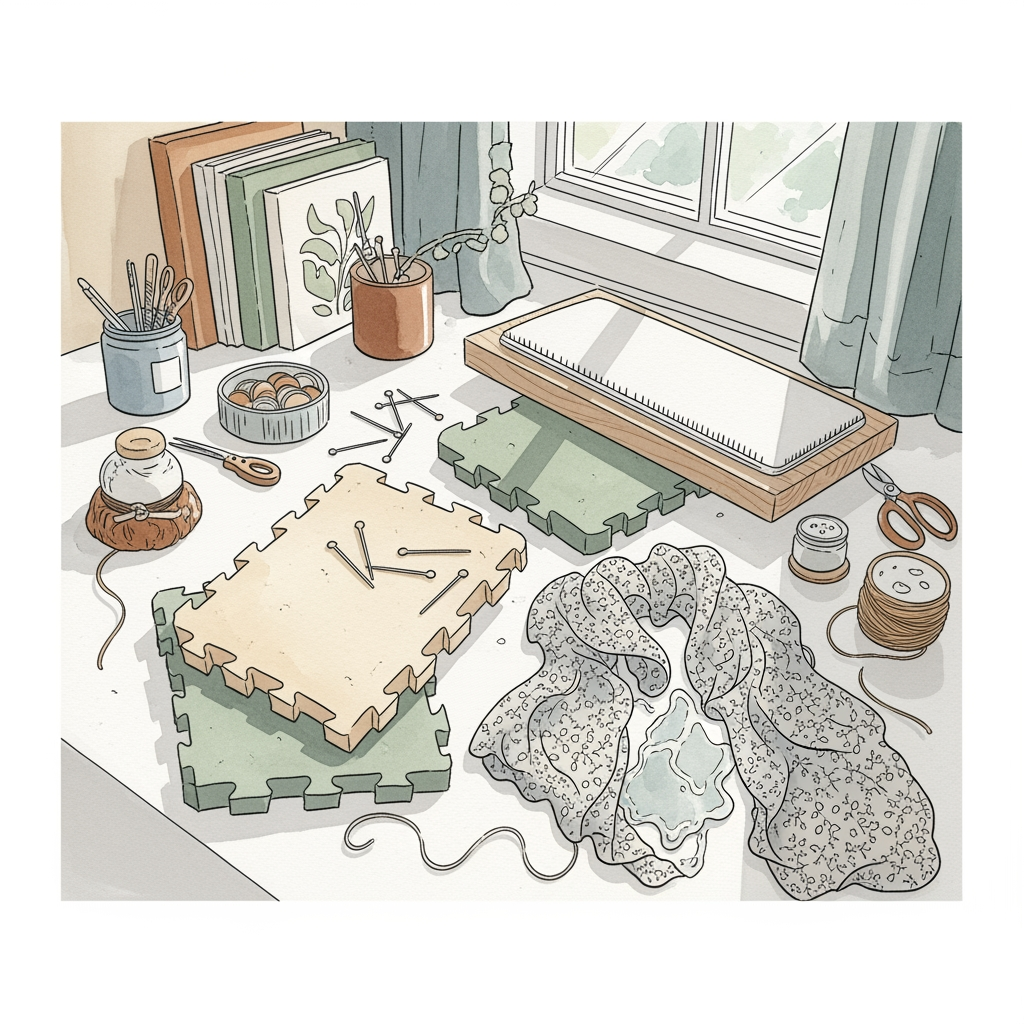
Equipping yourself with the right tools ensures that the mounting process is as precise as the knitting itself. A self-healing cutting mat and a sharp X-Acto knife are essential for achieving perfectly straight edges that look tailored.
- Stainless steel T-pins: Essential to avoid rust stains on your fiber.
- A steel-edge ruler: Provides the guide needed for clean, sharp cuts.
- A measuring tape: Use it to ensure the grid is perfectly square before pinning.
- Blue painter’s tape: Great for holding the project in place while adjusting tension.
Always keep a small pair of precision scissors nearby to trim loose ends before pinning. A clean, finished look on the back of the project contributes to a more professional display overall.
Step-by-Step Guide to Pinning Your Textile Work
Begin by laying your blocking-ready project flat on the board, identifying the center point to ensure the piece is aligned. Secure the center of the project first, then work outward toward the edges, maintaining even tension to prevent the stitches from distorting.
For lace or delicate colorwork, pin from the center out along the main axes. This keeps the pattern repeat symmetrical and prevents the “pulling” effect that often happens when starting at one corner.
If the piece has a hem or a folded edge, use extra pins to hold the fold flat against the board. Once fully pinned, step back and check the piece from several angles to ensure the tension is uniform; make small adjustments until the project looks as if it is floating on the board surface.
Selecting the right backing board is a final act of respect for your hard work and the time you have invested in your craft. Whether you prioritize archival protection, rigid structural support, or budget-friendly display, there is a mounting solution that will elevate your fiber art. With the right tools and a bit of patience, your projects will look just as professional on the wall as they feel in your hands.