
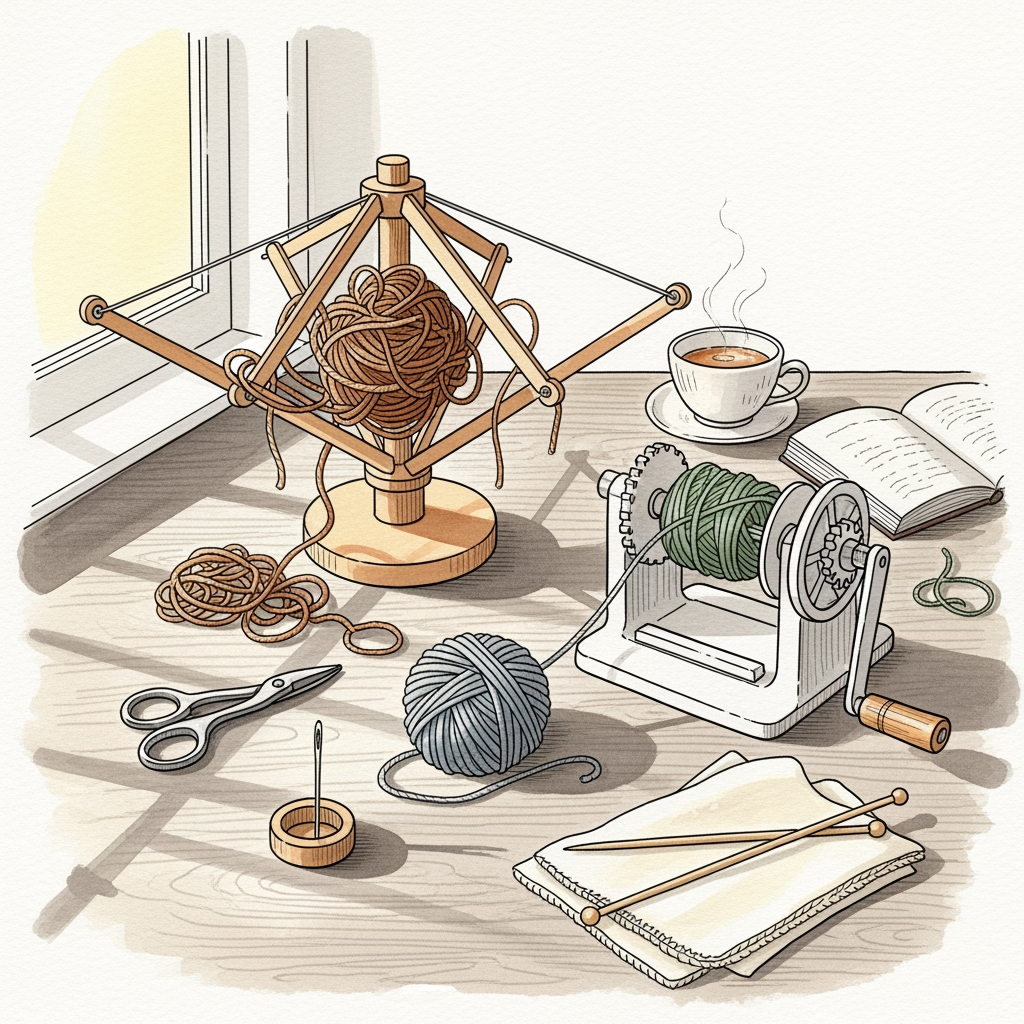
6 Best Swift Tools For Unraveling Yarn Skeins
Struggling with tangled yarn? Discover the 6 best swift tools to streamline your process and wind hanks efficiently. Explore our top expert recommendations today.
Transforming a tangled hank of yarn into a neat, ready-to-use center-pull cake is one of the most satisfying rituals in the fiber arts. While many beginners start by draping yarn over chair backs or knees, a dedicated swift is the definitive upgrade for efficiency and yarn health. Using the right tool prevents unnecessary stretching, reduces the risk of frustrating tangles, and protects delicate fibers during the winding process. This guide evaluates the top tools available to ensure every skein is handled with the care it deserves.
Stanwood Metal Umbrella Swift: Best Overall Pick


The Stanwood Metal Umbrella Swift is the industry standard for durability and consistent performance. Constructed from heavy-duty metal components, it eliminates the wobbling and frame warping often seen in wooden models.
This swift excels at handling large, heavy hanks of worsted or bulky wool, which can often overwhelm lighter, wooden structures. The rotation is remarkably smooth, providing just enough resistance to keep the yarn from flying off while preventing the tugging that leads to uneven tension in the final cake.
If frequent winding is a standard part of the knitting routine, this is the most reliable investment. It functions flawlessly with almost any yarn weight, from delicate lace-weight mohair to rustic, heavy-gauge Icelandic wool.
Lykke Mango Wood Umbrella Swift: Most Stylish

For those who view their knitting space as a sanctuary, the Lykke Mango Wood Umbrella Swift offers a marriage of form and function. Crafted from smooth, polished mango wood, it functions as a beautiful piece of equipment that is far too attractive to tuck away in a dark closet.
Beyond the aesthetics, the wood provides a slightly grippier surface than metal, which can be advantageous for slick yarns like silk or bamboo blends. These fibers tend to slide off metal arms, but the natural texture of the wood holds them securely in place during the transition to the ball winder.
It remains a functional, high-quality tool that balances visual appeal with reliable mechanics. It is the perfect choice for the maker who appreciates artisanal quality and wants equipment that enhances the atmosphere of the craft room.
The Woolery Amish Style Swift: Best Tabletop

The Amish-style swift operates on a horizontal plane, resting directly on a flat surface rather than clamping to the edge of a table. This design is exceptionally stable, as it relies on the weight of the base rather than a tension-sensitive clamp.

Because it sits low, it is easier to control for knitters with limited vertical workspace or those who prefer to wind yarn while seated at a dining table. The adjustable pegs allow for infinite sizing, accommodating everything from tiny, 50-gram lace skeins to massive 200-gram hanks.
This design is particularly popular because it does not require a specific edge thickness on a table. It is the most versatile option for those who may need to wind yarn in various locations, such as living room coffee tables or kitchen islands.
KnitPicks Birch Swift: Top Budget-Friendly Pick

The KnitPicks Birch Swift is a classic, lightweight solution that serves as an accessible entry point for new knitters. While it lacks the heavy-duty components of more expensive metal models, it performs the essential task of holding a hank perfectly well for standard projects.
This swift is ideal for those who primarily use worsted-weight, wool-based yarns that have a bit of natural “grab.” It is not designed for industrial-level output, but for the hobbyist who winds a few skeins a month, it offers exceptional value.
Maintenance is simple, and the lightweight construction makes it easy to store in a small space. It is a practical, no-nonsense tool that proves one does not need to break the budget to achieve professional-looking yarn cakes.
Strauch Rosewood Swift: The Heirloom Investment
The Strauch Rosewood Swift is a masterclass in engineering, designed for the serious fiber enthusiast who requires absolute precision. Every component is machined to tight tolerances, ensuring that the rotation is silent, fluid, and perfectly balanced.
When handling luxury fibers like cashmere, alpaca, or hand-dyed singles, the smoothness of this swift is a significant advantage. It prevents the friction-based damage that can sometimes cause soft, delicate yarns to bloom or lose their twist before they even hit the needles.
Purchasing this piece is a commitment to the craft, intended to last a lifetime of consistent use. For the knitter who frequently works with high-end, precious materials, the mechanical superiority of this swift protects the investment made in the yarn itself.
The Nostepinne: A Swift-Free, Portable Option

The nostepinne is an ancient, simple tool that replaces both the swift and the ball winder with a single wooden stick. To use it, one wraps the yarn around the stick in a specific pattern, building a center-pull cake by hand.
This is the ultimate portable solution, requiring no clamps, tables, or complex mechanisms. It is perfect for winding yarn while traveling or for those who simply prefer a tactile, low-tech connection to their fiber.
While it lacks the speed of a mechanical swift, it offers incredible control over the final tension of the ball. It is a wonderful skill to master, especially for those who enjoy the meditative aspect of manual labor in their craft.
Umbrella vs. Amish Swift: Which Is Right For You?
Choosing between these two primary styles comes down to workspace and yarn volume. Umbrella swifts, which expand vertically like a fan, are generally faster to set up and adjust for different skein circumferences.
Amish-style swifts, by contrast, offer superior stability and a lower profile. They are less likely to tip over if the yarn gets stuck or if the winding speed becomes erratic.
- Choose an Umbrella Swift if: The workspace is tight and clamping to a desk edge is preferred.
- Choose an Amish Swift if: The surface area is large, and stability is the primary concern for winding heavy, bulky skeins.
Setting Up Your Swift and Ball Winder Correctly
The relationship between the swift and the ball winder is critical to preventing tangles. The swift should be placed at least two to three feet away from the winder to ensure the yarn maintains a consistent, gentle angle of tension.
Always ensure the hank is placed on the swift so the yarn feeds from the outside, not the inside, to avoid an immediate mess. Check the pegs on an umbrella swift to ensure they are even and snug; if they are loose, the swift may wobble, leading to uneven cake density.
When starting the winding process, go slowly. Speed can be increased once a stable rhythm is established and the yarn is feeding smoothly without snagging on the labels or the swift’s own frame.
How to Care for and Maintain Your Yarn Swift
Wooden swifts require occasional attention to keep the moving parts fluid. A very light application of wax or silicone lubricant on the central joints can eliminate squeaking and improve rotation significantly.
Avoid storing wooden tools in areas with extreme temperature fluctuations or high humidity, as wood is a natural material that can warp or crack over time. If a metal swift begins to catch, check the alignment of the arms and ensure the central screw is tightened correctly.
Regularly wipe down the components to remove fiber dust and any residual oils from the yarn. Keeping the tool clean ensures that delicate silk or white yarn does not pick up debris during the winding process.
No Swift? No Problem: How to Wind Yarn by Hand
When a swift is not available, the back of a chair is the classic substitute, provided it is sturdy and won’t snag the yarn. Carefully stretch the hank over the chair, ensuring it is positioned so it cannot slip off while being pulled.
If no chair is available, a partner can hold the yarn, though this requires patience and a steady hand. If forced to use the knees, proceed with extreme caution, as any movement will cause the hank to collapse and tangle immediately.
Regardless of the method, the goal is always to keep the hank open and free from twists before starting the winding process. Never try to wind a ball from a loose, twisted hank without first creating a stable loop, as this is the primary cause of the dreaded “yarn barf.”
Equipping a knitting studio with a reliable swift is one of the most effective ways to streamline the craft. By choosing the tool that best fits the specific needs of the projects and workspace, the process of preparing yarn becomes a seamless, enjoyable prelude to the knitting itself. Quality equipment serves as a silent partner in the creative journey, ensuring that every stitch begins with well-prepared, tension-perfect yarn.
