6 Best Measuring Gauges For Center Alignment To Own
Find the 6 best measuring gauges for center alignment to improve your project accuracy. Explore our top expert-tested recommendations and shop your tool today.
Achieving perfect symmetry in knitting projects—from placing a cable panel exactly in the center of a sweater back to spacing intarsia motifs—is the mark of professional-grade work. Relying on guesswork often leads to skewed designs that only become apparent after hours of tedious knitting. A proper centering gauge removes the margin for error, ensuring every stitch is accounted for before the yarn meets the needle. Choosing the right tool depends largely on whether you need a portable check or a permanent workstation fixture.
Dritz See-Thru Ruler: Best for Quick Checks


The Dritz See-Thru Ruler is a staple in many notions kits due to its sheer simplicity and transparency. Because it is made of clear, flexible plastic, it allows for immediate visualization of stitch counts across a row of knitting.
This tool shines when checking the placement of a neckband or ensuring a buttonhole band is perfectly centered against a placket. It eliminates the struggle of trying to align opaque measuring tools over delicate stitches that might shift or distort under pressure.
However, the plastic can become brittle over time if stored in a crowded notions bag. It serves best as an on-the-go tool rather than a heavy-duty cutting guide.
Omnigrid Centering Ruler: Quilter’s Top Pick
While designed for quilting, the Omnigrid Centering Ruler is a secret weapon for blocking intricate lace shawls or complex geometric colorwork. The zero-centered numbering system allows for immediate symmetry without the need for mental arithmetic.
When blocking, you want to ensure the spine of a shawl is perfectly perpendicular to the base. This ruler makes it easy to measure out from the center line, ensuring both wings of the shawl grow at identical rates.
Take care when using this on delicate fibers like mohair or silk, as the edges are quite rigid. It is best used for marking your blocking surface rather than manipulating the wet fabric directly.
SINGER Centering Tape: Ideal for Garments

A flexible centering tape is indispensable when you are sewing knit seams or measuring the circumference of a sleeve head. Unlike rigid rulers, this tape conforms to the 3D shape of a garment, providing accurate readings on curved surfaces.
The zero-center marking on the tape is particularly helpful when you need to find the midpoint of a circular cast-on. It takes the frustration out of identifying the exact center of a sweater front when planning a complex cable layout.
Always ensure the tape is not stretched while measuring, as synthetic tapes can distort over time. If the tape feels loose or wavy, it is time for a replacement to maintain accuracy.
Westcott Steel Ruler: The Most Durable Option
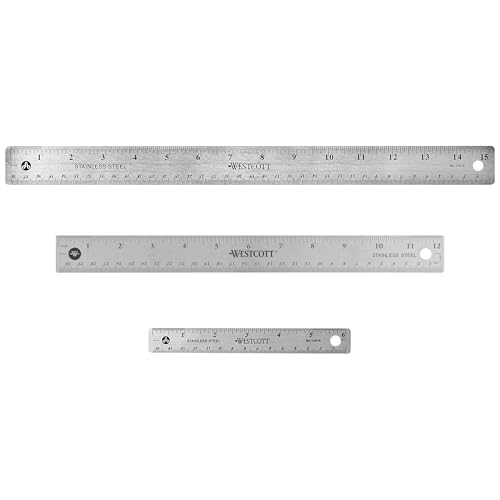
For the knitter who demands a tool that lasts a lifetime, a stainless steel ruler is the superior choice. It will not warp, snap, or fade, making it an excellent investment for a permanent knitting station.
The laser-etched markings provide high contrast, which is essential when counting stitches under poor lighting. It is heavy enough to lay flat on a project without the need for pins, holding its position while you mark chart rows or stitch locations.
The primary trade-off is the lack of flexibility, which makes it unsuitable for measuring curved necklines. Use this tool exclusively for flat work and blocking measurements.
Incra Precision Rule: For Ultimate Accuracy
The Incra Precision Rule is designed for woodworkers, but its micro-fine marking holes are a game-changer for knitters planning complex charts or stranded colorwork. You can place a pin through the holes to mark your fabric or pattern paper with absolute precision.
This level of accuracy is rarely needed for basic garter stitch scarves, but for haute couture knitting where every millimeter counts, it is unmatched. It essentially turns your ruler into a high-precision drafting tool.
The high cost makes this an investment piece for the dedicated designer. It is best reserved for those who draft their own patterns or work with very fine-gauge yarn where minor errors are highly visible.
Arteza Cutting Mat: Best All-in-One Surface

A large-scale cutting mat with a built-in grid is the backbone of an efficient fiber arts studio. While primarily used for cutting fabric or trimming pom-poms, the grid lines serve as a permanent centering gauge for your projects.
When blocking sweaters, the grid allows you to pin your work in place relative to a center axis. You can visually confirm that your shoulders are even and your side seams are perfectly vertical before the project dries.
Ensure your mat is stored flat; even a slight bow in the surface can ruin the symmetry of a large piece. Keep it away from direct sunlight, which can cause the plastic to warp and the grid lines to fade.
How to Choose Your Ideal Centering Gauge
Selecting the right gauge depends on the nature of your projects. If you are a designer or a structural knitter, a steel ruler or an Incra tool will provide the repeatability you require.
For the average hobbyist who mostly works on hats and scarves, the Dritz See-Thru or SINGER tape will suffice. Consider the following when purchasing:
- Material: Steel for longevity, plastic for flexibility.
- Graduation: Metric or imperial, depending on the patterns you most frequently follow.
- Portability: Does it need to fit in your project bag, or will it stay on your desk?
Always prioritize tools that clearly display a zero-point center, as this is the primary feature that saves time.
Using a Centering Ruler: A Quick How-To
To use a centering ruler, locate the midpoint of your garment by folding it evenly or identifying the center stitch. Align the zero mark on the ruler with that center point.
Once aligned, the markings on either side of the zero will indicate the exact distance to the left and right simultaneously. This ensures that features like cables or pockets are perfectly balanced, preventing a lopsided finished product.
If you are working with lace or stretchy fabric, do not pull the fabric tight against the ruler. Let the material rest naturally to ensure the measurement reflects how the garment will actually sit when worn.
Ruler vs. Tape Measure: Which Is Best?
A ruler offers rigidity that is essential for checking the vertical alignment of stitches, especially in colorwork. It is the gold standard for drafting and ensuring your tension is consistent across the width of a row.
A tape measure, conversely, is the only way to effectively measure circumference or curved seams. In an ideal kit, both tools serve distinct roles that the other cannot fulfill.
Never attempt to use a flexible tape to measure a straight edge for a seam, as it will inevitably introduce a small amount of variance. Keep a rigid ruler nearby for all flat construction needs.
Why Perfect Centering Matters in Your Work
Perfect centering is the threshold between a project that looks handmade and one that looks expertly crafted. When a design element is even a few stitches off-center, the eye immediately perceives it as a mistake, which can diminish the pride you take in your labor.
Taking the time to measure correctly before you finish your bind-off saves you from the frustration of an uneven garment. Investing in a quality centering tool ensures your effort is translated into a professional result every single time.
Consistent results build confidence, allowing you to tackle more ambitious designs with the assurance that your foundations are solid.
A reliable centering gauge is not just a ruler; it is a commitment to the quality of your finished work. By selecting the tool that best fits your specific knitting style, you ensure that every project meets your personal standard for excellence.