6 Best Warping Frames For High Capacity Warping
Boost your production efficiency with these 6 best warping frames for high capacity warping. Read our expert review and choose the right equipment today.
Warping is the foundation of a successful weaving project, determining the structural integrity of every piece of cloth that leaves the loom. Choosing the right warping mill transforms a tedious, error-prone chore into a rhythmic, efficient part of the craft. High-capacity tools are essential for weavers tackling long warps or complex multi-shaft patterns that require hundreds of individual threads. The following selection highlights equipment designed to maintain consistent tension, save studio space, and handle substantial yardage with ease.
Schacht Horizontal Warping Mill: Best Overall


The Schacht horizontal mill is widely considered the gold standard for its remarkable combination of stability and ease of operation. Its design allows for the smooth winding of long warps without the frustration of tangled threads or uneven tension.
The horizontal rotation minimizes physical fatigue during long sessions, as the handle remains at a comfortable height. Its sturdy base ensures that even when winding heavy cotton or linen—fibers that can be unforgiving if tensioned poorly—the mill remains firmly in place.
If you frequently work with long, complex warps, the sturdy construction and consistent winding geometry of this mill justify the investment. It is a workhorse that bridges the gap between hobbyist convenience and professional precision.
Glimakra Warping Mill: Top Pick for Durability
Glimakra tools are engineered with the kind of Scandinavian robustness that outlives the weaver. This mill is constructed from high-quality, dense woods that resist warping or splintering even after years of exposure to fluctuating humidity levels in a studio.
The design prioritizes sheer capacity and mechanical reliability. Because the frame is built to handle significant torque, you can wind dense warps of wool or slick synthetics without worrying about the structure flexing or binding.
When long-term ownership is the priority, the exceptional wood craftsmanship makes this the superior choice. It is a legacy piece that maintains smooth rotation regardless of how much yarn weight is piled onto the pegs.
Ashford Warping Mill: Best Value for Home Weavers
The Ashford mill serves as an ideal entry point for weavers ready to graduate from a peg-frame to a professional-style mill. It captures the essential functions of high-capacity warping while remaining accessible in price and size.
It is lightweight and easy to navigate, yet robust enough to handle standard weaving projects like towels, scarves, or table runners. The pegs are spaced to provide clear, logical paths, which helps maintain order when working with multiple colors or intricate stripes.
For those with limited budgets who still require efficient, long-warp capabilities, the Ashford mill offers the best cost-to-performance ratio. It is perfectly suited for home studios where space is at a premium and versatility is required.
Leclerc Floor Warping Mill: Pro-Level Capacity
Leclerc mills are designed for the weaver who views the loom as a central fixture of their professional life. This equipment is specifically built for massive yardage, making it the go-to for weavers producing large runs of fabric or high-density heirloom blankets.
The floor-standing model offers superior stability, allowing you to wind at a faster pace without shaking the frame. The heavy-duty pegs are engineered to hold thousands of yards without bowing, ensuring the warp stays perfectly organized throughout the entire process.
If you are scaling up to production-level weaving, the sheer scale and structural rigidity of the Leclerc floor mill provide the necessary support for high-volume work. This is not just a tool; it is a serious piece of industrial equipment for the dedicated maker.
Louët Warping Mill: Smartest Collapsible Design
Small-studio weavers often struggle with the footprint of traditional warping mills. The Louët model addresses this directly by featuring a clever, collapsible design that can be folded down when not in use, tucked behind a loom or into a closet.
Despite its ability to fold, it sacrifices none of the stability required for quality warping. It is exceptionally lightweight yet remains steady during use, thanks to a balanced rotating base that prevents tipping.
For the weaver constrained by space but unwilling to compromise on tool quality, the collapsible convenience of the Louët mill is unmatched. It effectively solves the “where do I put this?” dilemma that haunts many fiber artists.
Harrisville Warping Reel: A Timeless Classic

The Harrisville reel is a testament to the idea that simple, elegant engineering often outperforms complex gadgetry. Its vertical design is a classic choice for weavers who appreciate a smaller vertical footprint and a straightforward winding motion.
It is particularly effective for managing tension in a very direct way, allowing the weaver to monitor the yarn path closely. Because it is compact and features a simple rotation, it is easy to transport or move around a busy studio space.
If you prefer a traditional, reliable, and space-conscious tool, the Harrisville reel remains a perennial favorite. Its longevity in the craft is a testament to its effectiveness and ease of use for almost any weaving project.
Warping Frame vs. Mill: Which One Do You Need?
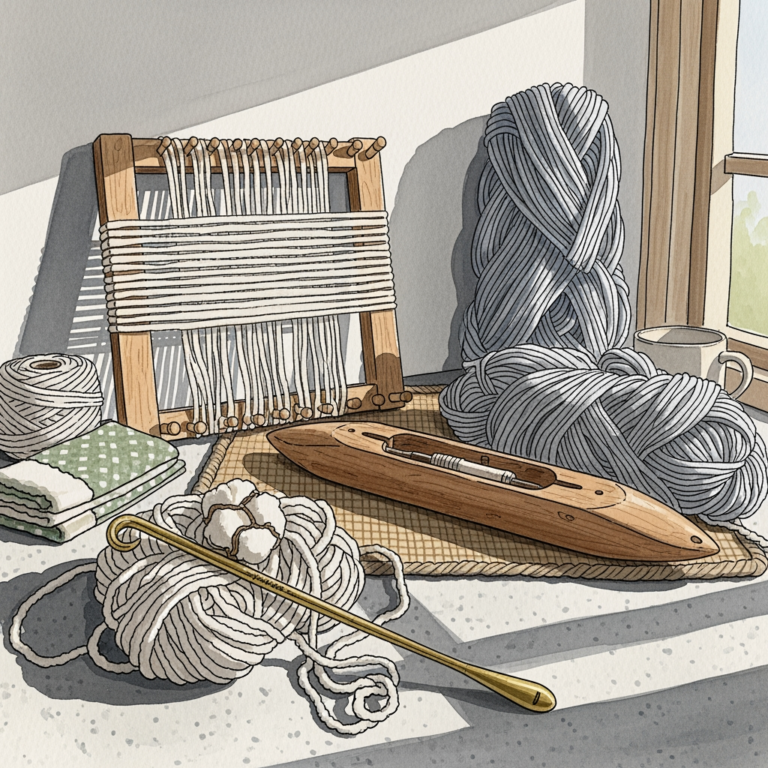
A warping frame—essentially a large board with wooden pegs—is ideal for short to medium-length warps where space is very limited. They are inexpensive and can be mounted on a wall, making them perfect for occasional weavers.
However, a warping mill is vastly superior when the project requires long warps or high-density threads. The revolving nature of the mill keeps tension even and eliminates the constant walking back and forth required by a fixed frame.
If you find yourself winding warps longer than four yards, or if you regularly use silk or delicate fibers that require constant, gentle tension, investing in a mill will save you hours of physical labor. A frame is for the hobbyist; a mill is for the regular weaver.
How to Calculate Your Ideal Warping Capacity
To determine what size mill you need, always multiply your finished project length by your take-up and shrinkage factors. For instance, wool will shrink significantly more than cotton, so you need extra length to reach the desired final dimensions.
Add at least 20 percent to your total yardage calculation to account for loom waste, which is the yarn that cannot be woven because it remains trapped in the lease sticks or behind the reed. Never assume the length on the project pattern is the length you should wind.
Always factor in the total number of ends (individual threads). If your mill capacity is small but your project requires 400 ends, you will have to wind the warp in multiple passes, which increases the chance of tension errors.
Tips for Tensioning Your Warp Evenly Every Time
Consistent tension is achieved by maintaining a steady speed and a uniform grip on the yarn. Do not rush the process; the mill should be the boss of the tempo, not the speed of your arm.
Use a tensioning device if your mill allows it, or hold the yarn under a consistent weight. If the yarn feels “springy”—common with high-twist wool—ensure the pegs are long enough to keep the layers from slipping off and collapsing the structure.
Pro-tip: Always maintain the same posture throughout the entire winding process. Changing how you stand or reach will subtly alter the tension, leading to stripes of tight and loose threads that only become visible once the project is on the loom.
Making Space for a Mill in a Small Studio
Verticality is the best friend of a small-studio weaver. If you cannot fold your mill, consider placing it on a heavy-duty furniture dolly with locking casters. This allows you to roll the mill into the center of the room for warping and back into a corner when it is time to weave.
Alternatively, look for “dead” vertical space. Some weavers hang their warping mills from the ceiling or mount them on wall brackets when not in use. Even a floor-standing mill can be repurposed as a yarn storage rack for active projects during downtime.
Do not allow the equipment to dictate your studio layout. By utilizing mobile bases or wall-hanging solutions, you can integrate a large-capacity mill into even the most modest of living spaces.
The right warping mill serves as the mechanical heartbeat of the studio, ensuring that every thread is placed with intent and precision. By balancing the need for capacity, stability, and space efficiency, you move closer to a seamless workflow that allows creativity to flourish. Choose the tool that respects your current project goals while providing the room for your skills to grow in the years ahead.