6 Best Jewelry Crafting Kits For Beginners
Start your creative journey with these 6 best jewelry crafting kits for beginners. Shop our top picks today to begin making your own unique handmade accessories.
Jewelry crafting offers a tactile satisfaction remarkably similar to the rhythmic focus of knitting, where individual components transform into a cohesive, wearable textile. Choosing the right kit acts as the foundation for this creative process, much like selecting the appropriate needle material or yarn weight determines the drape of a finished shawl. These collections provide the essential hardware needed to begin without the overwhelm of sourcing individual components from scratch. Selecting an entry-level set ensures that the technical learning curve remains manageable while the focus stays on developing dexterity and design intuition.
Modda Deluxe Jewelry Making Kit: Best Overall


The Modda Deluxe kit functions much like an interchangeable needle set for a new knitter: it provides a comprehensive range of tools and findings that cover almost any entry-level project. It removes the guesswork by including a diverse array of base metals, clasps, and jump rings.
For those just starting, having a complete set of pliers—round-nose, chain-nose, and wire cutters—is as essential as owning a full range of needle sizes from 2.25mm to 5mm. This kit ensures that the transition from simple stringing to more complex construction is not hindered by missing equipment.
The primary benefit here is the balance between quality and variety. It serves the learner well who wants to experiment with different aesthetics before settling into a specific jewelry-making niche.
Beadnova Starter Beading Kit: Best for Beads
Beadnova focuses heavily on the raw materials, specifically the variety of bead shapes and colors, making it ideal for those who prioritize colorwork and pattern design. Much like selecting a variegated hand-dyed yarn for a simple garter stitch project, the beads themselves provide the visual interest here.
Beginners often struggle with inconsistent tension in beadwork, just as they do when first learning to maintain even gauge across a row of stockinette. This kit provides enough volume to allow for trial and error without the fear of running out of supplies mid-design.
Expect a wide spectrum of glass and acrylic options that are lightweight and easy to manipulate. It is the perfect choice for the crafter who wants to focus on color theory and pattern repetition rather than metalwork.
Cousin DIY Wire Wrapping Kit: Best for Wirework
Wire wrapping is the jewelry equivalent of intricate lace knitting, requiring precision and the ability to control tension consistently. This kit provides the necessary gauges of wire to practice creating loops, coils, and structural armatures for gemstones or beads.
Wire stiffness is a critical factor, similar to the difference between a bouncy superwash merino and a rustic, non-superwash wool. This kit teaches the importance of work-hardening wire, which is the process of shaping metal until it becomes rigid, much like blocking a lace shawl to set its final form.
If the goal involves structural work or creating complex pendant frames, this kit offers the best entry point. It prioritizes the mechanics of movement and structural integrity over decorative bead volume.
Paxcoo Jewelry Making Supplies Kit: Best Value
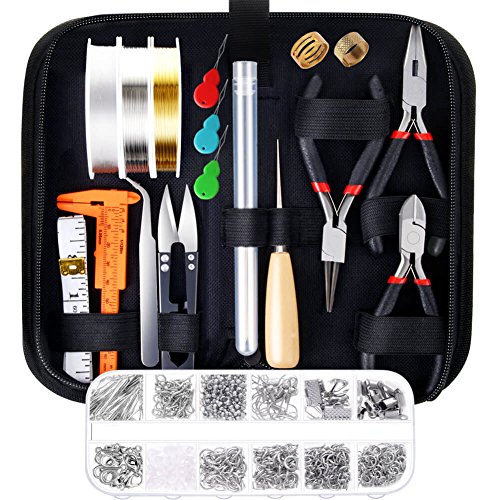
The Paxcoo set is the utilitarian choice, similar to keeping a stash of affordable bamboo needles for practice or travel knitting. It offers the most “bang for the buck” by including a vast quantity of standard findings, such as headpins and earring hooks, that every maker eventually depletes.
Quantity matters when learning, as broken wires or misplaced jump rings are inevitable during the early stages of development. Having a high volume of these small, easily lost components prevents the frustration of halting a project due to a missing piece.
While the metal finishes might not be heirloom quality, they are perfectly serviceable for prototyping designs. It is the ideal selection for someone who wants to produce a high volume of practice pieces to hone their physical coordination.
Sculpey Clay Earring Kit: Best for Polymer Clay
Working with polymer clay mimics the sculptural aspect of fiber arts, like felting or creating three-dimensional knitted toys. This medium allows for immense creative freedom, as the clay can be textured, cut, and baked into custom shapes that aren’t possible with standard beads.
Understanding the “cure” time and temperature of polymer clay is as vital as understanding the fiber content of a yarn before dyeing it. Improperly cured clay is brittle, much like a garment that hasn’t been properly blocked or finished, leading to premature breakage.
This kit is perfect for those who want to build their jewelry from the ground up, rather than simply assembling pre-made parts. It leans into the artistic side of making and requires a different set of fine motor skills than traditional stringing.
Made By Me Ultimate Jewelry Studio: Best for Kids
Designed with simplicity and safety in mind, this kit mimics the experience of learning to knit with chunky needles and bright, high-contrast yarn. It keeps components large and easy to manipulate, which helps develop confidence without requiring excessive finger dexterity.
The inclusion of bright colors and easy-to-grasp fasteners makes it a low-stakes environment for learning the logic of jewelry assembly. It avoids the tiny, fiddly findings that can cause frustration in younger makers or those with limited fine motor control.
It functions as an excellent introduction to the concepts of jewelry making. The focus remains on the joy of creating a finished piece that is ready to wear immediately after completion.
How to Choose the Right Jewelry Kit for You
Selecting a kit depends on the desired outcome: do you want to string beads, bend wire, or sculpt shapes? Much like choosing a pattern based on whether you enjoy mindless stocking stitch or complex cables, your choice of kit dictates the pace and type of work you will perform.
Consider your workspace and available tools before buying. If a kit doesn’t include pliers, you will need to purchase them separately, just as you cannot knit a sweater without needles of the correct diameter.
Prioritize your primary goal. If the objective is to make gifts, look for kits with higher quality findings; if the goal is to learn the craft, prioritize kits with a large volume of practice materials.
Understanding Your Kit’s Pliers and Hand Tools
The tools in a kit are the extensions of your hands. Chain-nose pliers are for gripping, round-nose pliers are for creating loops, and wire cutters are for precision trimming.
Think of these tools like different knitting needle materials. Slick metal needles allow for fast knitting, while bamboo provides grip; similarly, pliers with rubberized handles offer more control, while bare steel tools allow for a more tactile feel.
Always check for a smooth finish on the jaws of your pliers. Any burrs or rough edges can leave permanent marks on your wire or metal findings, much like a damaged needle tip can snag and split delicate silk yarn.
A Quick Guide to Common Jewelry Findings
Findings are the hardware—the clasps, jump rings, and ear wires that hold a project together. A jump ring is essentially the stitch marker of the jewelry world, connecting different elements with a simple, functional open-and-close mechanism.
The lobster clasp is the standard closure, offering reliability similar to a secure bind-off. Ear wires are the final touch, and choosing between hypoallergenic materials or standard plated alloys is as important as checking a label for wool allergies before starting a blanket.
Always keep a small organizer for these items. Like stitch markers and tapestry needles, findings have a way of disappearing the moment they are set down, and having them categorized makes the assembly process significantly faster.
Metal Quality: What to Look For in Your Kit
When reviewing the metal components, look for labels like “nickel-free” or “hypoallergenic” to avoid skin sensitivities. This is the equivalent of checking a yarn label for “superwash” or “organic” certifications—it directly impacts the wearer’s comfort and the longevity of the finished piece.
Base metals are often plated with thin layers of gold or silver, which can wear away over time depending on skin acidity and friction. If a piece is intended for daily wear, consider the durability of the plating rather than just the initial shine.
Sterling silver and gold-filled components are more durable, acting like high-quality wool blends that stand up to years of use. If the kit includes these, the price will be higher, but the investment often pays off in a piece that doesn’t tarnish or irritate the skin after a few wears.
Mastering jewelry making, much like perfecting one’s knitting technique, requires patience, the right tools, and an understanding of how materials behave under tension. By choosing a kit that aligns with your specific creative goals, you establish a solid foundation for building skills that will last a lifetime.